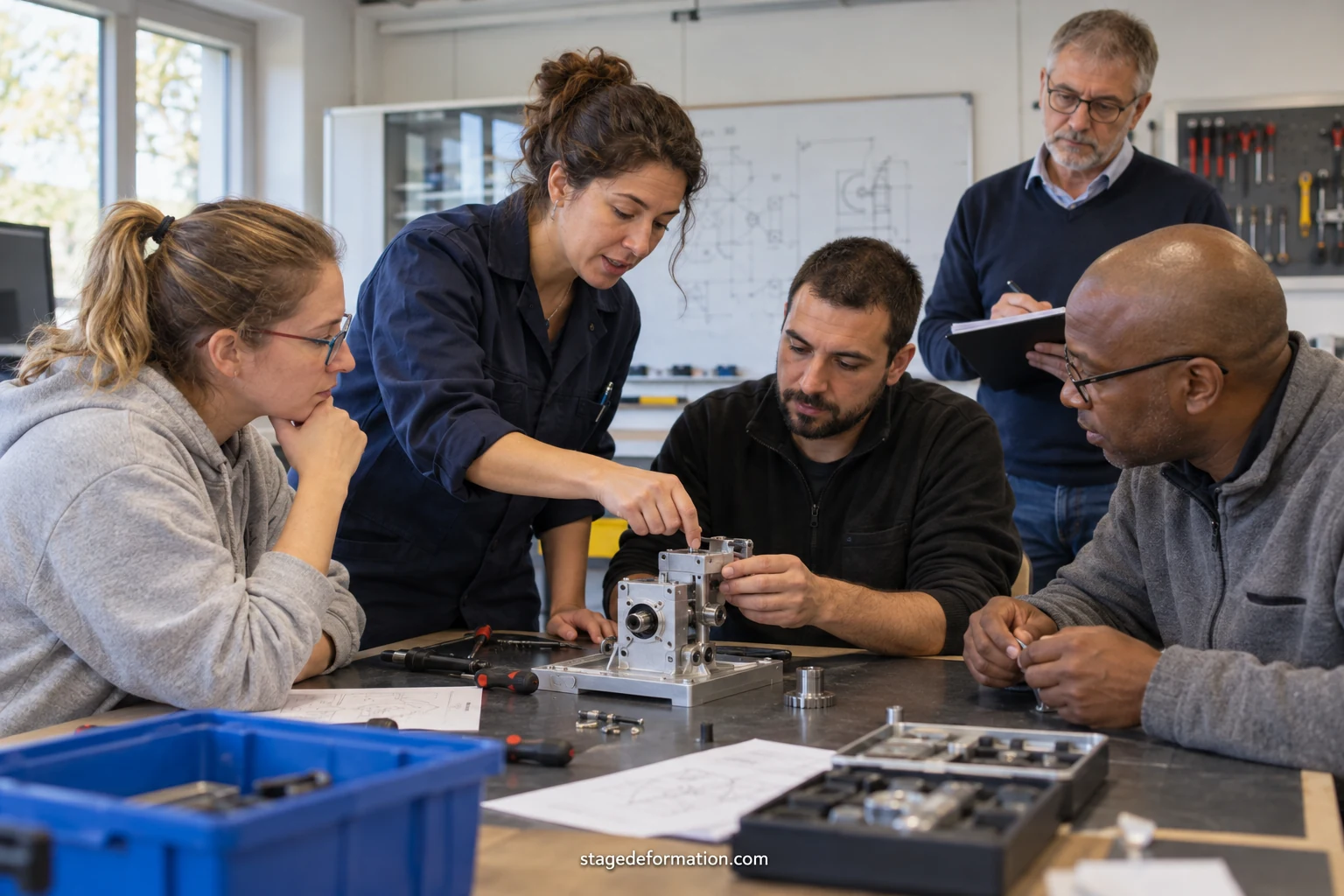
What adult vocational training covers
Adult vocational training brings together every action that helps people already in work, or looking for a job, to gain or update skills. In France it takes place in private training providers, voluntary organisations, in-house training departments, public institutions and chambers of commerce networks. The audiences are very varied: employees sent by their employer, jobseekers, people retraining, and workers using their personal training account.
The trainer’s job is not just talking in front of a group. It includes analysing the need, writing the objectives, choosing methods, preparing materials, delivering the session, then assessing and handling the administrative follow-up. An internship is a chance to discover this whole chain, which often stays invisible when you have only been a learner.
There are also several statuses: employed trainer at a provider, occasional trainer who passes on a trade alongside another job, and freelance trainer working for several organisations. Seeing these realities during the internship helps you choose a direction before you commit.
Who can find a place as an intern
Several profiles are concerned, and their expectations differ.
- Students of education sciences, trainer training or training engineering, whose course includes a period in a workplace.
- Professionals from a technical trade (accounting, IT, construction, healthcare, sales) who are thinking of passing on their know-how and want to try it before changing jobs.
- People retraining who are preparing a vocational trainer certificate and must complete a period in a company.
- Management or human resources students interested in running in-house training.
Not everyone will be given the same tasks. A student without technical expertise will often be placed on the design and logistics side, while an experienced professional may be invited to co-lead a module in their own field after a period of observation.
The tasks you may be given
Tasks depend on the size of the organisation, but they usually fall into four families.
Design
Rephrase a need expressed by a client, write observable learning objectives, split content into sequences and think up exercises, practical cases or role plays. This is the most instructive part for an intern, because it forces you to ask what participants will be able to do at the end, not what the trainer is going to say.
Prepare
Produce clear materials, activity sheets, quizzes, plain slides and written instructions. Check that the room, equipment and digital access are ready.
Lead or co-lead
Welcome the group, present the outline, run an exercise, manage time and rephrase questions. Beginners often start with a short slot of fifteen to twenty minutes, followed by feedback from the tutor.
Assess and follow up
Prepare assessments, collect participants’ opinions, complete attendance sheets and contribute to the session review. This last dimension is linked to the quality standards that providers must demonstrate when training is funded from public or pooled money.
Skills to develop during the placement
A successful internship shows progress in specific skills, more than a general impression of being at ease when speaking.
- Write an objective with a verifiable action verb (identify, calculate, draft, present) rather than a vague one such as understand.
- Adapt your vocabulary to an adult audience, which has experience, concrete expectations and little patience for content with no immediate use.
- Vary methods: short input, demonstration, exercise, feedback on experience, rather than a continuous talk.
- Manage a mixed group, where one person already masters the subject and another is discovering it.
- Assess at several moments: at the start to gauge the level, along the way to adjust, at the end to measure what was learned.
The four-level evaluation model proposed by Kirkpatrick, which separates participants’ reaction, learning, changes in behaviour and results for the organisation, is a classic framework in the sector. Knowing it helps you see why a satisfaction questionnaire alone is not enough.
Preparing and applying with a useful file
Training providers receive very generic applications. To stand out, show that you have already thought about passing knowledge on.
- Target the type of organisation: a provider specialising in office software, languages, management, safety or social integration; the training department of a large company; an apprentice training centre.
- Attach a mini-resource: a one-page outline of a short sequence on a subject you master, with an objective, two activities and a check question. It proves your method better than a sentence about your taste for teaching.
- Describe an experience of passing on knowledge: peer tutoring between students, voluntary-sector coaching, supporting a new colleague.
- State your availability, since some sessions are held early, late or away from the office.
At interview, be ready to describe how you would explain a technical idea to someone meeting it for the first time. The exercise reveals how clear you are.
Internship framework and pay
In France, an internship requires an agreement signed by the educational institution, the host organisation and the student. It sets out the tasks, length, hours and tutor. When the time spent on site exceeds a threshold set by the Education Code, a gratification (a legal minimum allowance) is compulsory; its minimum amount is set by regulation and changes, so check the rule that applies in 2026 with your institution or the host organisation.
For people retraining who do a period in a company as part of a course, the arrangements may differ: placement within the course, pay for a vocational-training trainee, funding by a public body. Ask the training centre which scheme applies to your situation.
In every case, an intern is not there to replace an absent employed trainer. If you are asked to lead a whole module alone in the first week with no preparation or review, raise the question of the framework with your tutor and your academic supervisor.
Illustration: a two-hour session on writing emails
Imagine an organisation that trains administrative assistants who are changing careers. The tutor asks the intern to build a two-hour sequence on writing professional emails. The figures that follow are purely hypothetical.
- Objective: by the end, each participant can write a request email in under ten lines, with a precise subject line and a suitable closing phrase.
- Outline: ten minutes of round-table to gather real situations, fifteen minutes of input on the structure of a message, twenty-five minutes of individual exercise on realistic cases, twenty minutes of discussion in pairs, twenty minutes of group correction, and the rest for summary and checking.
- Check: everyone writes a final message, reviewed by a peer using a grid of three criteria.
After the session, the intern notes what worked, what took too long and what participants misunderstood. This record, together with the documents used, makes excellent material for the internship report.
Frequent mistakes and how to avoid them
- Wanting to say everything. Overloaded content gives an impression of richness but little learning. Choose three key ideas per sequence.
- Talking more than participants practise. Adults retain better what they have tried themselves.
- Neglecting the initial assessment. Without knowing what the group already knows, you risk repeating the obvious or going too far too fast.
- Confusing satisfaction with learning. A group can enjoy a day without being able to redo the exercise the next morning.
- Ignoring the administrative side. Attendance sheets, programmes, certificates and assessments are part of the job and determine whether training is funded.
- Not asking for feedback. Approach your tutor after each slot with a precise question rather than a general request for an opinion.
After the internship: routes and alternatives
The job of professional adult trainer can be reached by several routes. In France a vocational certificate at bac+2 level exists for people who want to professionalise in the role. Professional bachelor’s degrees and master’s degrees in training engineering or education sciences open the way to design and management. Some trainers come straight from their technical trade and learn teaching methods afterwards.
If delivery appeals to you less, the internship may also reveal a taste for instructional design, catalogue management, learning support, career-change advice or the training function in a human resources department. Comparing these paths is one of the main benefits of a period in a training organisation.
To extend the experience, work-study can offer a longer immersion, with a contract and a rhythm shared between school and host organisation.
Frequently asked questions
Do I need teaching experience to get an adult trainer internship?
No, it is not essential. Providers mostly look for rigour, clear expression and curiosity about teaching methods. Experience of tutoring, voluntary-sector coaching or supporting colleagues is a good starting point. If you master a technical trade, put it forward, because it can become your area of delivery.
Can I lead a session alone during the internship?
It depends on the organisation, the intern’s level and the tutor’s confidence. The most common route is step by step: observation, co-leading, then leading a short sequence with feedback. Leading an entire module alone with no shared preparation is not the norm for an internship.
What is the difference between a trainer and a teacher?
A teacher works mainly in a school or university setting, with national curricula and pupils or students. An adult trainer answers a precise skills need, often expressed by a company or a funder, for people who already have work experience. Objectives, methods and assessment reflect this.
Is the internship paid?
For a student internship in France, a gratification becomes compulsory beyond a length of time on site set by regulation, and its minimum changes. For someone retraining, the arrangement depends on the training scheme followed. It is best to ask before signing the agreement, directly with the institution and the host organisation.
Which documents should I keep for the internship report?
Keep the sequence sheets you prepared, the instructions, the assessment grids and your notes on what you learned from experience. Remove or mask anything that could identify participants or clients, and ask your tutor which internal documents can be quoted or attached.
How can I tell whether a training provider is reputable?
Check whether it presents its programmes, objectives and assessment methods clearly, whether it explains who its trainers are and whether it mentions the quality certification required to access certain funding. Also ask who your tutor will be and which precise tasks you will be given before you sign.