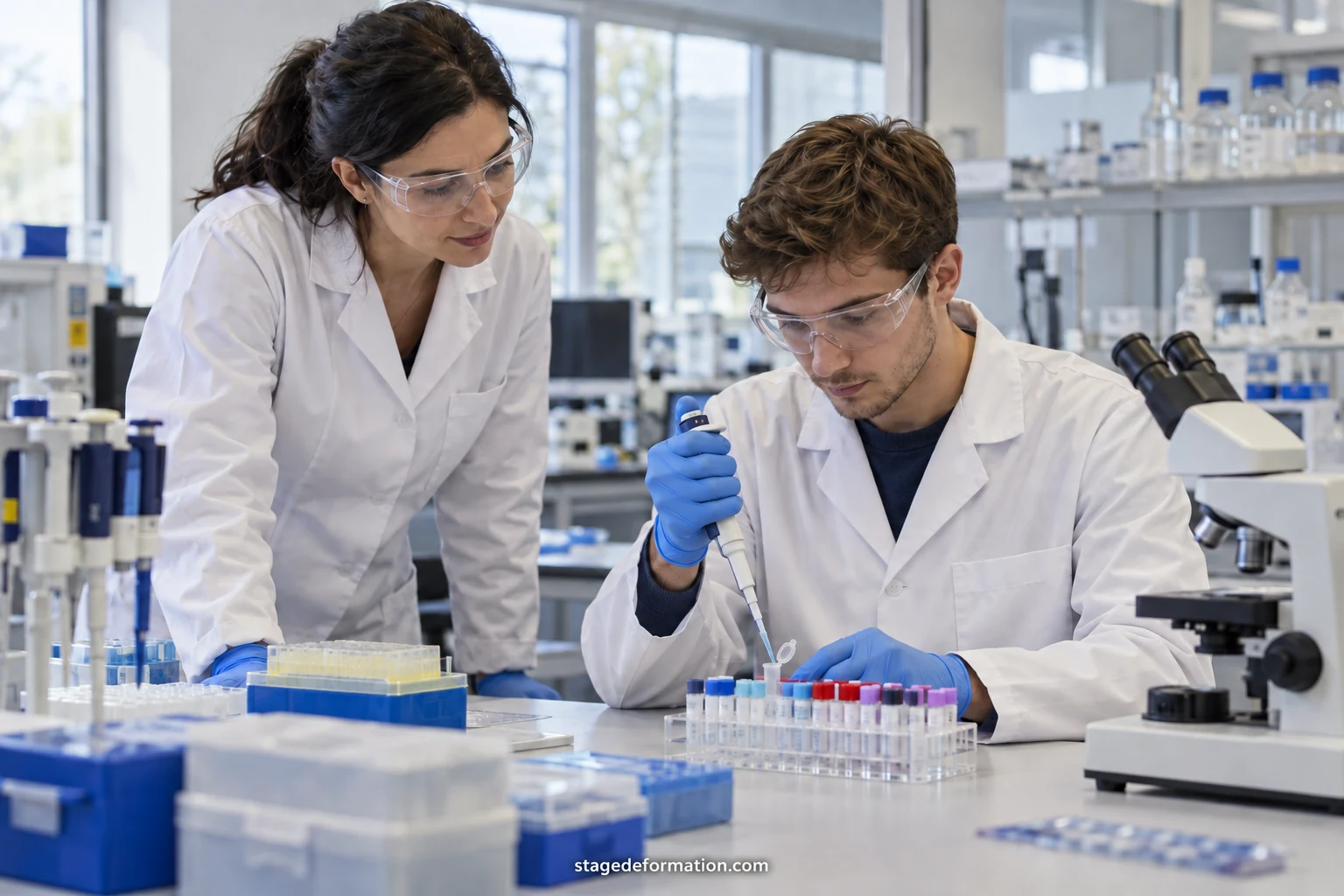
What a medical biology laboratory actually is
A medical biology laboratory carries out tests on biological samples such as blood, urine or microbiological specimens, to help a doctor make a diagnosis, monitor a treatment or prevent a disease. These laboratories may be private, grouped into networks with hundreds of collection sites, or attached to a hospital, a cancer centre or a blood transfusion service.
They should not be confused with research, industrial quality-control or cosmetics laboratories. The vocabulary is similar, but the rules, the responsibilities and the tasks a trainee is allowed to perform are not the same. In medical biology, the quality of an analysis has a direct effect on a patient’s health, which is why rigour and traceability matter so much.
For an intern, understanding what kind of organisation is hosting you is the first step. A community laboratory handling many sample collections, a hospital technical platform and a specialised microbiology unit do not offer the same learning.
Who can do an internship, and with which qualification
Several study routes lead to an internship in this field:
- The BTS in medical biology, a two-year vocational course that replaced the former BTS in medical biology analysis at the start of the 2025 academic year. According to the CIDJ, it includes 14 compulsory weeks of internship over the two years, preferably split between two organisations. It is also available as work-study.
- The state diploma for medical laboratory technicians, open to those who continue their studies after certain courses, which prepares for a regulated profession.
- The BUT in biological engineering and some bachelor’s degrees in life or health sciences, with shorter or more research-oriented placements.
- Pharmacy or medical studies, for the future role of medical biologist, following a hospital residency pathway.
Secondary school pupils can also ask for a short observation placement. The answer depends on the laboratory’s capacity to host them and on the safety of the premises, since contact with samples is tightly controlled.
The life of an analysis: before, during and after the machine
Professionals describe the work in three phases, which help to show what an intern will see and do.
The pre-analytical phase
It begins at the moment of collection: identifying the patient, choosing the right tube, respecting any fasting requirement or requested time, transport, reception at the laboratory and registration. Many avoidable errors happen in this phase, such as a badly labelled tube or a sample left too long at room temperature.
The analytical phase
Samples are prepared and then analysed on automated analysers or with manual techniques: biochemistry, haematology, immunology, microbiology, molecular biology. Quality controls surround each run to check that the instruments produce accurate results.
The post-analytical phase
Results are reviewed, validated under the responsibility of a medical biologist, interpreted where necessary, and then sent to the prescriber or the patient. Storing samples and data is also part of this phase.
What an intern really does
The tasks given to an intern depend on the qualification, the year of study and the laboratory’s authorisations. A first-year intern often starts by observing the workflows, sorting and registering samples, and preparing reagents or slides, before carrying out simple techniques under supervision. Later, they may follow a run of analyses, assist with the maintenance of an analyser or review a quality-control result.
Some activities are reserved: validating a result is the biologist’s job, and taking blood requires training and formal authorisation. According to a training provider presenting the work-study BTS, preparation for the blood-collection certificate is part of the course, but the student practises only with the laboratory’s agreement and under supervision.
It is normal not to handle everything. A useful internship is measured by how well you understand the sequence of steps and can explain why each one exists, not by the number of instruments you have touched.
Quality, traceability and safety: three reflexes to acquire
Medical biology laboratories work within a quality system, and their activity is assessed by an accreditation body. For an intern, this translates into very practical habits.
- Follow the written procedure and never change it on your own initiative, even if another method looks faster.
- Record everything: reagent batch, time, operator, any anomaly noticed. What is not written down is treated as not done.
- Report any anomaly immediately: an unlabelled tube, a strange result, an incident with an instrument, a needlestick injury or a splash.
- Wear the required protective equipment: lab coat, gloves, goggles where needed, hair tied back, and no food or drink in technical areas.
- Follow the waste routes for infectious-risk waste and the hand-washing rules.
Patient information is covered by medical confidentiality. An intern therefore takes no named document out of the laboratory, does not photograph screens and prepares the report using anonymised data.
Finding a laboratory and applying effectively
Laboratories receive many requests, especially in spring for end-of-year placements. It is better to start contacting organisations several months before the period you want.
- Check with your school or university the dates, the length and the objectives of the placement, as well as the agreement that has to be signed.
- List nearby organisations: community laboratories, hospital departments, transfusion services and specialised centres.
- Look at the careers pages of laboratory groups and research bodies, which sometimes set out a specific application procedure.
- Send a one-page CV and a short letter stating the qualification you are preparing, the period and your interest in the discipline concerned.
- Follow up once by phone after about ten days.
In the interview, explain what you have already done in practical classes: aseptic technique, pipetting, microscope work, keeping a laboratory notebook. A recruiter is looking first for someone reliable, punctual and careful.
A sample internship logbook for one week
To illustrate, here is a hypothetical week for a BTS student in a community laboratory, with tasks that build up gradually.
- Monday: welcome, safety rules, tour of the areas, observation of how samples are received.
- Tuesday: registering tubes under supervision, spotting non-conformity criteria, first traceability notes.
- Wednesday: preparing slides for haematology and watching how blood counts are validated.
- Thursday: following a biochemistry run, reading the quality control, and understanding an alert triggered by an out-of-range result.
- Friday: review with the supervisor and writing a sheet describing a sample’s path from arrival to archiving.
A sheet like this, simple and precise, is later very useful for building the internship report and for answering a jury’s questions.
Assessment, pay and what comes next
The supervisor assesses rigour, autonomy, compliance with safety rules and the quality of relationships with the team. The school or university then reviews the report or the skills portfolio. If the internship exceeds the legal length from which a gratification becomes compulsory, the minimum amount is set by regulation and changes over time: check this when you sign the agreement.
After a BTS, the further-study options mentioned by the CIDJ include the third year of the state diploma for medical laboratory technicians, the BUT in biological engineering, a vocational bachelor’s degree or a science degree. Graduates work in private laboratories, transfusion services, research centres or pathology laboratories, among other places.
A successful internship often opens the door to an apprenticeship contract, to summer replacement work where the rules allow it, or to a recommendation for another site.
Common mistakes and how to protect yourself
A few faults come up again and again among beginners.
- Neglecting the identification of a tube, which is essential to avoid a patient mix-up.
- Correcting a procedure from memory instead of rereading it.
- Not reporting a minor incident for fear of being judged.
- Talking about patients in a public place or on a messaging app.
- Forgetting to ask which samples an intern is allowed to handle.
- Writing a report that describes the instruments without explaining their role in the reliability of the result.
The best safeguard is a small routine: reread the procedure, check the identity, note the time and the batch, and ask for advice as soon as a doubt appears. This discipline will be expected later in any laboratory job.
Frequently asked questions
How long does an internship in a medical biology laboratory last?
It depends on the qualification. For the BTS in medical biology, the CIDJ states 14 compulsory weeks of internship over two years, preferably in two different places. Other courses, such as a BUT or a bachelor’s degree, set their own lengths. The exact calendar is always in your institution’s internship regulations.
Can an intern validate or release an analysis result?
No. Biological validation and interpretation belong to a medical biologist, who takes responsibility for them. The intern carries out tasks assigned by the supervisor, observes and learns the reasoning behind validation. The aim is to acquire the method, not to replace a qualified professional.
Can a school pupil do a placement in a laboratory?
It is possible, but some laboratories hesitate to host minors because of biological risks and confidentiality. An early request, accompanied by the school’s agreement, improves the chances. Observing how the laboratory is organised, how samples are received or a microscopy station is more common than hands-on handling.
Which vaccinations are required?
Requirements depend on the organisation and on the rules that apply to professionals and students in healthcare settings. Some vaccinations may be requested before you arrive. Ask your school or university and the laboratory, then see your doctor to check your vaccination record and any updates needed.
What is the difference between a medical analysis laboratory and a research laboratory?
The first produces results used to diagnose or monitor patients, within a regulated framework with quality requirements. The second seeks to understand mechanisms or test hypotheses. The techniques can look alike, but the objectives, the controls and the responsibilities differ.
How can I present this kind of internship on a CV?
State the type of organisation, the length, the disciplines covered and the concrete skills: following procedures, traceability, quality control, biological safety. Avoid mentioning patient names or results. One or two precise achievements, such as a procedure sheet you wrote, make the internship more credible.