What structural work covers
Structural work (gros œuvre in French) brings together everything that gives a building its strength: earthworks, foundations, load-bearing walls, floors, staircases, concrete columns and beams, and sometimes masonry roof structures. The mason is one of the central players, alongside the formwork carpenter, the steel fixer, the crane operator and the site manager. Depending on the company, they work mainly on individual houses, on apartment blocks or on the renovation of old structures.
This variety explains why two masonry interns do not have the same experience. In a small craft business, you do a bit of everything: setting out, pouring a slab, building a wall, rendering. In a large building firm, tasks are more specialised and the organisation more tightly structured, with formwork teams, concrete plants and cranes.
Observation internship, workplace training period or apprenticeship contract
Three frameworks exist, and they are not equal in terms of learning.
- The observation or discovery internship, often in year 9 or during a change of direction: a few days to see the trade, ask questions and carry a tool, with no responsibility for the work.
- The workplace training period, built into a CAP or vocational baccalaureate: several weeks spread across the course, with objectives set by the school and a supervisor in the company.
- The apprenticeship contract, a genuine employment contract: the apprentice alternates between the company and an apprentice training centre and receives pay whose level depends on age and year of training, under the rules applying in France in 2026.
A short internship serves to confirm or rule out a wish. An apprenticeship commits you for at least one or two years and suits those who have already made up their minds.
The qualifications that lead to the trade
The most common qualification for becoming a construction mason in France is the CAP in masonry, prepared over two years after year 10, in a vocational school or as an apprenticeship. It teaches you to read a simple drawing, build block or brick walls, apply renders, and form and pour small reinforced concrete structures.
To aim for more responsibility, several next steps are possible:
- the vocational baccalaureate in the structural construction family, which adds the study of situations, site organisation and team supervision;
- a professional certificate or a higher-level professional title for candidates already in a job;
- a building BTS to move towards site manager or estimator roles.
Course names change from time to time: check with the training centre for the exact title of the qualification being prepared and the entry requirements.
What you will really do, from day one to the following weeks
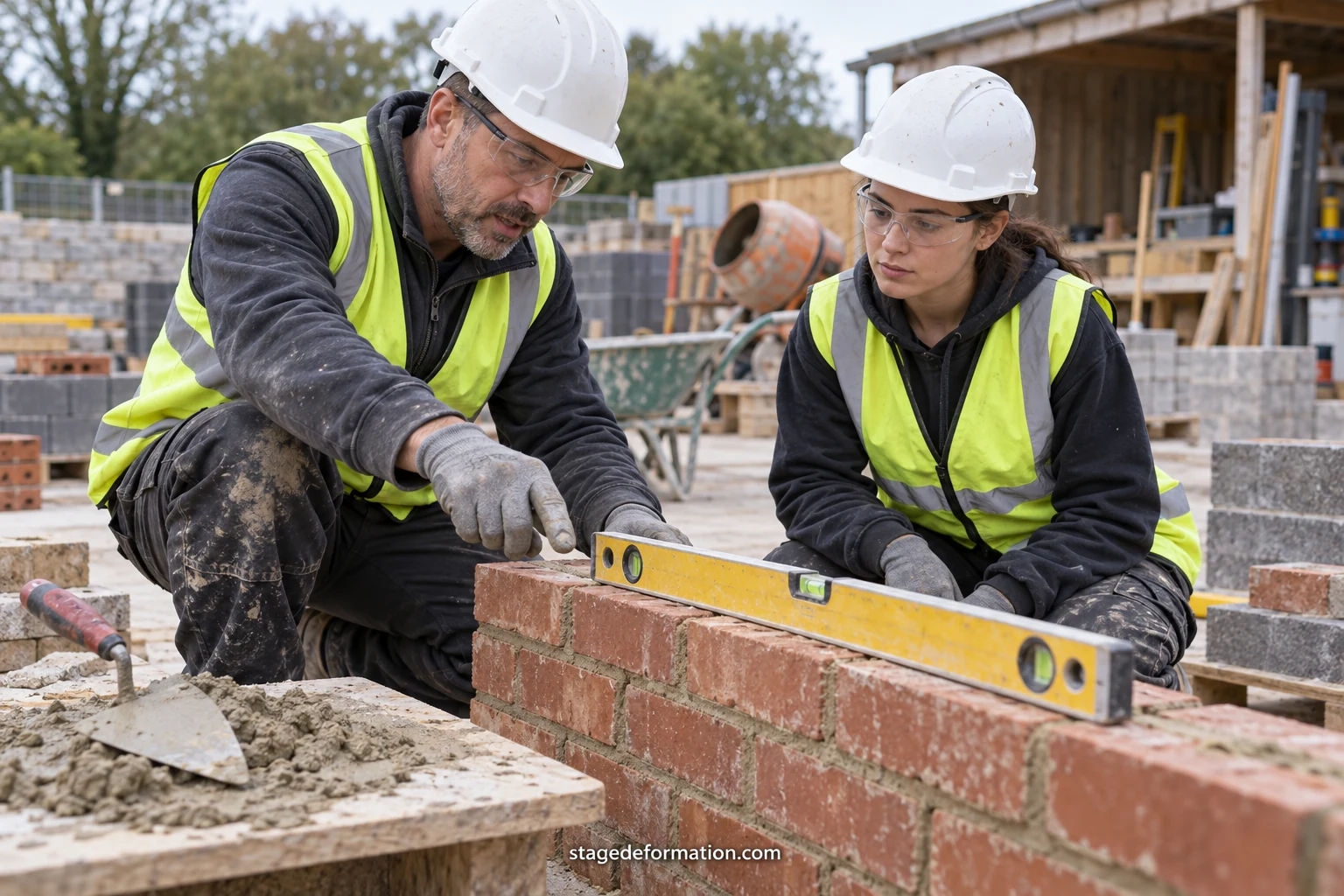
At the start, it is better to expect simple, repetitive tasks: cleaning the work area, preparing and carrying mortar, supplying blocks, holding a level, tidying tools. These jobs are not a punishment: they let you grasp the rhythm of the site and the vocabulary of the crew.
As the team's trust grows, more technical tasks follow:
- marking out axes and transferring levels from a fixed reference point;
- building the first courses of a wall, checking plumb and alignment with a string line;
- laying a screed, a levelling compound or a render on a small wall;
- helping with the formwork of a column or a lintel and with pouring the concrete.
Note what is corrected in your work and why. A deviation of a few millimetres in a first course carries through the whole height of the wall; it is one of the first lessons of this trade.
Safety, weather and physical fitness
A building site is a risky place: falls from height, handling of loads, cement dust, noise, moving machinery. Personal protective equipment (safety boots, helmet, gloves, glasses, ear protection) is part of the basic outfit. Work at height on scaffolding follows strict rules for erection and inspection; nobody should send you up there without a prior explanation.
For minors in France, so-called regulated work, such as certain work at height or the use of dangerous machines, is only possible within a precise training framework, with prior notification and reinforced supervision. Ask the question before the internship begins rather than discovering the answer on site.
On the physical side, the trade demands stamina, a firm footing and a certain resistance to cold, heat and rain. Many sites stop or slow down in bad weather; plan clothing suited to the season and a spare pair of gloves.
Finding a company or an apprenticeship supervisor
Building companies often recruit by word of mouth, but several routes are open to young people without a network:
- ask the training centre or vocational school for the list of companies it already works with;
- identify the craftspeople in your town or local authority area, and the sites under way whose boards display the names of the firms involved;
- take part in open days, careers forums and events organised by the building industry federations;
- look at the apprenticeship offers published by training centres and work-study platforms.
A short speculative application sent to about ten companies is worth more than a long letter addressed to just one. State the dates you want, the qualification aimed at and a concrete reason why you want this trade, for example a first experience on a family building project.
Preparing your application and interview
In construction, the file counts for less than the attitude. A company owner first looks for someone punctual, motivated and able to follow instructions. Your CV can fit on one page: training, any placements, manual activities (DIY, mechanics, team sport), licence or safety certificate, availability.
At an interview, a few questions come up often: why masonry, how you get to the site, how you react to criticism, whether you can stand working in all weathers. Prepare sincere, simple answers. Asking two or three questions yourself, about the types of site or the team, shows real interest.
If possible, offer a one-day trial before signing: it lets each side check that they get along.
Illustrative example: a typical week in a craft business
As an illustration, imagine a first-year apprentice in a small company building a house extension. The tasks and the sequence are hypothetical.
- Monday: the site foreman shows the setting out and the levels of the extension. The apprentice prepares the equipment and helps stretch the string lines.
- Tuesday and Wednesday: the team builds the block walls. She lays the first two courses under supervision and learns to set the joints.
- Thursday: pouring a footing or a tie beam; she watches the concrete being prepared and compacted with a vibrator.
- Friday: cleaning, a review with the supervisor, and a note of the points to work on again at the training centre.
This alternation between action and explanation is the strength of training in a company: each week, one specific skill is practised and then discussed.
Common mistakes and ways to progress
Beginners' mistakes repeat from one year to the next: turning up without equipment, being too quiet or, on the contrary, too hasty, neglecting measurements, not asking when a technique is unclear. Another common trap is wanting to go fast at the expense of finish, when the quality of a wall is judged by its plumb and its flatness.
Once you have the qualification, the paths are varied. You can become a skilled worker and then a team leader, specialise in heritage renovation or reinforced concrete, move up to site manager, or set up your own business after a few years of experience. The trade also opens onto other building trades, such as plumbing, electrics or joinery, which work in the same site environment.
Frequently asked questions
Do you need to be very strong to become a mason?
Strength helps, but technique, organisation and good use of handling aids count just as much. Sites have cranes, motorised wheelbarrows and blocks that are easier to carry than in the past. Above all you must accept a physical trade and learn to protect your back and joints from the start of training.
How old do you have to be to sign an apprenticeship contract in construction?
In France, apprenticeship is generally open to young people from sixteen to twenty-nine, and from fifteen for those who have finished year 10. Exceptions exist for certain groups. Age, year of training and the applicable agreement determine the pay, which changes: ask the training centre for the current scales.
Is an internship of a few days enough to know whether you like the trade?
It gives a first impression, not a final verdict. If possible, choose a period when the site is in an active phase, for example when walls are going up, and ask to stay long enough to see a complete stage. A second internship in another company lets you compare working conditions.
Can you do a masonry internship without any prior qualification?
Yes, a discovery internship generally requires no qualification, but an agreement signed by the school or host organisation is needed for cover in case of an accident. For an apprenticeship contract, it is enrolment at a training centre and signing a contract with a company that give the right.
Is the trade still possible for a girl or a woman?
Yes. Structural work welcomes more and more women, and the equipment, lifting machinery and organisation of sites are gradually reducing the physical load. Training centres and building federations regularly organise meetings on gender diversity in the trades, which can help you find a supportive supervisor.
What should I do if the atmosphere in the company is difficult?
Talk first to your supervisor or your contact at the training centre, describing precise facts rather than impressions. For an apprentice, the training centre and, if necessary, the mediation services provided for apprenticeship can step in. Do not stay isolated with a situation of danger or harassment.