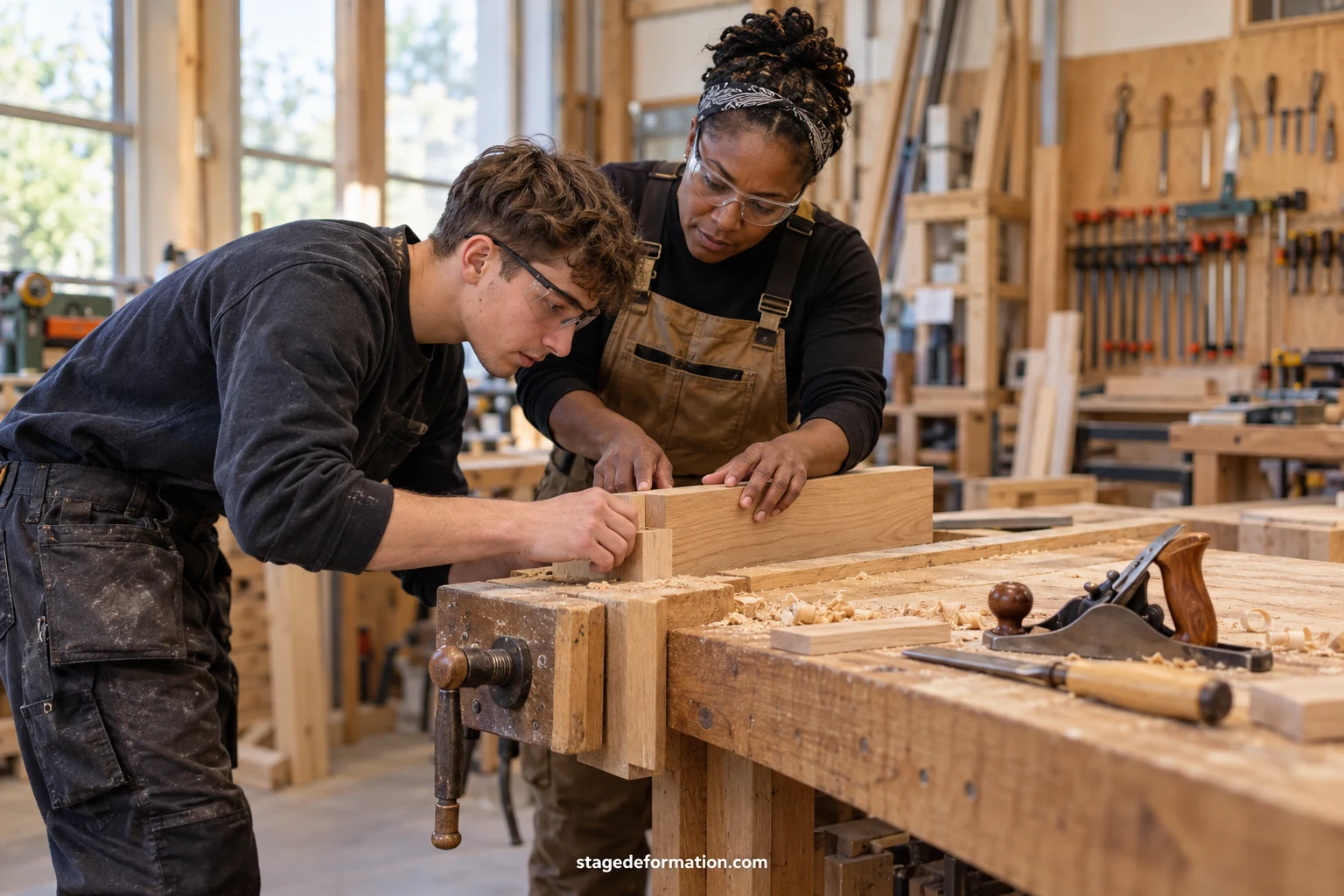
What woodworking involves in a business
The word "joinery" in fact covers several trades that are not practised in the same place. The manufacturing joiner works mainly in a workshop: cutting panels, machining parts, assembling them and preparing the finish. The installer fits doors, windows, staircases or wooden floors at the customer's premises, sometimes in an old building where nothing is square. The fitted-interiors specialist designs and builds made-to-measure fittings: kitchens, bookcases, shop counters, internal partitions. The cabinetmaker, finally, devotes himself or herself to furniture and restoration.
Before looking for a placement, it is therefore useful to know what attracts you: the precision of manufacturing, contact with customers and sites, or the creation of one-off pieces. A company of three people and a manufacturer of industrial joinery do not offer the same experience, even if the material is the same.
Which training routes lead to the wood trades
In France, several qualifications can be prepared as an apprentice or as a full-time student. The CAP menuisier fabricant and the CAP menuisier installateur are the classic entry points after lower secondary school, taking two years. The vocational baccalaureate for joiner-fitter technicians extends this level over three years, with more drawing, production planning and customer relations. The brevet professionnel de menuisier is aimed at people who are already qualified or have some experience.
For adults and people retraining, professional titles for joiner-fitter, installer or wood and wood-derivative manufacturing are offered by training bodies and by craft fellowship networks. Some courses last only a year when the candidate already holds a qualification. Exact durations vary according to the centre and the candidate's situation: confirm them with the organisation you choose.
- After lower secondary school: a two-year CAP, then possibly a vocational baccalaureate or a brevet professionnel.
- After another path: a one-year CAP or a professional title, depending on what you have already achieved.
- After the vocational baccalaureate: a BTS or further training in fitted interiors, timber or construction.
Internship or apprenticeship contract: two different approaches
An internship is a period of observation and supervised practice governed by an agreement between the pupil or student, their school and the company. It lasts a few weeks, it carries no salary, and its purpose is educational. Beyond two months in the same organisation, in France a gratification becomes compulsory, with a minimum set by regulation that changes from one year to the next.
The apprenticeship contract is a genuine employment contract. The apprentice divides time between the training centre and the company, receives pay calculated as a percentage of the minimum wage according to age and year of training, and progresses under the guidance of an apprenticeship master. In joinery, many young people start with a discovery placement, then sign a contract with the company that liked them. This is often the best way in.
What you really learn in the workshop
An internship does not mean sweeping the floor for three weeks. Even as a beginner, you generally follow the life of a piece of work: reading the plan, taking measurements, choosing the material, marking out, machining, dry assembly, then finishing. One of the first lessons is to understand that wood is a living material: it expands and shrinks with humidity, has grain and knots, and does not behave like chipboard or plywood.
The tasks accessible to a beginner include marking parts, sanding, preparing glues and screws, putting offcuts into storage and helping with assembly. Ask to understand why a particular species was chosen, why a joint is glued rather than screwed, or how the joiner checks that a frame is square. These questions show interest, and they feed your internship report.
Machines, dust and safety: the rules to know
A joinery workshop concentrates specific risks: saws, routers, planers, noise, wood dust and finishing products. Young people under eighteen are subject to particular rules in France: some dangerous work is forbidden to them, except under a supervised exemption when they are in vocational training. In practical terms, an intern uses a machine only if the manager allows it, after a demonstration and within the framework set by the company.
Come with safety shoes, avoid loose clothing, tie back long hair and take off jewellery and rings. Learn to find the emergency stops and the hearing and respiratory protection. A serious intern is one who asks the question before touching a machine, not one who improvises to save time.
Finding a host company
Joinery workshops are numerous but often small, and many do not post advertisements. The most effective approach remains direct contact: turning up in person with a one-page CV, or a phone call followed by a short email. Identify companies near you in trade directories, through apprentice training centres and in building craft networks.
- Draw up a list of ten to fifteen companies whose activity matches your plans: manufacturing, installation, fitted interiors or restoration.
- Call early in the morning, when the workshop is running but the boss is not yet out on a site.
- Suggest precise dates, taking into account the constraints of your school.
- Follow up once after a week, politely, and note the replies so you do not contact the same address twice.
Open days at training centres and careers fairs are also a chance to meet craftspeople who are looking for an apprentice.
Showing motivation when you have no experience
A craftsman does not expect a young person to know the trade already. He or she looks for punctuality, curiosity, attention to detail and a genuine wish to work with the hands. In your letter, mention an object you have built or repaired, a workshop visit, a technology project at school: a concrete detail is worth more than a general phrase about a passion for wood.
During an interview or a visit, bring a notebook to jot down instructions and show that you know how to observe. If you have photos of a personal project, present the stages, including a mistake you corrected. Explaining how you made up for a poor fit is more reassuring than a perfect piece that nobody can verify.
An illustrative example: three weeks around a made-to-measure bookcase
Take the example of a first-year CAP student placed for three weeks in a fitted-interiors workshop. In the first week, she attends the measuring visit at the customer's home and receives the bookcase plan. She then helps cut the panels following the cutting list, and checks each length before getting it approved by the journeyman.
In the second week, she takes part in the dry assembly: the uprights, shelves and back are put together without glue to check squareness. One shelf turns out to be two millimetres too long; the team corrects it, and the student notes the cause. In the third week, she follows the finishing and then the installation at the customer's home. In her report, she describes the sequence, the correction and what she would do differently. This example is fictional and simplified, but it shows that a successful internship follows an object from start to finish.
Common mistakes and career options to consider
Several mistakes come up often among beginners: arriving late, using a machine without permission, cutting "roughly" without checking the measurement, or not daring to ask for an instruction to be repeated. Another frequent trap is being limited to a single repetitive task. Say so kindly if you spend three days sanding, and offer to observe another workstation.
After training, career options are varied: workshop joiner, installer, fitted-interiors specialist, team leader, draughtsperson in a design office, CNC machine operator, or setting up your own business after some years of experience. Skills grow with time spent in companies, hence the value of gaining several experiences in organisations of different sizes before specialising.
Frequently asked questions
Do you need a qualification to do an internship in joinery?
No, no qualification is required for a discovery placement. You simply need to be enrolled in an institution that signs the agreement, whether a school, a vocational college or a training centre. For a longer placement, the company may simply ask for sincere motivation, punctuality and respect for safety instructions.
Can an intern use the workshop machines?
Only within the framework set by the company and after a demonstration. For minors, protective rules limit the use of certain dangerous machines, with possible exemptions in vocational training under conditions. If in any doubt, the intern asks the manager for approval before touching the machine, whatever the task.
What is the difference between the CAP menuisier fabricant and the menuisier installateur?
The first prepares mainly for workshop manufacturing: cutting, machining, assembly and finishing of joinery and fitted interiors. The second prepares for installation at the customer's premises: doors, windows, staircases, floors, with more travel. The two qualifications share common foundations, which makes it possible to move to the other route afterwards.
Is an internship paid in joinery?
An internship of less than two months in the same company does not automatically carry a gratification, although some craftspeople pay one. Beyond two months, a minimum gratification is compulsory in France, at an amount set by regulation and revised from time to time. An apprenticeship, by contrast, pays a wage from the first day.
How do you find an apprenticeship master?
The most effective approach is to combine three leads: contact workshops directly after an internship, rely on the training centre, which keeps offers from partner companies, and consult craft and compagnonnage networks. A successful discovery placement remains the best recommendation to a future employer.
Can you retrain in joinery as an adult?
Yes. Professional titles and one-year routes are designed for adults, sometimes as work-study or with funding linked to vocational training. A prior immersion in a workshop helps you check that the physical work and the precision required match your expectations before you commit.