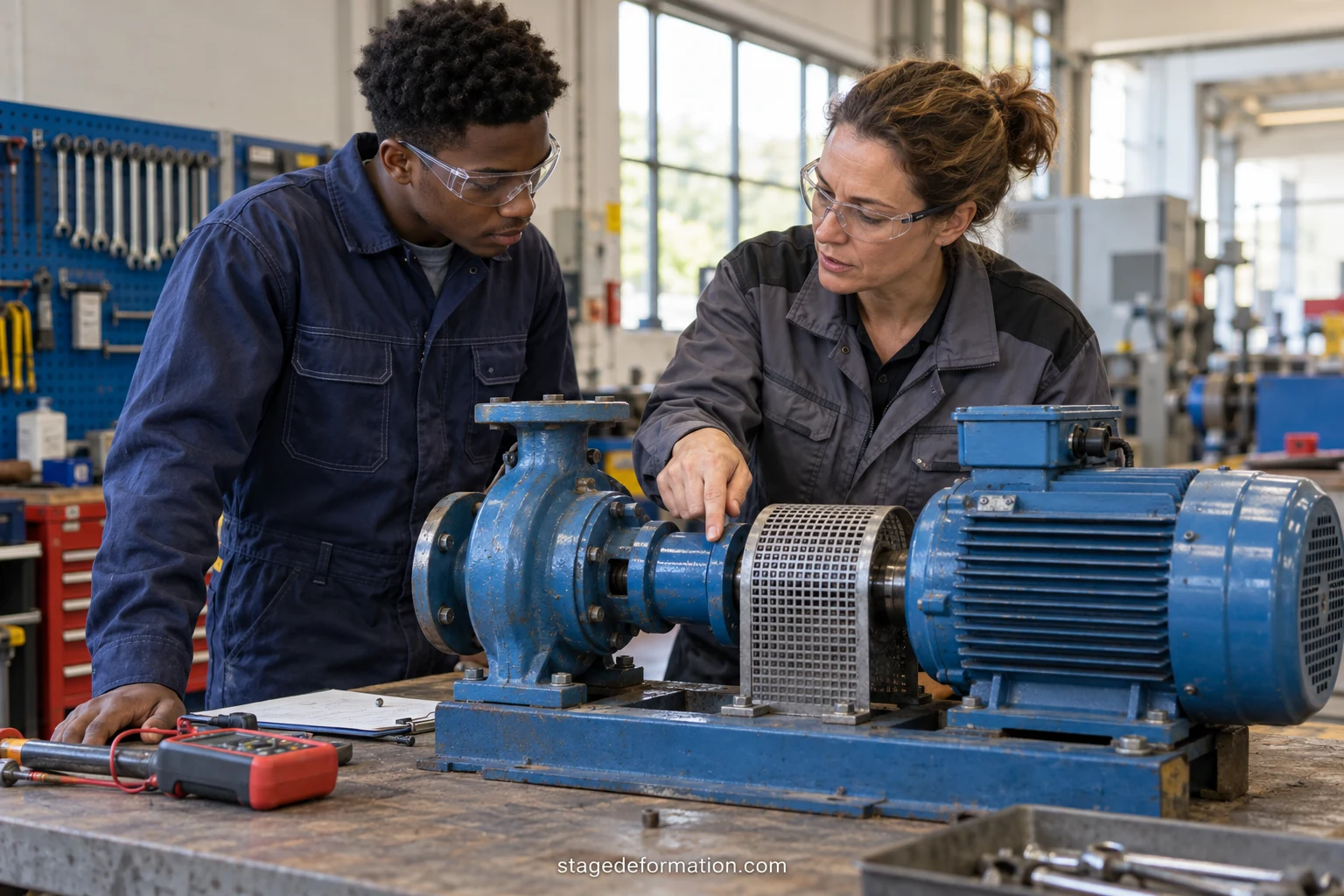
A trade devoted to keeping machines available
A bottling line that stops, a robot that drifts, a pump that overheats: every minute of downtime costs the company money. The maintenance department's job is to limit those stoppages, restore operation quickly and stop breakdowns from recurring. The work is therefore less that of a hurried repairer than of a methodical investigator.
You meet a variety of profiles there: mechanical technicians, electromechanical technicians, automation specialists, planners and area managers. In small businesses one person does everything; in a large factory the roles are specialised. An intern or apprentice is welcomed into a team, often on a rota, and starts by getting to know the plant's machinery and the site's vocabulary.
Preventive, corrective, improvement: three approaches to tell apart
These three words come up in every workshop conversation, and an internship is the chance to really understand them.
- Preventive maintenance schedules checks, lubrication and replacement of wear parts at regular intervals, to avoid breakdowns.
- Corrective maintenance responds to a failure that has already happened: a quick fix to restart, then a lasting repair.
- Improvement maintenance modifies equipment to make it more reliable, safer or easier to maintain.
There is also condition-based maintenance, where the intervention depends on measurements such as vibration, temperature or current. The profession's reference frameworks also classify operations into levels, from simple actions entrusted to the operator up to rebuilds carried out by a specialist workshop. Asking your supervisor which category each task falls into saves precious time.
The logic of diagnosis
Faced with a breakdown, the mistake is to replace a part at random. The expected approach unfolds in stages.
- Gather the symptoms from the operator: when, after what, and with which message from the machine.
- Consult the intervention history and the technical documents: diagrams, instructions, manuals.
- Form hypotheses, from the most likely to the least likely.
- Test one hypothesis at a time, using the right instruments.
- Confirm the repair with a test, then record the real cause.
Simple methods help structure your thinking: tracing causes through a series of "whys", or analysing the failure modes of a piece of equipment. An intern does not have to master them, but should recognise them when a technician uses them in front of you. What matters is telling the symptom, for example a motor that stops, from the cause, for example a thermal protection that trips because of poor ventilation.
Safety: lock out, authorise, verify
In a factory, energy is everywhere: electricity, compressed air, hydraulics, steam, stored mechanical energy. Before intervening, the rule is to isolate the equipment from its energy sources, lock them off, verify that no residual energy remains, and only then begin. This procedure is called lockout (consignation in French), and each site has its own padlocks, tags and forms.
For electrical work, an authorisation issued by the employer after training is required. An intern does not always have one: in that case they watch interventions from a distance or help with preparation. Other authorisations exist for operating lifting equipment, working at height or entering certain areas.
The golden rule is simple: touch nothing on a machine without the agreement of the person supervising you, even if it appears to be stopped. A machine that has stopped can restart, and an unlit indicator does not prove there is no voltage.
Tools, documents and traceability
The technician uses hand tools, multimeters, clamps, thermal cameras and vibration-checking devices, but also documents. An equipment file brings together drawings, a bill of parts, maintenance schedules and the breakdown history. Many companies manage this information in computerised maintenance management software, often called a CMMS (GMAO in French).
In that software, every intervention is the subject of a work order: date, equipment, symptom, cause, action, parts used, time spent. This traceability makes it possible to spot machines that break down too often, plan preventive work and make the case for an investment.
A clear report, written before the equipment goes back into service, summarises what was found, done and checked. Knowing how to write it in short sentences is a valuable and often neglected skill, one that an internship can help you develop.
Training routes that lead into maintenance
The sector recruits at several levels, and many routes can be followed on a work-study basis.
From CAP to vocational baccalaureate
The vocational baccalaureate in industrial equipment maintenance trains versatile technicians in mechanics, electrics and automation. It includes periods in a company and can be studied as an apprenticeship.
Two- and three-year higher education level
The BTS in systems maintenance and the BUT in industrial engineering and maintenance prepare you for senior technician and maintenance planning roles.
Professional titles and career change
The professional title of industrial maintenance technician, offered by industry training centres and other providers, takes about a year, alternating between the centre and a company. As an example, one regional centre describes a one-year course with three weeks in a company for each week at the centre; these figures are indicative and can be adapted. Check the details with each provider.
Applying: show that you can reason, not only repair
Factories, food and drink companies, chemical sites, print works, local authority technical departments, hospitals and equipment manufacturers all hire technicians. To find a placement, you can rely on your training centre, which knows the companies in the area, on industry forums and on networks of maintenance professionals.
On your CV, list the equipment you have worked with in class or on placement, any authorisations you hold, the software you have used and one specific project, for example the refurbishment of a test bench. The cover letter can tell the story of a fault you solved, from first observation to final check.
At interview, expect a scenario question: a motor stops, what do you do first? The right answer begins with safety and gathering information, not with tools. Also show that you are willing to work unusual hours or be on call, which exist at some sites, after checking the rules that apply to apprentices and interns.
An illustrative example: a conveyor that keeps stopping
Here is an invented scenario to show the reasoning. A parcel conveyor stops several times a day, always after a few hours in service.
- The technician questions the operator and checks the history: three similar stoppages in two weeks.
- They lock out the equipment with the intern, who observes and notes down the steps.
- Checking the motor reveals overheating; the bearing of a drum is turning badly and dragging.
- The bearing is replaced, the lubrication checked, and the work order completed with the real cause.
- A preventive action is added: a monthly temperature check on the drum.
The figures are fictional, but the sequence is typical: symptom, history, lockout, cause, repair, prevention. The intern can reuse this structure in their report.
Common mistakes at the start
- Intervening without lockout or without permission, out of a wish to help.
- Changing several parts at once, which hides the real cause.
- Neglecting the report, even though the next team will depend on it.
- Ignoring the operator, who knows how the machine normally behaves.
- Staying confined to carrying tools instead of asking for diagrams and explanations.
- Forgetting to refit the guards after an intervention.
A maintenance internship is judged less on the number of faults repaired than on the quality of the reasoning, the rigour of the safety practice and the reliability of the reports. A notebook kept up week by week, with the equipment you have met, the methods you have seen and the questions still unanswered, is a solid basis for your next interview.
Frequently asked questions
Do you need to be a keen tinkerer to succeed in industrial maintenance?
A taste for technical things helps, but the job mostly calls for method, rigour and reading documents. Knowing how to take things apart is not enough: you have to understand why a machine breaks down. Communication skills also count, because you work with the production teams.
What is the difference between maintenance and industrial mechanics?
Industrial mechanics makes parts and assemblies, from drawing to inspection. Maintenance keeps production equipment in working order, intervening before or after a breakdown. The two meet on mechanics, but maintenance adds electrics, automation and diagnosis.
Can an intern work on a machine that has broken down?
Only within the limits set by their supervisor, after the equipment has been locked out and in line with their authorisations. Often they observe, assist, prepare the tools and write up the report. Electrical work requires an authorisation, which is not obtained automatically during an internship.
Does the job involve being on call or working unusual hours?
At some sites that run continuously, yes. Conditions depend on the company, the collective agreement and the age of the young person in training, who benefits from protective rules. It is better to ask at the interview than to find out after signing.
Can you progress after a few years in maintenance?
Yes, towards roles such as senior technician, team leader, maintenance manager, methods technician or reliability specialist. Further training in automation, electrics or management often goes with these moves. The possibilities vary with the sector and the size of the site.
Which documents should you keep after a maintenance internship?
Keep your agreement, the internship certificate, the supervisor's assessments and a personal logbook of the equipment and methods you saw. Do not keep drawings or confidential data without permission. These items help in writing the report and preparing later applications.