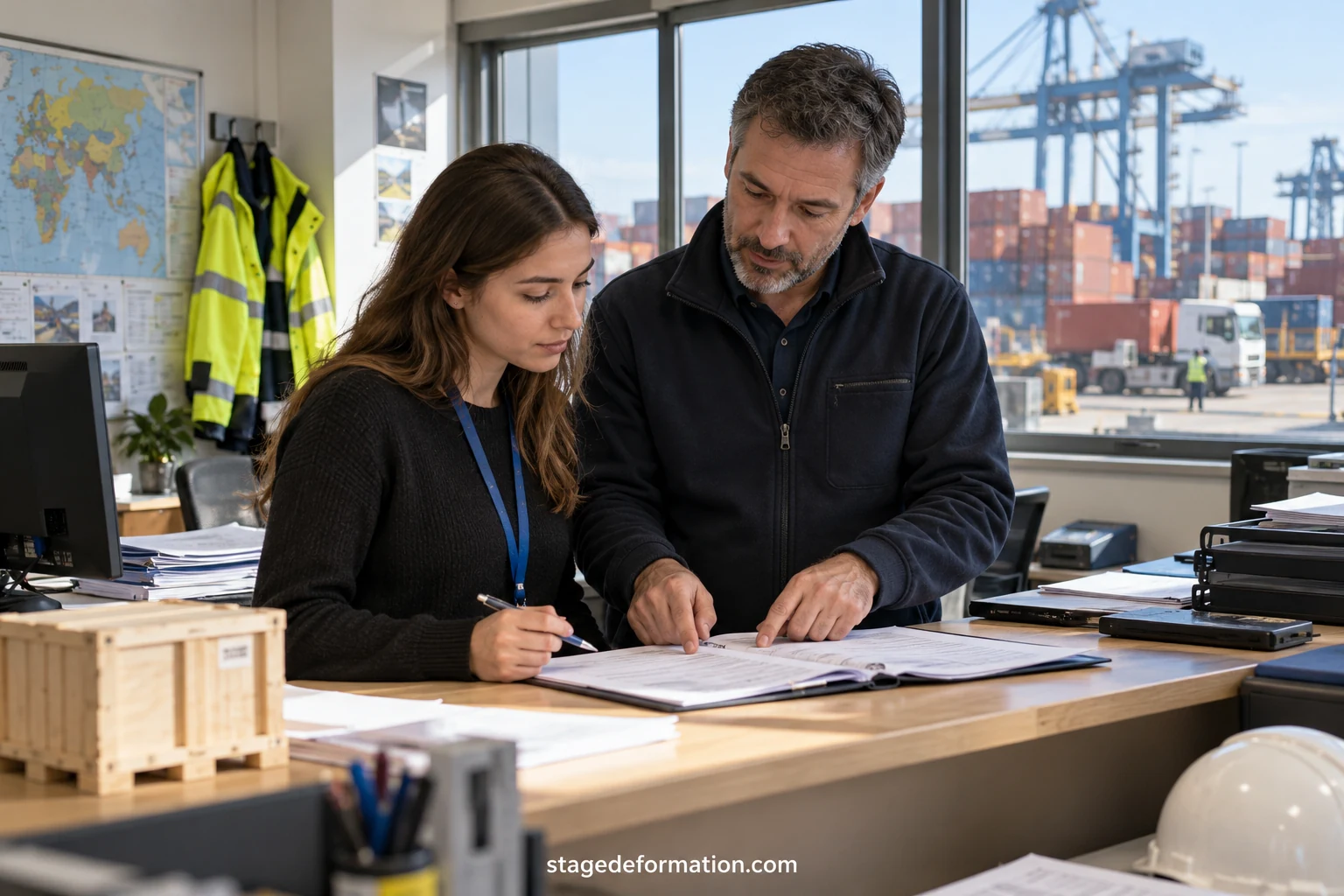
What international trade means inside a company
Under the label “export” you find very different realities. In a small manufacturing company, one person may prospect, draw up offers and follow shipments. In a large group, these roles are split between account managers, sales administrators, logistics managers and compliance specialists.
Before applying, work out which flows are actually handled: sales of finished goods, of parts, of services? European markets, where the movement of goods is made easier, or non-EU countries, which involve extra formalities? These elements determine the useful languages, the documents handled and what you will learn.
Possible tasks for an intern
A well-designed internship alternates between sales and administration, respecting the level of responsibility that can be entrusted to a beginner.
On the sales side
- Monitoring a market: competitors, prices charged, trade shows, product regulations.
- Building prospect lists and preparing messages in a foreign language.
- Helping to write offers, presentations and responses to tenders.
On the sales administration side
- Entering and following orders, chasing payments, checking references and quantities.
- Preparing the documents of a file: invoice, packing list, documents requested by the customer.
- Dealing with carriers and freight forwarders under the supervision of a contact person.
Basic notions to know before you start
You do not need to be an expert, but a few reference points make it easier to fit in. The Incoterms, published by the International Chamber of Commerce, divide the costs, risks and formalities of transport between seller and buyer. The same goods sold on different terms do not carry the same obligations.
The method of payment matters as much as the price: bank transfer after delivery, advance payment, documentary collection, documentary credit. Each spreads the risk of non-payment differently. Finally, the country of destination may require documents of origin, certificates or licences, and indirect taxation differs depending on whether you sell inside the European Union or outside it.
The internship is there to help you understand who is responsible for what, without improvising customs expertise: if in doubt, ask a colleague, the freight forwarder or the competent authority.
Languages and skills in demand
English is almost always required, in writing and in speech: emails, calls, negotiating deadlines. A second language, such as German, Spanish, Italian, Arabic, Chinese or Portuguese depending on the company’s markets, is a real asset, especially if you can back it up with a stay abroad, an exchange or a certificate.
- Rigour: a quantity, reference or date passed on wrongly can block a whole order.
- Ease in dealing with people, including at a distance and across time zones.
- Intercultural awareness: not mistaking local politeness for a commercial agreement.
- Command of spreadsheets and a taste for procedures.
Qualifications and routes towards international work
Several courses lead to export careers, with periods in a company or by work-study.
- The French BTS in international trade and the BTS in sales negotiation and digitalisation of the customer relationship, which introduce trade and customer relations.
- The BUT in marketing techniques with an international focus, or the BUT in logistics and transport management depending on your orientation.
- Vocational degrees in international trade occupations.
- Master’s programmes and business schools with a double degree, a semester abroad or a dedicated pathway.
These courses often include long placements, sometimes abroad. European mobility schemes for trainees can support a stay; contact your institution’s international relations office.
Finding an internship: chambers of commerce, networks and trade shows
Exporting companies can be found in the directories of chambers of commerce and industry, through export support networks, at trade shows and on internship platforms. An SME that exports to ten countries often needs help following its files, even if it does not advertise.
Tailor your application: mention the market you know, the language you speak, an international trade course or a class project. Attach a one-page CV and a letter linking your profile to a specific product of the company. For an internship abroad, plan ahead for residence formalities, insurance, health cover and accommodation.
From internship to international corporate volunteering
After your studies, the international corporate volunteering scheme (V.I.E) lets young graduates be sent by a French company on an assignment abroad, for six to twenty-four months. It is open to people aged 18 to 28, under the conditions set by the scheme, and relies on a specific status with an allowance. Offers are published on an official site run by Business France.
An international trade internship is good preparation: it helps you understand the exporter’s constraints, trains you to write in a foreign language and gives you concrete examples for the interview. It does not guarantee an assignment, because companies recruit according to their needs at the time.
Illustrative example: a four-month internship in a machinery SME
Imagine Sofia, on a vocational degree, hosted by an SME that sells packaging machines in about twelve countries. The case is hypothetical.
- Month 1: discovering the catalogue, the markets and the Incoterms used, observing calls with distributors.
- Month 2: following twenty orders, checking consistency between quote, order and invoice, and spotting discrepancies.
- Month 3: monitoring a Central European market, a list of ten potential distributors and a draft message in English.
- Month 4: a good-practice sheet on shipping documents and a presentation to the team.
She ends her internship with a file showing her rigour and her ability to structure information.
Common mistakes in applications and in the job
Some mistakes come up again and again among export internship candidates.
- Claiming a level of language that you cannot sustain when speaking.
- Confusing selling with prospecting and promising unrealistic commercial results.
- Sending a document without proofreading it, when precision is the core value of the job.
- Confining yourself to data entry without understanding the overall logic: ask to follow a file from order to delivery.
- Ignoring the confidentiality of prices, customers and commercial terms.
Also check the length, the payment and the agreement with your institution before committing.
Frequently asked questions
Do I need to speak several languages for an international trade internship?
English is almost always necessary. A second language is an advantage, especially if it matches the company’s markets. If your level is average, be honest and show that you are improving, for example through a stay abroad, a certificate or regular practice. A poorly mastered language quickly shows at interview.
Can I do an export internship in a small company?
Yes, and it is often a good idea. In an SME you deal with prospecting, orders and shipments, whereas a large group separates tasks more. In return, supervision may be less formal; ask from the start who will support you and how your objectives will be shared out.
Which documents can an intern handle?
Depending on their level and the trust placed in them, they prepare or check quotes, invoices, packing lists or purchase orders. Customs formalities and sensitive certificates remain the responsibility of authorised people. The intern learns to recognise these documents without committing the company alone.
Is an internship abroad better than one in France?
Not necessarily. An internship abroad brings language and cultural immersion, but it needs serious preparation: reception, insurance, housing, budget. An internship in France with an exporting company may offer stronger supervision. The right choice depends on your plan and on what your course allows.
Does the V.I.E replace an internship?
No. The V.I.E is a scheme for professional assignments abroad aimed at young people who are already trained, with a specific status. An internship is a training period within a course. Many V.I.E candidates have first done one or two internships that gave them experience and a network.
How can I show interest in international work without experience?
Draw on verifiable things: international trade courses, a class project, a language stay, a study of a market or a trade show. Mention a country or a product of the target company and explain what you want to learn there. A precise application convinces more than a general statement of openness to the world.