Three families of programmes, three families of assignments
The Institut Français de la Mode offers training in fashion management, design and craft skills. Each family leads to distinct roles, and an internship should be chosen from that logic.
- Management: product, buying, merchandising, retail, e-commerce, marketing, communication, entrepreneurship.
- Design: fashion design, textile design, studio direction, leather goods, footwear, art direction.
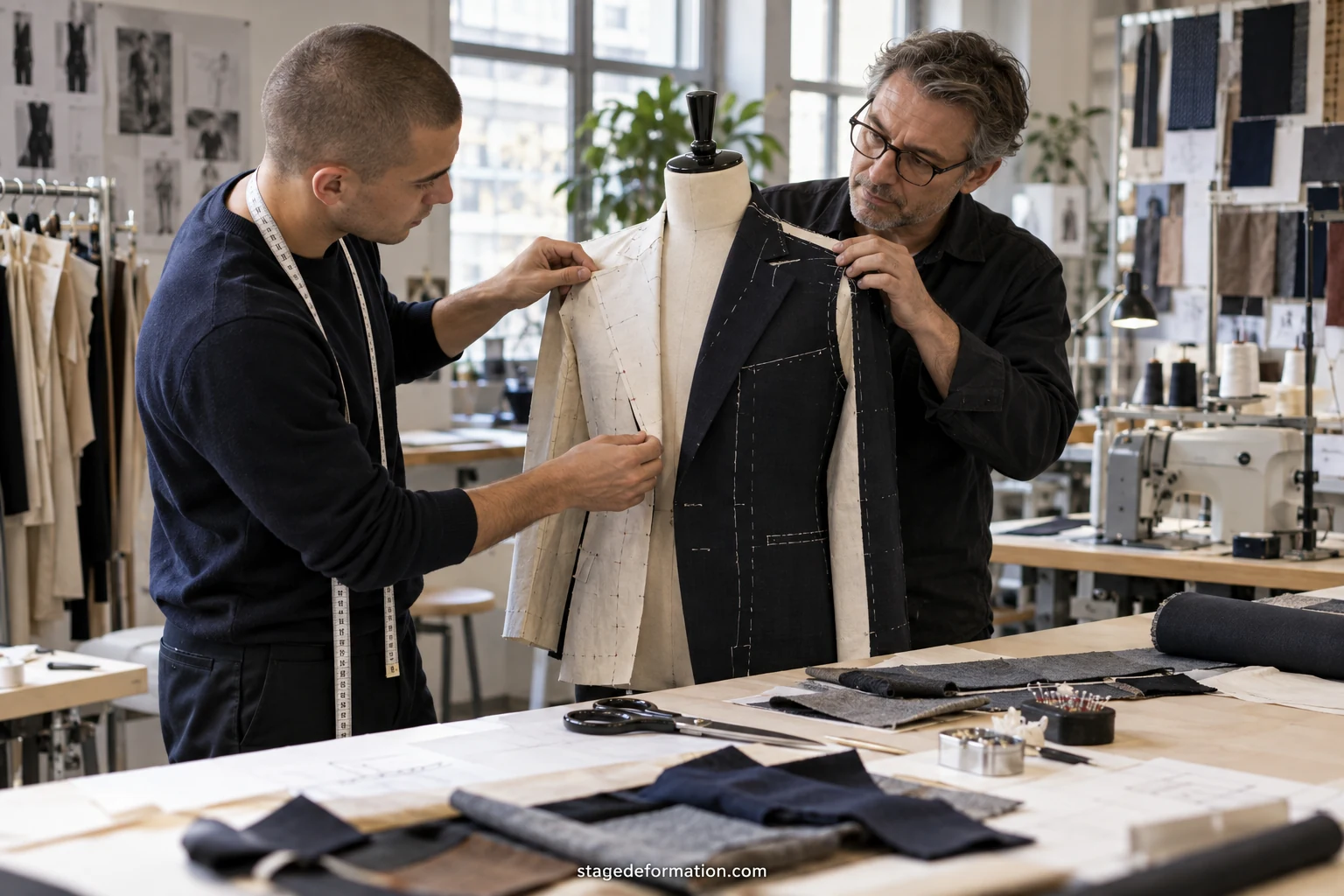
- Craft skills: toile making, pattern cutting, computer-aided pattern making, prototyping, quality, most often through apprenticeship or a professionalisation contract.
Before applying, identify without ambiguity the role you are aiming at. The same fashion house recruits for positions as different as assistant designer, assistant merchandiser and prototype maker.
Internship, work-study, VIE: do not mix them up
According to the information published by the institute, students on the management and design programmes carry out an assignment in a company during or after their training. It can take the form of an internship, an international corporate volunteering contract (VIE), a fixed-term contract or a permanent contract. The craft skills programmes, for their part, rely on apprenticeship or the professionalisation contract.
An internship remains a supervised period of training governed by an agreement, without the kind of subordination that applies to an employee. Work-study is an employment contract that carries a salary, calculated as a percentage of the minimum wage depending on age and situation. Comparing these options before you search stops you from applying to an offer that does not match your programme.
A profile the fashion house can read at a glance
Design, pattern making, merchandising and management are not recruited on the same evidence. A designer shows boards, choices of materials and the development of a collection. A merchandising candidate brings sales analyses, reasoning about the product range or a budget simulation. A pattern maker presents patterns, assembled toiles and corrections.
In every case, explain your decisions: why this cut, why this selection of references, why this order of priority. Always state your exact role in collective work. A pretty image with no explanation tells a busy recruiter very little.
Portfolio and business application: two different logics
A design portfolio should be selective: four to six well-documented projects are worth more than a pile of work. Each project includes an intention, inspiration research, development stages and the final result. Prepare a light digital version to send and a printed version for the interview.
A commercial or management application relies on a one-page CV, a targeted letter and, if possible, a short case with figures: analysis of a brand, a range recommendation, a digital action plan. In both cases, adapt the file to the house you are targeting: a luxury leather goods world, an accessible ready-to-wear brand and a young independent label do not expect the same tone.
Taking the rhythm of the collections into account
The sector lives by the seasons: design, prototype development, presentation, sales and then delivery. Each phase creates periods of intense activity and quieter ones. An internship slotted into the middle of fashion-show or showroom preparation does not give the same experience as one at the start of a cycle.
Ask precisely where your assignment falls in the calendar, who will supervise you day to day and what responsibilities you will be given. An intern left alone at a workload peak, with no supervisor available, learns little and wears out quickly. Ask about working hours during presentation periods too.
Agreement, allowance and working conditions
In France, every internship rests on an agreement signed by the student, the host organisation and the institution before it begins. It states the assignments, the length, the location and the supervisor. The length in the same organisation is limited to six months per teaching year, and an allowance is compulsory beyond two consecutive months of attendance. The minimum amount is set by regulation and changes: check it before you sign.
In workshops and studios, also ask about the practical organisation: access to machines, equipment supplied, safety gear, catering and transport during show periods. An assignment that is clear on paper should be recognisable in the daily routine.
Confidentiality of designs and reuse of your work
Fashion protects its creations heavily before their public presentation. Sketches, patterns, materials and collection plans may be covered by confidentiality clauses, or even by intellectual property rights. Before adding work done during an internship to your portfolio, ask for written permission stating what you may show, to whom and from what date.
The same caution applies to social networks: a workshop photo posted too early can wreck a launch and damage your reputation for a long time. If the company refuses any circulation, ask at least for a certificate describing your role and achievements.
Searching, applying and avoiding pitfalls
Offers are posted by companies on the recruitment platform used by the institute, and alumni networks also pass on opportunities. Complement these channels with unsolicited applications sent to a named manager, recruitment events organised with the fashion houses and trade federations.
Illustration with hypothetical data. Inès, a management student, is aiming for a six-month merchandising internship. She prepares an analysis of a product range page, sends it to twelve brands, obtains four exchanges and two interviews. Before signing, she asks for her supervisor’s name, the season calendar and the confidentiality policy.
To avoid: an overlong portfolio, a vague assignment, an internship with no named supervisor, the circulation of unauthorised visuals and the acceptance of working hours incompatible with the legal framework.
Frequently asked questions
What is the difference between an internship and work-study at the IFM?
An internship is a supervised period of training governed by an agreement, with an allowance beyond two months. Work-study is an employment contract with a salary and time shared between school and company. Craft skills programmes rely mainly on work-study, the others on assignments in companies.
Do I need a portfolio for a management internship?
Not in the creative sense, but a file of evidence helps: a brand analysis, a sales study, a marketing project. It shows your reasoning and your results. Present it briefly, with your precise role and the tools you used.
How do I find an internship offer?
Watch the recruitment platform used by the institute, approach the alumni network, take part in events with the fashion houses and send targeted unsolicited applications. A short, personalised message with a clear file generally gets more replies than a mass mailing.
Can I show my internship creations in my portfolio?
Only with the company’s agreement. Ask for written permission stating the visuals, the period and the media allowed. Creations not yet shown to the public are often confidential, and publishing them early can make you liable.
What internship length is allowed?
In France, an internship in the same organisation cannot exceed six months per teaching year. Depending on the programme, the institute sets specific periods, and each agreement states the exact dates. Check them with the relevant department before accepting an offer.
What should I check before accepting an assignment in a fashion house?
Ask for the supervisor’s name, a written description of the assignments, the dates in relation to the collection calendar, the allowance, the working hours and the confidentiality rules. A precise answer on these points is the best sign of a serious welcome.