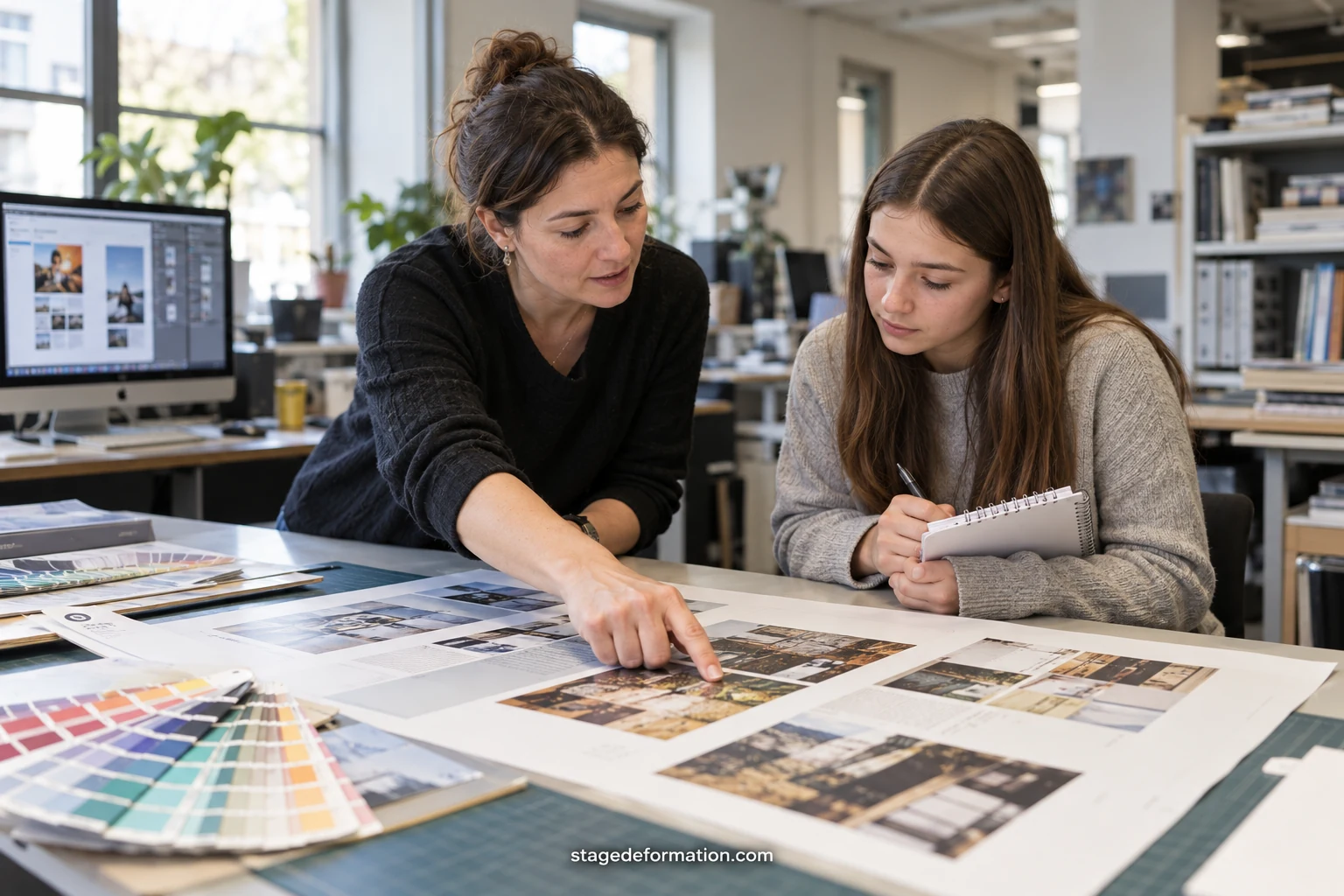
Five days to look closely at a job
In France, the observation internship in troisième, the last year of collège when pupils are around 14 or 15, is a compulsory part of the school year for every pupil in that class. It lasts five days, either consecutive or split into two periods, for example three days then two. It takes place outside school holidays, on a date the head teacher sets in coordination with neighbouring collèges; according to the official guidance, it falls between the All Saints' break and the spring holidays.
The aim is not to work but to understand: how an organisation runs, which jobs meet there, which studies lead to them and what an ordinary day looks like. The internship is unpaid, and the pupil keeps their status as a school pupil, with protection linked to the agreement signed by the school.
It forms part of the Parcours Avenir, the careers guidance programme at collège that supports thinking about future choices. It can also feed the report presented in the oral exam of the diplôme national du brevet, depending on how the collège organises it.
Who does what: pupil, family, school and host organisation
Several people are involved, and each has a precise role.
- The pupil looks for a host, writes the request, keeps to the hours and reports on what they have seen.
- The legal guardians help with the search, check the journey and sign the agreement.
- The collège gives the calendar, supplies the standard agreement, appoints a teacher as contact and can guide pupils who have no lead, notably through the form tutor or a local placement hub.
- The host organisation can be a company, an association, an administration, a public body or a local authority. It appoints a supervisor who guides the pupil and presents the activity.
The agreement is the central document. Signed by the collège, the host organisation and the legal guardians, it describes the activities, the supervision, the pupil's follow-up and the safety conditions. Without it, the internship cannot begin, and the school's managers cannot approve the chosen place.
Finding a place without waiting until the last minute
The best host places fill up quickly: pharmacies, town halls, hospitals, large companies and sought-after practices are often full several weeks before the dates. Starting to look from the beginning of the school year leaves time to receive answers and to take a few refusals.
To find a place, several routes complement one another:
- the national platform "1 élève 1 stage", which gathers offers and lets you sign the agreement online;
- family and friends: a neighbour who is a craftsperson, a relative working in an administration, or a classmate's parent;
- local shops and services, by calling in with a letter;
- health establishments, local authorities or associations that announce they take pupils of this age;
- group formats, such as the scheme run in the Sarthe département, where groups of six to eight pupils spent each day in a different company.
Do not chase prestige at all costs. A small bakery that takes the time to explain is worth more than a big name where you are asked to sit in a corner. Think about the journey too: a place that is an hour and a half away by transport is tiring and discouraging.
The request letter that gets a reply
Every approach should come with a short letter or message written by the pupil personally. There is no need to imitate adult language: a few clear, polite and precise sentences are enough.
- Who you are: first name, surname, class, school.
- What you are asking for: a five-day observation internship, with the exact dates given by the school.
- Why this organisation: a genuine reason, however modest ("I like animals and I would like to see how a vet's surgery works").
- How to reach you: a phone number or address for a legal guardian.
- Thanks: and a note that you will call back in a few days.
Attach the agreement or mention it, so that the person knows the framework is ready. After ten days without an answer, follow up once, politely. If a refusal comes, say thank you and ask whether a colleague or another organisation might be able to host you. Keeping a record of your attempts also helps the school support you if there is a difficulty.
Observing and asking questions during the week
The intern's best tool is a small notebook. Each day, note the tasks you saw, the tools used, new words and the people you met. Professional vocabulary written down from Monday makes the report much easier to write.
Prepare simple questions, suited to each person you speak to:
- How did you come to this job, and what did you study?
- What changes from one day to the next?
- What is the hardest moment? The most enjoyable?
- Which colleagues or customers do you work with most?
- What qualities do you need to succeed here?
Respect the rules of the place: hours, dress, safety instructions and confidentiality. Do not photograph people or documents without permission, and do not post anything on social media. For safety reasons, a pupil of this age does not handle dangerous machinery or carry out work forbidden to minors; if a task worries you, say so.
A sample week: Léa in a pharmacy
By way of illustration, here is an imaginary week. Léa, aged thirteen, spends five days in a neighbourhood pharmacy, from nine to twelve and from two to five, about thirty hours in all.
- Monday: welcome from the owner, a tour of the premises and an introduction to the jobs: pharmacists, dispensing assistants and delivery staff.
- Tuesday: observing the counter. Léa notes the most common customer questions and how they are answered.
- Wednesday: seeing how medicines are shelved and stock is managed, without handling sensitive products.
- Thursday: a half-hour interview with a dispensing assistant about her studies and daily routine.
- Friday: a review with the owner, handing over of the certificate and a talk about her impressions.
When writing her report, Léa chooses to describe Wednesday, which she understood best, and to compare what she had imagined with what she saw. She concludes that she enjoys contact with people but that the repetitive stock tasks appeal to her less: a useful result, even if she does not choose this career.
Building a readable, personal report
The internship report is often required in written form, sometimes followed by an oral in front of a panel. The precise instructions come from the school: number of pages, structure and items to attach. A simple structure almost always works:
- A cover page: name, class, place of internship and dates.
- An introduction to the host organisation: activity, size, public and organisation.
- An account of the week, day by day or by theme.
- A focus on one job or one task understood in detail.
- A personal review: what the internship changed in how you see things and in your plans.
- Possible appendices: permitted photos, public documents and acknowledgements.
A report is better when it is sincere. Markers appreciate precise observations ("the kitchen opens at six and the first job is checking deliveries") more than general sentences. Read it through to correct spelling, check that you have not copied the company's brochure, and remember to thank your supervisor.
Possible difficulties and solutions
Things do not always go as planned. If no place is found, talk to your form tutor early: the school knows partners and can suggest a solution. If the internship has to take place far from home, the head teacher's agreement is needed.
During the week, a pupil may find themselves with nothing to do, given tasks unrelated to the job, or feeling uncomfortable. They can politely ask their supervisor to be involved in an activity, and tell their family and the school if the situation continues. An absence must be reported both to the host organisation and to the school.
For a pupil with a disability, the internship remains compulsory, but its arrangements can be adapted with the education team, in line with the personalised schooling plan. Finally, a "mini-internship" during the holidays, lasting a week at most, falls under a separate framework and remains optional.
Frequently asked questions
How long is the troisième internship?
The observation internship lasts five days, which can be organised consecutively or split into two periods, for example three days then two. It takes place outside school holidays, on dates set by the school. The exact calendar depends on the school and the local area, so ask your form tutor.
Is the troisième internship paid?
No, this observation internship is unpaid. The pupil does not work for the host organisation and keeps school status. Some employers may offer a meal or travel costs as a courtesy, but that is not an obligation and it is not a wage.
What should I do if I cannot find an internship?
Tell your form tutor, the school life team or the careers adviser very early, because the school knows partners and can suggest solutions. Also check the national platform of offers, be open to less well-known places and accept a group placement if the school offers one.
Can I do my internship with a relative or in a family business?
The school may accept it, but many schools advise against it, because the point of the internship is to discover a new environment and meet professionals who do not know you. Ask the school's opinion before choosing, and in every case have an agreement signed.
What should I wear, and how should I behave?
Choose clean, simple clothes suited to the place: closed shoes in a workshop or kitchen, covering clothes in a hospital, plainer dress in an office. Be punctual, greet everyone, ask questions at the right moment and put your phone away. Respect the safety and confidentiality instructions.
Does the internship report count towards the brevet?
The internship is part of the Parcours Avenir and can serve as the basis for the oral of the diplôme national du brevet, if the school has planned it for the presentation. The exact arrangements, marking and report format are set by the school and should be confirmed with the teacher in charge.