An employment contract with a qualification at the end
Apprenticeship rests on a simple principle: you are a full employee of a company and you prepare a qualification or professional title at an apprentice training centre, the CFA. The contract alternates periods at the company with periods in class, and it aims at one specific certification, from a vocational certificate (CAP) up to engineering or master's degrees.
This status differs from an internship, which is a training period under an agreement with no employment contract. It also differs from the professionalisation contract, which is more geared towards getting people into work. In an apprenticeship, the training timetable and the job timetable are designed together.
Three players, three roles
The triangle of apprentice, employer and CFA only works if each knows their part.
- The employer signs the contract, pays the salary, gives tasks related to the qualification and appoints an apprenticeship master.
- The CFA delivers the teaching, follows your progress, organises the assessments and helps with the search for a company when needed.
- The apprentice attends classes, carries out the tasks assigned and follows the company's rules like any other employee.
A good habit is to ask from the start how the CFA and the company communicate: a progress logbook, a visit to the workplace, a quarterly review. These moments make it easier to adjust tasks when a course moves on to a new topic.
Age, length and training time
In principle, the contract is for people aged 16 to 29 inclusive. Exceptions exist, in particular from age 15 for young people who have finished the last year of lower secondary school, beyond 29 in certain cases, and with no age limit for workers with disabilities.
The contract can be fixed-term, from six months to three years, or open-ended with an apprenticeship period at the start. Its length matches the training cycle being prepared. The apprentice must start at the CFA within three months of the start of the contract, and teaching makes up at least a quarter of the total length of the contract.
The pattern of alternation depends on the qualification and on how the CFA is organised: one week in two, two days in class and three at work, or blocks of several weeks. Ask for the calendar before signing, because it affects housing, transport and working hours.
The apprenticeship master, cornerstone of the course
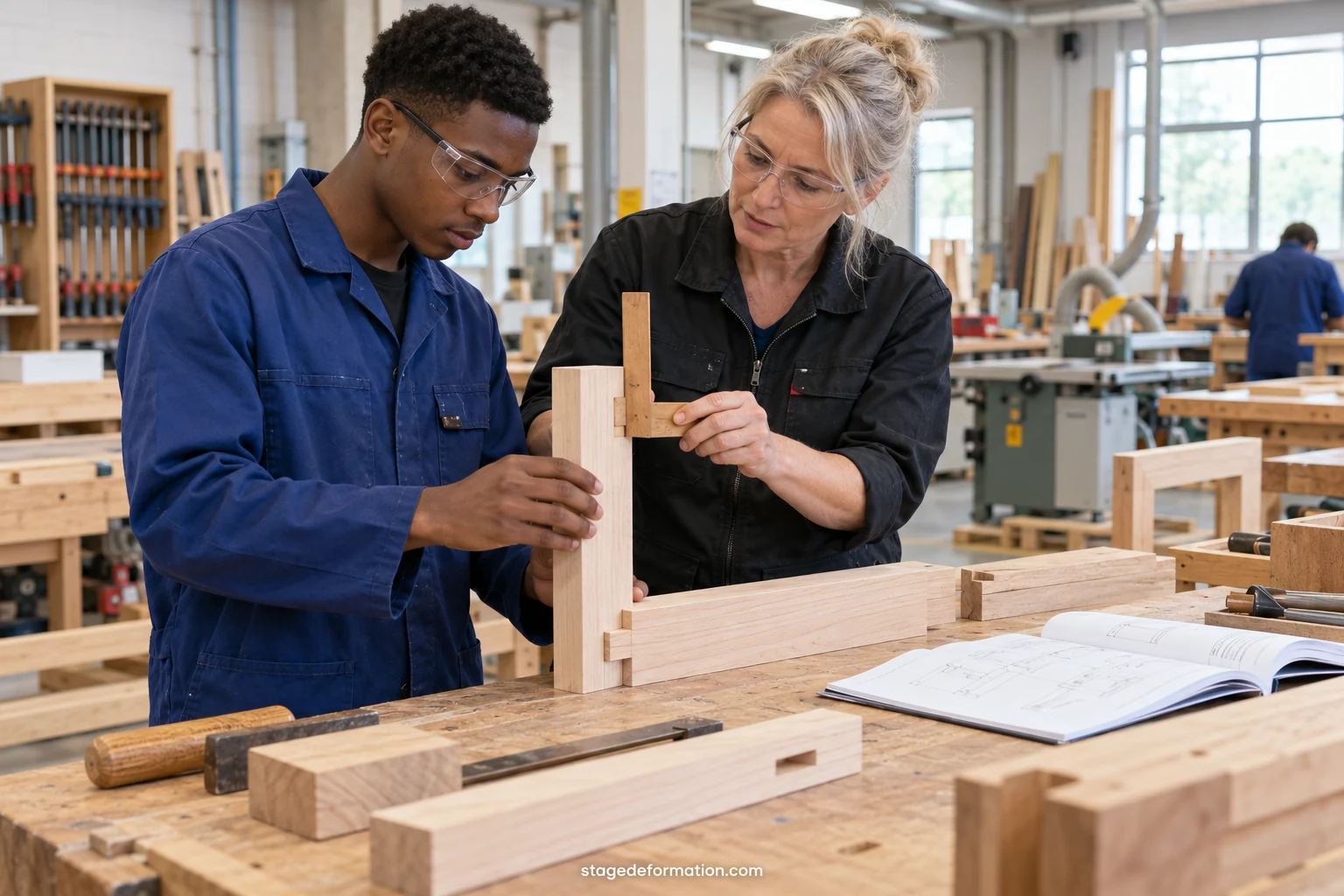
This is a volunteer employee of the company, of legal age, whose job is to pass on the skills of the trade and to liaise with the CFA. They must hold a qualification in the same field plus one year of experience, or failing that two years of practice. An apprenticeship master can supervise two apprentices at most, plus one who is repeating a year.
This framework guarantees a minimum of availability. Ask concrete questions at the interview: how much time each week will they give you, who stands in when they are absent, how will your skills be signed off?
Signs of good mentoring
- Tasks that grow more difficult over the months.
- Regular feedback on your work, not just at the end of the year.
- A real knowledge of the qualification framework.
Pay: how it is calculated
Pay is set as a percentage of the French minimum wage (the Smic), according to age and year of the contract, or at the collective-agreement wage if that is more favourable. Under the rules applying in 2026, the first year is for example 27% of the Smic for a 16 or 17 year old, 43% for ages 18 to 20 and 53% for ages 21 to 25. From age 26, the minimum is 100% of the Smic.
The percentage rises with each year of the contract and may receive an increase in some cases where contracts follow one another. Because the Smic changes, check the exact amount before signing with the employer, the CFA or a careers adviser.
A practical tip: work out your net budget including rent, your transport pass and the meals you eat during class weeks, which are sometimes far from home.
Signing, filing and the first days
The contract is in writing and drawn up on the official form provided for the purpose. It is signed by the employer and the apprentice, together with a legal representative if the apprentice is a minor. The employer then sends it to its skills operator (OPCO) within five working days of the start of the contract, together with the training agreement. Sending it is free and the body has twenty days to rule on it.
During the first forty-five days of practical training at the company, the contract can be ended in writing, at the initiative of either the employer or the apprentice. After that, ending it follows more tightly regulated rules: mutual agreement, referral to the mediator, obtaining the qualification with notice, serious misconduct or being declared unfit for the job.
Looking for a course and a company in the same process
The tricky point is often finding the employer. Start by choosing the qualification, identify three or four CFAs that offer it, then ask them how they help with the search for a company. In parallel, send speculative applications to companies in the sector you are aiming at.
- State the qualification, the level and the start date you want.
- Adapt your CV: education, experience, internships, skills linked to the trade.
- Prepare for the interview as you would for a job, with a question about the apprenticeship master and how the alternation is organised.
- Have the CFA check the contract before you sign.
Many CFAs admit candidates without an employer for a while, which leaves a few months to find one.
Example: a two-year BTS by apprenticeship
An illustration with hypothetical figures. Léo, aged 19, is preparing a BTS (a two-year vocational higher diploma) in SME management. He signs a twenty-four-month contract with a building-materials trading company.
- Pattern: two days at the CFA, three days at the company, so about 40% of the time in class, well above the legal minimum of a quarter.
- First year: data entry, customer follow-ups and filing; second year: order tracking and preparing a dashboard.
- Pay: a percentage of the Smic depending on his age, rising in the second year.
- End of contract: the BTS exam, then the possibility of continuing to a professional bachelor's degree or of receiving a job offer.
Common mistakes to avoid
Signing without having read the alternation calendar, accepting tasks that have nothing to do with the qualification, or waiting until the last week to look for an employer are common mistakes. Another trap is neglecting the paperwork. If a verbal commitment (working hours, remote working, covering a journey) matters to you, ask for it in writing.
Finally, do not confuse apprenticeship with a mere search for labour. If the tasks are limited to repetitive jobs with no growth in skills, tell the CFA, which has a monitoring role.
Frequently asked questions
Can you sign an apprenticeship contract without an employer at the start?
The contract requires an employer, but many CFAs agree to enrol a candidate without a company for a limited time and help them find one. Entry to the CFA must take place within three months of the start of the contract, which leaves some room to conclude.
What is the age limit for being an apprentice?
In principle 16 to 29 inclusive. Exceptions exist, in particular from age 15 after the last year of lower secondary school or beyond 29 in certain cases, and there is no age limit for workers with disabilities. Check your situation with the CFA before applying.
How much time do you spend at the CFA?
At least a quarter of the total length of the contract. The real pattern depends on the qualification and the CFA: some courses alternate by weeks, others by days or by blocks. The CFA gives out the calendar, and it is best to ask for it before signing.
How is an apprentice's pay calculated?
It is calculated as a percentage of the Smic, according to age and year of the contract, or at the collective-agreement wage if that is higher. The percentages rise year by year. The Smic changes, so ask the employer or the CFA for the exact amount that applies to you.
Can the apprenticeship contract be ended?
Yes. During the first forty-five days of practical training, the employer or the apprentice can end it in writing. After that, ending it goes through mutual agreement, referral to the mediator, obtaining the qualification with one month's notice, or serious misconduct or unfitness.
What is the role of the apprenticeship master?
A volunteer employee of the company, they support you day to day, give you tasks that build up gradually and talk to the CFA about your progress. They must hold a qualification in the field and one year of practice, or two years of practice, and supervise two apprentices at most.
Is there a probationary period?
The official guidance does not provide for a probationary period in the apprenticeship contract, but it allows written termination during the first forty-five days of practical training. If you are hired when the contract ends, no probationary period can be imposed, unless a collective agreement says otherwise.