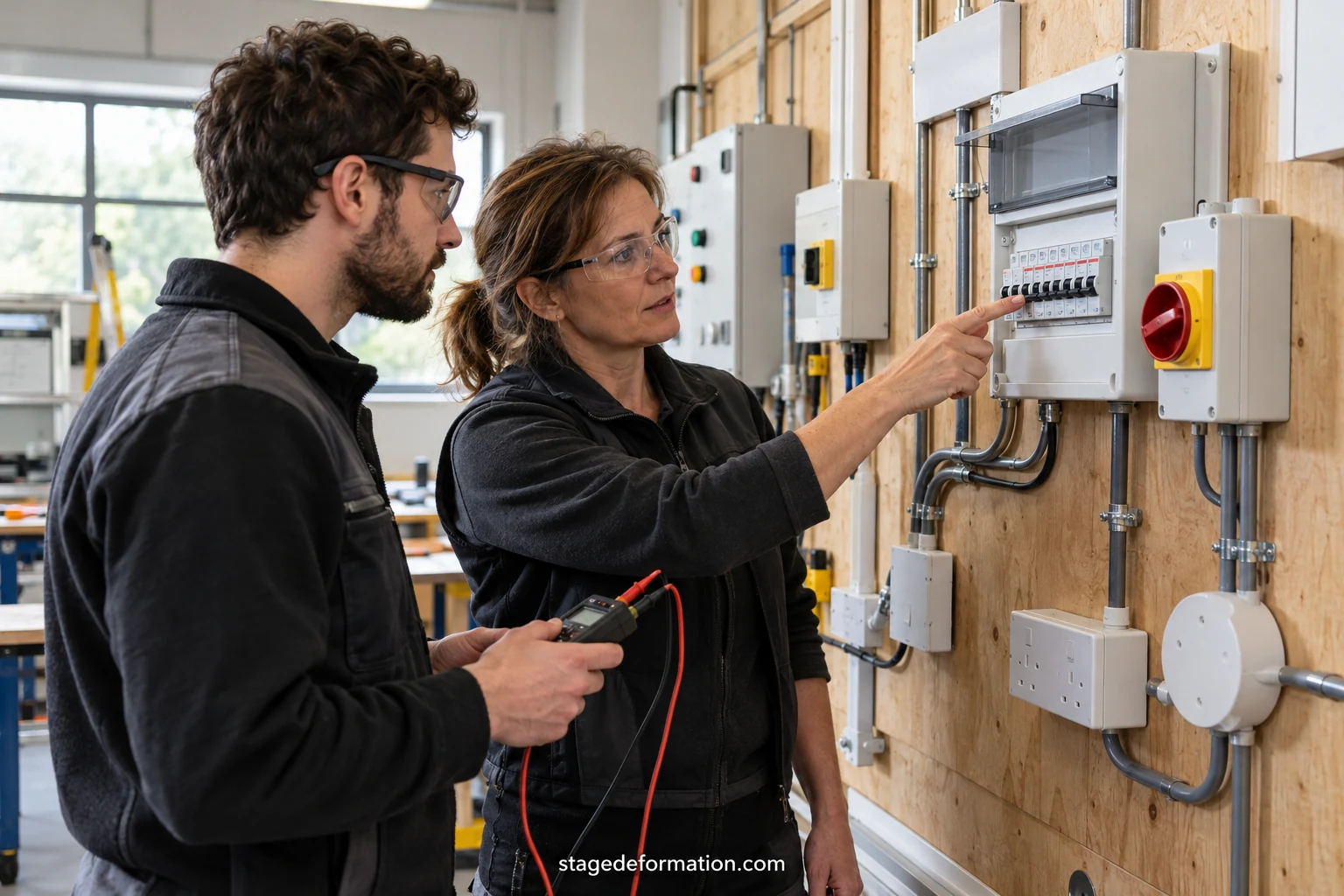
A trade that touches almost every building
No modern building works without electricity: new homes, offices, shops, schools, hospitals. The building electrician designs or carries out the installation from the distribution board to the sockets, switches, light fittings and fixed appliances. Electricians also fit communication, alarm, access-control, video-entry and home-automation networks, often grouped under the term low-voltage or extra-low-voltage systems.
Demand for skilled people is sustained by energy-efficient renovation, the spread of electric vehicle charging points, solar panels and systems that manage energy consumption. The trade therefore changes quickly and calls for training throughout a career.
Understanding the difference between observing, helping and working on the installation
The central rule of the trade fits in one sentence: you only work on an electrical installation if you are authorised to do so. An internship does not, on its own, give you that right. Three levels need to be kept apart.
- Observing: following an electrician, watching how a diagram is read, how a panel is prepared and how end-of-job tests are carried out.
- Helping: carrying equipment, running out cables, fixing cable trays and conduits, drilling under instruction, always with the power off in the areas concerned.
- Working on the installation: connecting, isolating and locking off, commissioning. In France, this requires training in electrical risk prevention and an authorisation issued by the employer, depending on the operations planned.
Ask from the first day which areas are de-energised, who checks that no voltage is present and who is supervising you at all times.
Electrical authorisation in practice
In France, the prevention standard that applies to work on electrical installations defines several levels of authorisation, identified by letters and numbers. People who do not carry out electrical operations but work near installations, such as bricklayers or painters, receive a basic level. Qualified electricians complete fuller training, including practical scenarios, before the employer issues them an authorisation certificate.
Training centres generally build this preparation into the course. For an intern, the company or school sets out what is allowed. If you are asked to do a task that worries you, you have every right to say you have not been trained for it: that is in fact the right reaction.
Training routes
In France, the CAP électricien, a two-year vocational certificate taken after lower secondary school, is the classic entry point: it teaches you to read a plan, pull cables, fit wiring accessories, wire a simple panel and carry out basic checks. The vocational baccalaureate in electrical trades and connected environments goes further, with more complex installations, home automation, energy efficiency and network connections.
After the vocational baccalaureate, you can continue towards a professional certificate (brevet professionnel) or a BTS in electrical engineering and energy, which leads to roles such as site technician, project manager or works supervisor. Shorter professional titles are aimed at adults changing career.
Each of these qualifications can be prepared as a full-time school student with periods in a company, or as an apprentice attached to a training centre. The names of the courses have been changed several times, so confirm the exact title with the institution.
Typical tasks on a new-build housing site
In a house or flat under construction, the work unfolds in several stages:
- marking positions on the plans and setting out the chases and flush-mounting boxes;
- fitting sleeves, conduits and boxes before the cables are pulled through;
- pulling and labelling the conductors for each planned circuit (lighting, sockets, hob, heating);
- wiring the panel, with circuit breakers and residual-current protection;
- fitting wiring accessories and light fittings after the painting;
- checks, tests and commissioning under the responsibility of an authorised electrician.
An intern can take part in stages one to three and observe the rest. The later stages call for particular rigour, since that is where wiring mistakes are detected.
Renovation, commercial buildings or maintenance: choosing your field
Conditions vary a great deal depending on the type of company. In renovation, you have to cope with old walls, ageing installations and sometimes occupants who are still living there. In commercial work, sites are larger, with cable trays, cabinets, IT networks and fire-safety systems. In maintenance, you troubleshoot and inspect, which develops reasoning and a method for diagnosis.
If you are undecided, one internship with one type of company and another with a different type will let you measure your preferences. A small firm offers great versatility; a larger company emphasises specialisation, procedures and safety equipment.
Applying: covering letter, CV and interview questions
In your CV, highlight the qualities installers look for: care, precision, a taste for technical work and the ability to work at height or in confined spaces. Mention your technology or electrical classes, a successful personal project (a lamp, a small connected gadget) or any manual activity.
In an interview, expect questions such as: what do you know about the risks of electricity, how would you organise a task, how would you react if a colleague were working without taking precautions? Showing that you know safety rules exist is more reassuring than excess confidence. Prepare your own questions too, on the type of sites, the equipment provided and the follow-up by a tutor.
An illustrative example: a path in three stages
Here is a fictional example, with rounded durations. A first-year vocational school student interested in home automation first spends a week of discovery in an installation company. He learns to read a housing diagram and to identify the circuits on a panel.
The following year, he chooses a two-year apprenticeship contract for the CAP, in the same company. He learns to pull cables and wire sockets on renovation sites, while preparing the theory and practical exams at the training centre.
Once he has the CAP, he continues with a vocational baccalaureate as an apprentice, with more home automation and low-voltage work, before considering a BTS. This kind of gradual path is common; it depends on a tutor who entrusts increasingly complex tasks over time.
Points to watch and possible career paths
The most serious errors are rarely spectacular: a poorly marked cable, a neutral connected wrongly, a forgotten protection device. Get into the habit of checking twice, taking notes and asking questions. Avoid being drawn into tasks for which you have received no instruction, even if a colleague insists.
Career paths are many: team leader, design office technician, specialist in photovoltaics or charging points, industrial maintenance technician, trainer, or business owner. The qualifications that professional bodies award to companies, for example for charging installations or energy-saving works, play a role in recruitment: find out which ones your host company holds.
Frequently asked questions
Can an intern work on a live installation?
No, except within the strictly supervised framework of a training course and with the required authorisations. In practice, an intern works on de-energised circuits, checked by an authorised electrician. If you are asked to do anything else, politely refuse and tell your tutor or your school: safety comes before the image you want to give.
Do you need to be good at maths to become an electrician?
You need a sound level in basic arithmetic, proportion and reading diagrams, but not advanced mathematics for the CAP. Vocational baccalaureates and BTS courses ask for more calculation of power and current. Courses include support, and practice on site helps give meaning to the formulas.
What is the difference between a building electrician and an industrial electrician?
A building electrician installs circuits in homes, offices or shops. An industrial electrician works mainly on machines, automation, control cabinets and production equipment. The basics are shared, but the environments, standards and maintenance differ; some career paths make it possible to move from one to the other.
Is an apprentice paid during periods at the training centre?
Yes, an apprentice is an employee for the whole length of the contract, including the weeks spent at the training centre. The amount depends on age, year of training and the rules in force, which change: the training centre or the employer can give you the current year's pay scales.
What equipment should you bring on the first day?
Ask the company what it provides. Generally, an apprentice buys or is given safety shoes, work clothes, insulating gloves if needed and a few basic hand tools. Do not spend anything before you have asked for the exact list, since some organisations cover part of this equipment.
Is the trade compatible with a disability or fragile health?
It depends on the situation. Some tasks involve working at height, standing for long periods and handling loads, but other roles, such as the design office, inspection or maintenance, are better suited. Training centres have disability advisers who can give advice and arrange adjustments.