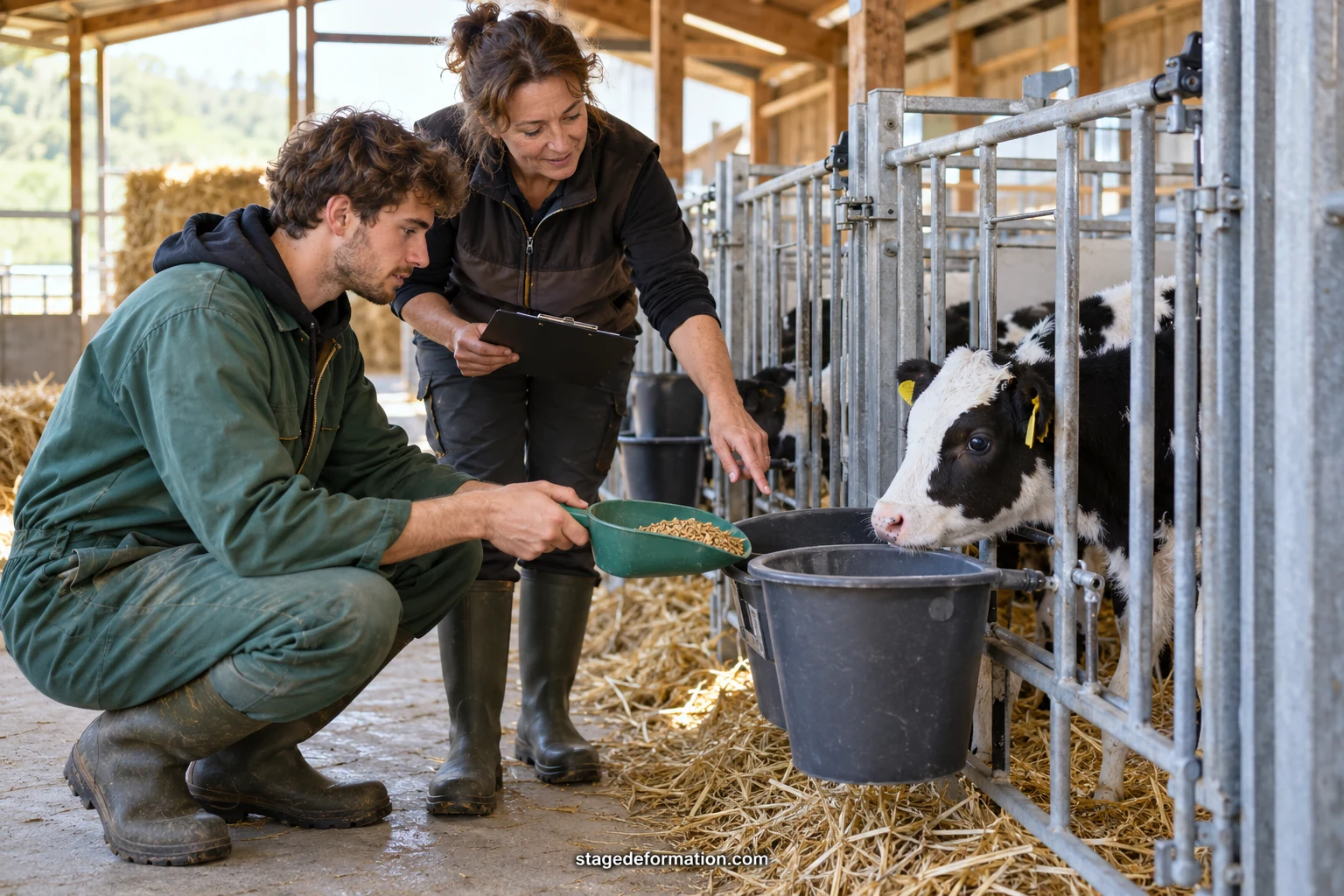
What a farm internship or a livestock apprenticeship involves
Farming offers two main forms of practical experience. The internship is a period of observation and hands-on practice required by a school or university course: it is governed by an agreement and remains a time of training, not a job. The apprenticeship rests on an employment contract signed with a farm, a cooperative or an agricultural contracting business, with alternating periods at a training centre.
In both cases the farm is the real place of learning. You learn to read a herd, to judge the state of a field and to drive a tractor, but also to understand that every action answers an economic, health or weather constraint.
This kind of path interests pupils in agricultural streams, students on higher technical agricultural diplomas (BTSA), adults retraining, and farmers’ children who want to see systems other than the family farm.
Livestock, arable crops, market gardening: choosing a type of production
A mixed crop-and-livestock farm, a dairy farm and a cereal estate do not teach the same things. Before you start looking, it is better to decide what you want to discover.
- Dairy farming: milking, feeding the cows, monitoring breeding, hygiene in the milking parlour. Hours are regular but start early and finish late.
- Beef, sheep or goat farming: watching over births, managing pasture, routine care, sometimes cheese-making on the farm.
- Intensive housed livestock (pigs, poultry): strict biosecurity, running the buildings, monitoring performance.
- Arable farming: soil preparation, sowing, observing fields, harvesting, with very marked peaks of work.
- Specialist crops: vines, orchards, market gardening, which need plenty of labour at certain times of year.
Ask yourself a simple question: do you prefer daily contact with animals or the technical side of machinery and crops? Your answer points to the type of farm to contact.
Qualifications that draw on practice
Agricultural education, public or private, relies heavily on alternating classroom study with time in business. Several qualifications give access to it at different levels.
- The CAPa (agricultural trades certificate) trains you to carry out production activities.
- The vocational baccalaureate in running and managing an agricultural business prepares you to work on a farm, or even to set up your own.
- The BTSA (for example, analysis, management and strategy of the farm business, or animal production) aims at roles as farm manager, technician or adviser.
- The professional certificate for farm business managers, often taken by adults, prepares you to run a farm.
Public colleges, rural family schools (maisons familiales rurales) and private school networks offer these courses, sometimes as apprenticeships and sometimes as school-based training with compulsory placements. Titles and arrangements change: check the website of the school you have in mind to find out the work-placement periods for the current year.
Where and how to find a host farm
Many placements are arranged by word of mouth. Start with your own school: technical teachers and course managers know farms used to welcoming young people and know which ones give real supervision.
You can also approach:
- chambers of agriculture, which run the network of farmers in their département;
- cooperatives and producer groups, which know their members;
- agricultural contractors and machinery-sharing cooperatives (CUMA), useful for getting to know the machines;
- farm job platforms, which also publish apprenticeship offers;
- agricultural shows and open days, where you can meet livestock farmers directly.
A local approach works well: a trip to the farm, a short visit and an honest account of your goals are often worth more than an anonymous email sent to fifty addresses.
Applying and first contact: what reassures a farmer
A farmer does not expect a sophisticated CV; he or she wants to know whether you will be punctual, reliable and attentive. Send a one-page CV, a short letter stating the period you want and your motivation for this particular type of production, and any experience you have (gardening, a riding centre, seasonal work, a youth work camp).
Preferably phone outside the busy times: on a dairy farm, avoid early morning and late afternoon. A few points to settle in the very first conversation:
- the dates, length and expected working hours;
- how you will get there, since many farms are isolated;
- any constraints you have (allergies, fear of animals, medical restrictions);
- accommodation, which needs a clear agreement if the farm is far away.
When you meet, show that you have looked at the farm: a word about the breed, the grassland management or the equipment shows genuine curiosity.
Legal framework, pay and safety
An internship requires a three-party agreement signed by the school, the farm and the intern before the first day. Beyond a certain amount of time spent in the same organisation, a stipend is compulsory; its rate is set by regulation, expressed as a percentage of an hourly ceiling used by the French social security system, and it changes: check the current amount with your school.
An apprentice, by contrast, is an employee. Pay depends on age and year of training, as a proportion of the minimum wage, with rules that may be more favourable under a collective agreement. The apprenticeship master must show a suitable qualification or experience.
Safety is a central issue: tractors, sharp tools, large animals, treatment products and slurry pits all carry risks. For young people under eighteen, certain dangerous tasks are banned or possible only under training-related exemptions, with supervision. A good welcome therefore begins with a clear explanation of the rules, the protective equipment and the areas to avoid.
A typical day and what you can learn
Take the example, purely for illustration, of a four-week internship on a dairy farm with sixty cows. The intern arrives at half past six, helps hand out the feed, watches the milking and notes any animals behaving unusually. After the midday meal, he helps clean the milking parlour, goes with the farmer into the meadows to check the fences, and then records the day’s information in a notebook.
As the weeks go by, the farmer may entrust him with more independent tasks: preparing rations under supervision, bedding down the buildings, helping to care for calves. Veterinary treatments and delicate technical operations remain reserved for authorised people.
Some skills are built in every system:
- observing an animal or a crop before acting;
- following a hygiene protocol;
- understanding the basic figures of the farm (milk per cow, feed cost, yield);
- working in a team despite tiredness.
Frequent mistakes and how to avoid them
Several blunders come up again and again among beginners.
- Underestimating the hours: farm work does not stop at a fixed time when a calving or a harvest demands attention. Discuss it beforehand.
- Turning up without suitable kit: boots, hard-wearing clothes, gloves. Ask the farmer for the list.
- Asking questions at the wrong moment: during a delicate procedure on an animal, it is better to watch in silence and ask afterwards.
- Neglecting the internship report: take notes every evening, with dates, actions observed and figures given by the farmer.
- Accepting a placement with no framework: no agreement, no clear accommodation, no named contact person: these are warning signs.
If a situation makes you uncomfortable or seems dangerous, tell your school without delay.
Internship, apprenticeship or seasonal job: how to choose
An internship suits you if you want to discover a sector, confirm a direction or meet a course requirement. An apprenticeship is for those who are determined to build a career: it offers a salary, continuous experience and often better chances of being hired at the end. Seasonal work, finally, lets you earn an income and test the peaks of activity, especially for the grape harvest, fruit picking or vegetable gathering.
Many paths combine these options: a first discovery placement in the final year of lower secondary school or in the first year of upper secondary, training periods during a vocational baccalaureate, then an apprenticeship on a BTSA on a different farm. Varying the organisations is an asset, because it lets you compare production systems, farm sizes and management styles.
Frequently asked questions
Do I need to come from a farming family to do a livestock internship?
No. Many young people with no family link to farming find a placement, provided they show motivation and reliability. Agricultural schools, chambers of agriculture and producer groups help identify farms open to beginners. A first visit in person often makes the farmer’s decision easier.
When in the year should I look for a host farm?
Ideally several months before the date you want, because farmers plan their work around the seasons. For an internship at a peak time, such as harvests or calving, you need to start early. Quiet periods are sometimes better for learning, since the farmer has more time to explain his or her choices.
Can an intern drive a tractor or handle animals?
It depends on age, level of training and the authorisation provided for by the regulations. For minors, certain tasks are banned or subject to strict conditions. In every case the farmer must explain the rules, supply or specify the necessary equipment and supervise the first operations.
Is a farm internship always paid?
Not always. A stipend is compulsory when time spent in the same organisation exceeds a threshold set by the regulations. Below it, payment is optional but possible. The minimum amount is calculated at a regulatory rate that changes: ask your school for the current figure before signing the agreement.
What is the difference between an apprentice and an intern on a farm?
The apprentice is an employee under an employment contract: paid, attending classes at a training centre and genuinely taking part in production. The intern is a pupil or student hosted under an agreement, whose presence has an educational purpose. Rights, length and the farmer’s responsibility differ.
Can I be housed on site during a farm internship?
Sometimes, but it must always be explicitly agreed before the internship starts: location, conditions, any contribution to costs, house rules. Some farms have a holiday cottage or a spare room; others point you to nearby accommodation. Without clear housing, an internship in an isolated area can quickly become difficult.