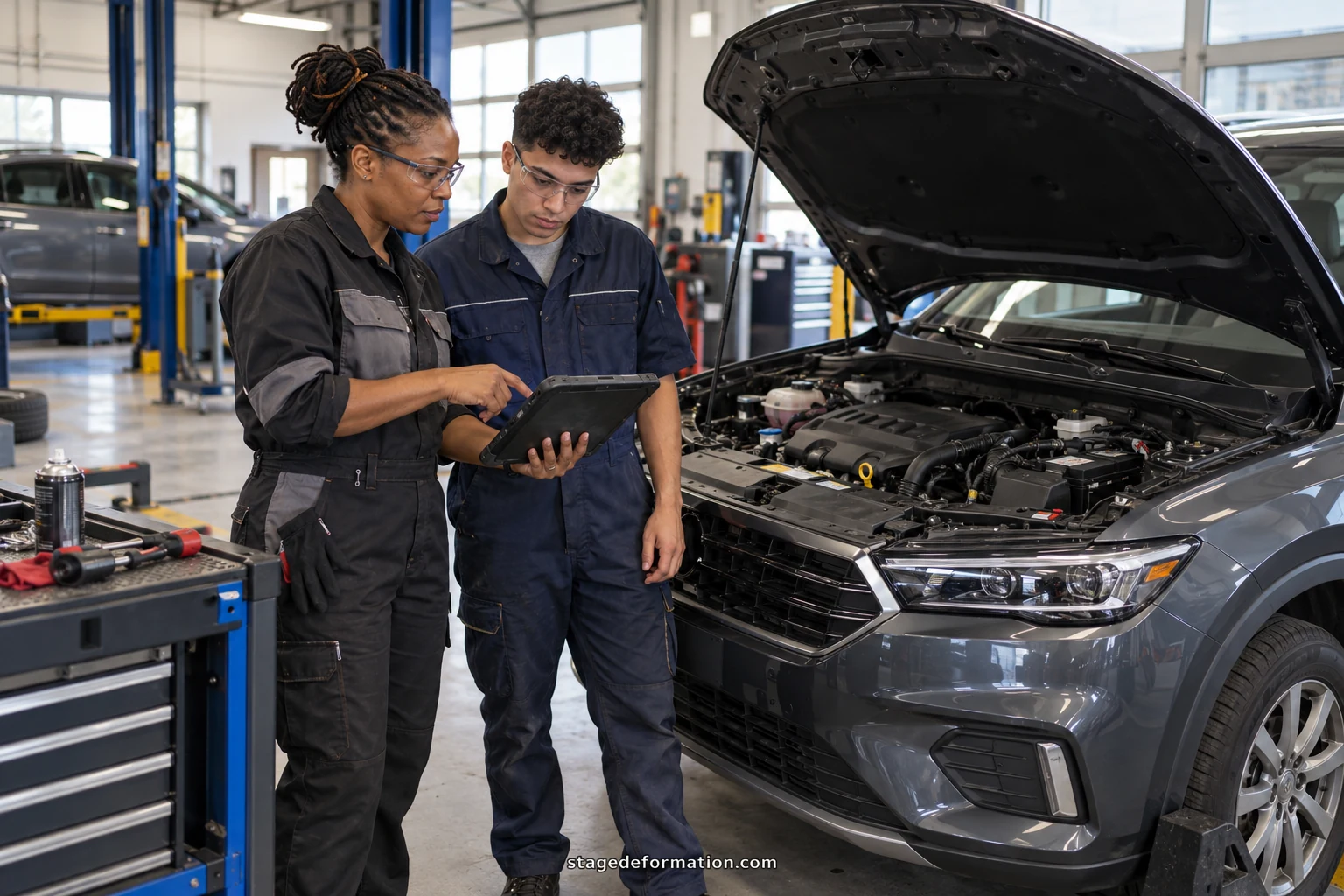
A trade that has changed its face
The mechanic of yesterday took components apart and put them back together. Today's mechanic also reads fault codes, plugs in a diagnostic tool, consults the manufacturer's documentation and checks driver-assistance systems. Hybrid and electric cars add high-voltage batteries, specific safety procedures and new tools.
Even so, the basics remain essential: understanding a braking circuit, a timing system, a cooling system or the suspension and steering. An internship or apprenticeship contract exists precisely to connect that knowledge with real vehicles, with their wear, their intermittent faults and their impatient customers.
Who is it for? Lower secondary pupils exploring careers, vocational school pupils, BTS students and adults retraining: all can find a way in, provided they choose the right format.
Which qualification for which level of responsibility
- CAP in vehicle maintenance: options for passenger cars, road haulage vehicles or motorcycles. An entry-level course into the trade, geared to routine servicing and basic operations.
- Vocational baccalaureate in vehicle maintenance: three comparable options, with more diagnostics and more independence. The periods in a company are longer.
- BTS in vehicle maintenance: senior technician level, with customer reception, in-depth diagnostics and workshop management.
- Supplementary certificates and professional titles: specialisations (for example in electric vehicles or bodywork) or a quick career change for adults.
Apprenticeship exists at almost all these levels, often in apprentice training centres attached to the industry's networks. The choice of option depends on what you want to repair: cars, lorries, two-wheelers. Keep in mind that job prospects vary by region and by make.
Observation internship or apprenticeship contract: which to aim for
An internship is a one-off: a week of observation in year 9 or 10 in France, or a few weeks of workplace training in a vocational school. It rests on an agreement signed by the school, the pupil or their legal guardians, and the company.
The apprenticeship contract is a genuine employment contract: the apprentice is an employee, paid according to age and year of training under the rules applying in 2026, and alternates between the workshop and the training centre. The length generally follows that of the qualification being prepared. This route suits young people who already know they want to work in a garage and prefer to learn on the job.
For minors, special rules govern so-called regulated work: certain equipment, such as vehicle lifts or work at height, requires specific conditions and prior safety briefing. The employer and the school must know them before the young person arrives.
What you actually do in a workshop
Receiving the vehicle
Welcoming the customer, noting the symptoms described, checking the service history, filling in the repair order. This is where the quality of the diagnosis is decided: a badly described fault costs time.
Routine servicing
Oil changes, filter replacement, checking fluid levels, tyres, brake pads and discs, batteries. These tasks build manual skill and safety reflexes.
Diagnostics
Reading fault codes, checking voltages and pressures, road tests, comparison with manufacturer data. A code is only a clue: the apprentice learns to cross-check observations before replacing a part.
Handing the car back
Final check, test drive, cleaning, explaining the work done. This step shapes the workshop's image and deserves as much attention as the repair.
Electric and hybrid vehicles: a safety skill
As soon as a vehicle has a traction battery, electrical risk appears. Work on these components requires a specific authorisation for electric and hybrid vehicles, issued by the employer after training. Without it, nobody should touch the orange cables or the power connectors.
For an intern, this often means an observer's role on these operations: preparing the area, following the lockout procedure, noting the values read. For an apprentice, it is a chance to train progressively, provided the training centre and the workshop organise it together.
When choosing an employer, ask whether it has the equipment and authorised staff. A workshop that handles none of these vehicles today will teach you less on this subject than your training will require tomorrow.
Where to find a place: dealerships, networks, independents
The landscape is varied. Dealerships and brand agents offer up-to-date equipment, manufacturer training and a structured pathway, but their places are sought after. Independent garages let you work on very different makes and ages of vehicle; the supervisor there is often the owner. Fast-fit centres and repair chains offer repeated tasks and a brisk pace. Haulage and heavy goods companies train you on larger components.
To search, go through the training centre, which often keeps a list of partner employers, through the trade federations, careers fairs and direct visits. In this trade, turning up in person, smartly dressed and with a printed CV, still works very well.
A typical week for a first-year apprentice
An illustration, with round numbers: a CAP apprentice spends three weeks in the workshop and then one week at the training centre. During the weeks in the company, they begin with twenty oil changes and fluid checks, then, over the months, replace brake pads under their supervisor's eye.
In the second year, they assist with longer diagnostics: engine warning light on, bearing noise, ineffective air conditioning. The supervisor asks them to put forward a hypothesis before plugging in the diagnostic tool. This habit of reasoning is worth more than speed: a workshop prefers a slow but methodical young person to a fast one who replaces three parts for nothing. Actual durations and tasks vary with the employer.
Applying with concrete arguments
A workshop manager looks first at reliability: punctuality, appearance, attention to instructions. Your CV can mention simple but telling experiences: servicing a scooter, restoring an electric-assist bicycle, mechanics at a karting club, a previous placement.
In the letter, state the option you are aiming for and why the workshop interests you: a specialist make, the presence of hybrid vehicles, the size of the team. At interview, prepare answers on safety (lifting, waste oil, protective equipment) and on what you learned from your earlier placements.
Also ask a question about support: who will be your supervisor, how often will you get feedback, which operations will you be able to carry out alone after a few months? It shows a wish to learn rather than a mere search for a contract.
Mistakes to avoid before and during training
- Choosing a workshop only for its make: a good supervisor counts for more than a logo.
- Underestimating theory: electrics, hydraulics and diagram reading underpin diagnosis.
- Replacing without understanding: the expensive part changed without an established cause remains the most common fault.
- Forgetting safety: shoes, gloves, a chocked car, a vehicle properly raised.
- Keeping no records: a logbook of the operations carried out is evidence of progress and feeds the examination file.
Finally, if a disagreement arises with the employer or supervisor, talk about it quickly with your training centre or your placement tutor, who can step in before the situation worsens.
Frequently asked questions
At what age can you start an apprenticeship in automotive mechanics?
In France, apprenticeship is in principle for young people aged 16 to 29, with possibilities from 15 after year 10 in certain cases provided for by law. The qualification aimed at, the region and what the training centre offers all influence the route. Ask the training centre in your area.
Which option should I choose: passenger cars, heavy vehicles or motorbikes?
Choose according to your real interest and the job prospects near you. Passenger cars offer the most workshops, industrial vehicles demand more strength and bulky components, and motorcycles are a more specialised, often seasonal market. An observation internship helps you decide.
Can an intern work on an electric vehicle?
Only within the framework set by the employer, with suitable training and supervision. Work on the traction battery and high-voltage components requires a specific authorisation. Without one, the intern observes and assists on operations with no electrical risk.
Do I need to buy my own tools before starting?
It depends on the workshop and the training centre. Many employers provide basic tools, while others ask you to build up a first personal toolbox gradually. Check the list requested before spending anything, and do not try to buy everything on day one.
Can you do an internship without a driving licence?
Yes, in many cases, but the employer may limit road tests to people who hold a licence and are covered by the workshop's insurance. Moving vehicles within the garage premises also follows internal rules. State your situation at the interview to avoid any surprises.
How do I make the most of an automotive mechanics internship on a CV?
Describe the operations carried out, the types of vehicle worked on, the diagnostic tools used and any authorisations. Add the name of the workshop and the duration. A reference from your supervisor or a short written appraisal makes your next application more credible.
Does an apprenticeship guarantee a job at the end?
No, there is no guarantee. It does, however, improve your chances of being hired by the host company or another in the sector, because you have already worked in a workshop. Recruitment needs change by region and by company; stay alert to opportunities.