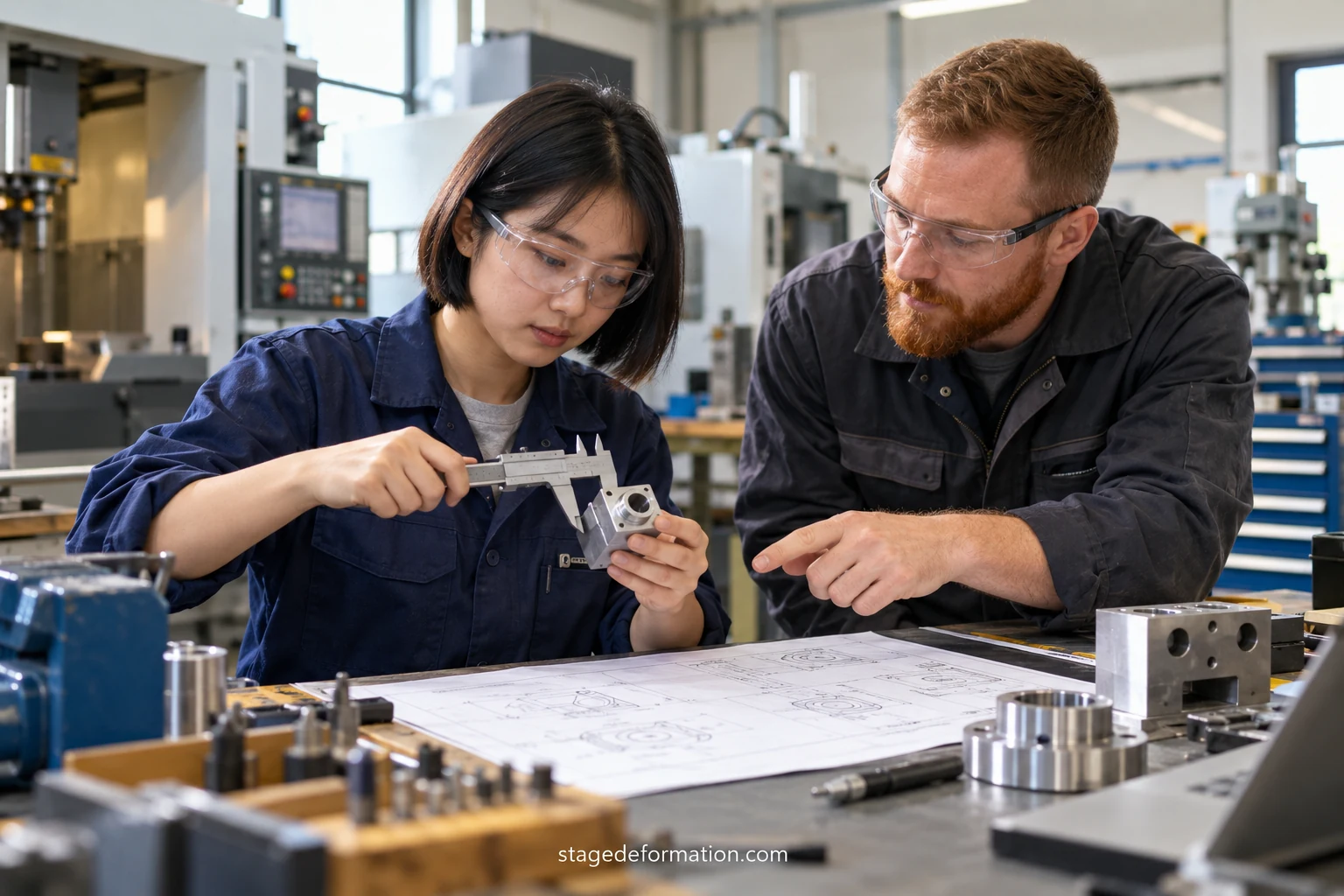
Two years for a tightly focused specialism
The brevet de technicien supérieur (BTS) and its agricultural equivalent, the BTSA, are qualifications at two years of higher education. They are prepared at a vocational school, at an apprentice training centre, at a family rural school for certain agricultural specialisms, or through continuing training. Each qualification corresponds to a precise specialism, from accounting to maintenance, from sales to farm production, from computing to water management.
This precision changes the nature of the internship: you are not looking for a general discovery of working life, but for a chance to practise activities already identified in the qualification’s framework. The student arrives with what they have learned in class, and the workplace lets them test it against real business situations.
Internship or work-study: two ways of learning in a business
A BTS or BTSA student generally has a choice between two statuses, depending on what the institution offers.
- Student status with internships: workplace periods are shorter, governed by an agreement, and followed by a return to classes. Beyond two months of attendance, a stipend is due.
- Work-study: an apprenticeship or professionalisation contract ties the student to an employer for the whole course. The student is an employee, paid, and alternates with lessons according to a calendar set by the centre.
Work-study means finding an employer before term starts or soon after, which makes the search earlier. Student status leaves more time, but each internship is negotiated separately. Compare them according to your budget, your ability to work at a sustained pace and the importance you give to getting into work quickly.
How long should you spend in a business?
Not all BTS and BTSA courses expect the same activities or the same lengths. In a BTS, the total internship time is often between about ten and fifteen weeks over the two years, but some specialisms provide more or less, according to the decree defining the qualification. In a BTSA, part of the time goes to individual internship periods and to group or study placements, depending on the specialism and the training route.
Rather than relying on an average, consult three documents: the qualification’s framework, your institution’s internship regulations and the calendar for the year. They state the minimum length, the possible periods, the type of organisation expected and the work to be handed in. If a period is fixed between two dates, you cannot move it without the agreement of the teaching team.
Starting from the framework to choose assignments
The framework for a BTS or BTSA lists the professional activities, the skills and the associated knowledge. It is the best grid for judging an offer: the assignments you are given should let you draw on several skills, with a growing level of independence and a professional available to explain the choices made in the trade.
An example of how to proceed: identify three skills to work on, look for concrete situations that bring them into play, then check with the business that these situations will be able to arise during your stay. An offer limited to data entry, filing or handling, with no link to the specialism, deserves a discussion with the supervisor and the lead teacher before the assignment begins, or an adjustment along the way.
Finding a placement suited to the specialism
Placements vary widely: an industrial SME, an accountancy firm, a farm, a local authority, an analytical laboratory, an estate agency, a maintenance workshop. Institutions often maintain relationships with partner businesses, which makes first contacts easier. Form teachers, former students and the region’s professional networks are valuable sources.
For applications, prepare a one-page CV, a letter explaining how the placement matches the specialism, and a precise question about the possible activities. Applications go out several months before the period, sometimes as early as autumn for end-of-year internships. Family rural schools, chambers of agriculture and agricultural apprentice training centres are useful relays for the specialisms linked to living things and the food industry.
Planning the write-up from day one
Most BTS and BTSA courses assess the internship or workplace experience through a report, a file of situations or an oral exam. Identify from the start the documents, situations and results that will be needed. An analysis showing a decision, its justifications and its effects is generally more useful than an exhaustive description of the business unrelated to your specialism.
Ask for permission to collect material before copying documents: price lists, customer data, plans, staff files, commercial information. Remember to anonymise what must be anonymised and to have sensitive passages approved by the supervisor. Keep a logbook every week, with the tasks, the difficulties and the skills used: it will spare you from reconstructing several months of activity from memory.
Stipend, pay and rights
An internship of more than two months in an academic year entitles you to a minimum stipend set by regulation and revised regularly. Under the rules applying in 2026, it is 4.50 euros per hour of attendance, and a collective agreement may provide for more. In work-study, pay is a percentage of the statutory minimum wage that depends on age and the year of the contract.
A worked illustration, with rounded values: a twelve-week internship at thirty-five hours a week amounts to 420 hours; at the minimum rate, the stipend would be 1,890 euros in total. A work-study contract weighs more heavily on the employer’s budget, but it offers the student a monthly income and longer experience. Always check the exact amount and the payment schedule in the agreement or the contract.
From the BTS to further study
After a BTS or BTSA, several paths open up: going into work, a professional licence (bachelor’s degree), the third year of a BUT under certain conditions, a specialist school or a bridging class. Experience in business then plays a direct role in applications: it shows responsibilities, results and a network.
From the first year, keep evidence of what you have done, certificates and the contact details of supervisors willing to vouch for you. If you are aiming to continue your studies through work-study, an employer you already know may sometimes offer to extend the collaboration, but nothing obliges them to. Plan your applications for the spring of the second year.
Mistakes to avoid during the course
- Waiting too long to look for a placement: the good offers go early.
- Accepting assignments unrelated to the specialism and regretting it at report time.
- Forgetting the agreement or signing it late: the student is not covered as they should be.
- Neglecting the supervisor: a fifteen-minute weekly check-in avoids many misunderstandings.
- Writing the report at the last minute: gradual writing produces a better text.
For the exact arrangements of your qualification, rely on your institution’s regulations and on the lead teacher.
Frequently asked questions
What is the difference between a BTS and a BTSA?
The BTS comes under the Ministry of Education and covers industry, services, sales and management. The BTSA comes under agricultural education and prepares for work with living things, the food industry, land management and farm machinery. Both are at two years of higher education, with workplace periods written into the framework.
How long an internship is planned in a BTS?
It depends on the specialism and on the decree that defines the qualification. Observed lengths often range from a few weeks to about fifteen weeks over the two years. Your institution’s regulations and the framework give you the figure that applies, as well as the permitted periods.
Is work-study possible in every BTS and BTSA?
No, it depends on what the institution offers. Many specialisms are open as apprenticeships, but not everywhere. Check with apprentice training centres which sections offer contracts in your region, and at what time of year employers recruit.
Must the internship be paid?
For an internship of more than two months in an academic year, a stipend is compulsory. Below that, the business is not obliged but may pay one. The minimum, set by regulation, is 4.50 euros per hour under the rules applying in 2026.
Can you do an internship abroad during a BTS?
Yes, if the institution authorises it and the agreement complies with the rules of the host country. Mobility funding exists, but it depends on the institution. Allow several months for the steps involved: academic approval, insurance, housing and administrative formalities.
What should I do if the assignments do not match the framework?
Speak quickly to the supervisor, then to the lead teacher. Rely on the targeted skills to suggest more suitable tasks. If the situation does not unblock, the institution can step in or accept a change of placement, depending on the time remaining.