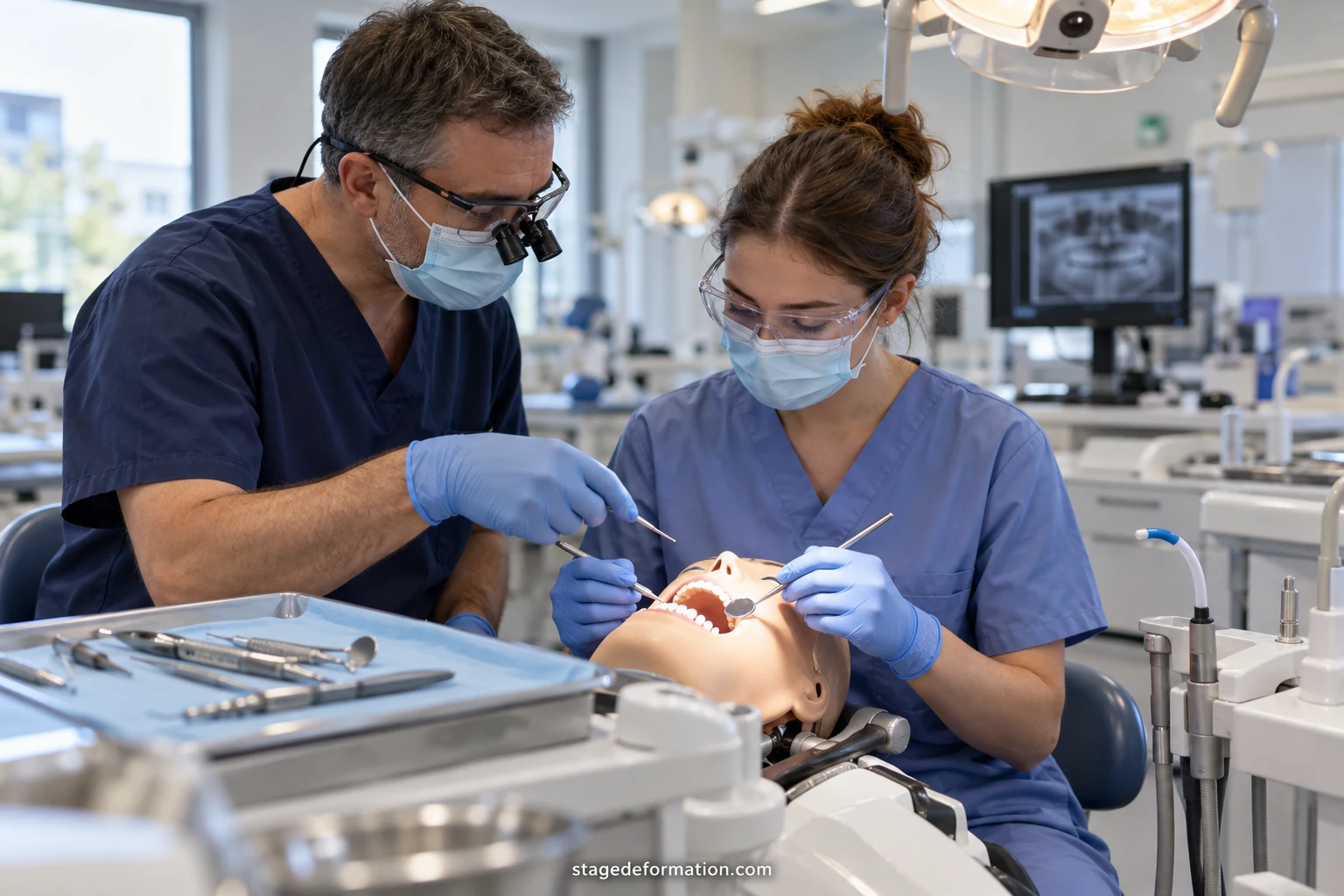
Progress in three stages: simulation, clinic, practice
The dentistry course does not hand a patient to a student on day one. It advances in stages. At the start, learning comes through practical classes: preparing cavities on artificial or extracted teeth, taking impressions on models, shaping prostheses, and exercises in handling the handpiece and the mirror. These sessions build precision, posture and aseptic discipline before any contact with a patient.
Next comes the university clinic. The student joins the faculty's treatment centre, attached to a university hospital, where they first take part in reception and observation and then in simple treatments, always with a lecturer or practitioner present. The procedures entrusted to them increase as their competences are signed off.
The final stage is the active internship with an approved dentist, often in a private practice. This is where you discover the real pace of a treatment day, appointment management and the balance between technical quality and time pressure.
Who supervises the student and who is answerable
Three parties share educational responsibility for a clinical internship: the teaching unit, the affiliated hospital and the practitioner who hosts the student. For the active internship, a three-party agreement sets out the academic year, the dates, and the days and hours of attendance. It is also brought to the attention of the county council of the dental order.
The dentist who receives the student must be approved as a placement supervisor. They must be able to step in at any moment, which rules out leaving a trainee alone at the chair. Some universities even offer specific training for future supervisors, a sign that supervision is regarded as a skill in its own right.
- The placement supervisor oversees the treatments, signs off procedures and writes the assessment.
- The faculty's lecturer in charge follows progress and receives the internship report.
- The student keeps their logbook and remains subject to the discipline that applies to hospital students.
What you really do during an active internship
Within the framework defined by the agreement, the trainee takes part in the practice's activity and carries out routine dental procedures under the practitioner's control. The precise list depends on the faculty's internship logbook, which sets the competences to acquire. A student therefore cannot decide alone to widen their scope, even if the patient is cooperative and the dentist is in a hurry.
A typical day mixes several kinds of activity:
- welcoming the patient, reading their medical record and spotting contraindications or current treatments;
- preparing the instrument tray, checking sterilisation and the traceability of instruments;
- carrying out a restorative treatment, a scale and polish or a prosthetic preparation, depending on the level signed off;
- explaining the treatment plan to the patient in plain words;
- recording the procedure in the file and debriefing with the placement supervisor.
This debrief, often more instructive than the procedure itself, is the moment when you understand why one treatment choice was made rather than another.
Status, insurance and pay: points to clarify
Rules vary by year and establishment, but a few principles recur in the agreements published by universities. During the active internship in a practice, the student generally continues to receive the flat-rate allowance paid by the affiliated hospital, because of their status as a hospital student. The amount depends on the regulations in force and changes: check it with the faculty or the hospital's administration service.
On insurance, the supervisor must hold professional liability cover that includes damage caused or suffered by the trainee. For their part, the student must show their own professional liability insurance, notably for damage that could affect patients, the dentist or their staff. It is prudent to keep the certificate to hand from the first day.
Finally, the faculty may suspend or end the internship, on its own initiative or at the request of one of the parties, after consultation and subject to notice. This mechanism protects the patient as much as the trainee.
Finding a placement without improvising
Placements are recognised by the faculty, and its decision is final. A friendly practice that is not approved will not do, whatever is promised verbally. Start by asking the registrar's office for the list of approved practitioners in your region, then ask student associations, which often know who readily takes a trainee and at what pace.
A few criteria help you choose:
- the patient base: general dentistry, orthodontics, oral surgery, paediatric dentistry;
- the equipment: digital radiography, optical impressions, compliant sterilisation;
- the supervisor's real availability to comment on cases;
- distance and accommodation, because an active internship may mean moving temporarily.
Contact practitioners well ahead of the planned dates. A short message with your year, your availability and the internship logbook attached shows seriousness straight away.
Preparing your arrival: uniform, vaccination record, mindset
A good start is prepared several weeks ahead. Healthcare settings impose health obligations: vaccinations required of health professionals, medical follow-up, sometimes a certificate in emergency first aid. Gather these documents early, because a missing certificate can delay the start.
On the practical side, think about your uniform, eye protection, the internship logbook and a minimal kit approved by the practice. On the mental side, approach the internship as an exercise in active observation: for each patient, note what surprised you, what you would do differently and the question you did not dare ask.
One simple tip: before each day, reread the procedures you may be asked to perform. A student who can name the instrument, the sequence and the risk immediately inspires confidence in the dentist.
Worked example: organising an eight-week internship
For illustration, imagine a student doing an eight-week active internship, four days a week, which makes about thirty-two days of attendance. All the figures are hypothetical.
- Weeks 1 and 2: observation, getting to know the records software, simple treatments in tandem with the dentist.
- Weeks 3 to 6: supervised build-up of independence, with about ten restorative treatments a week and a weekly assessment meeting.
- Weeks 7 and 8: consolidation, one or two more complex cases discussed beforehand, handing in the completed logbook.
At the end, the student has thirty-two short case notes, an assessment form and clear feedback on their strengths. It is this traceability, more than the number of procedures, that counts when the faculty validates the internship.
Common mistakes, and how this compares with training in the university clinic
The university clinic and the private practice do not offer the same things. The first provides a dense teaching framework, available lecturers and a very clearly marked progression. The second brings the pace, the relationship with a loyal patient base and the economic reality of a care business. The two complement each other and are better not set against one another.
Among the most common mistakes:
- accepting a procedure beyond the level signed off because the dentist is short of time;
- neglecting traceability or hygiene protocols out of habit;
- not recording cases, then being unable to analyse them for the report;
- underestimating postural fatigue and not adjusting your workstation;
- staying silent when a doubt arises instead of asking.
Independence is acquired gradually and never assumed: a trainee who asks ten questions is better than one who improvises a procedure.
After the internship: making the most of the experience
A successful clinical internship feeds several possible next steps: covering for a dentist in a practice, working as an assistant, preparing a doctoral thesis on a case encountered, or moving towards a speciality such as orthodontics or oral surgery. To keep a useful record, put together a file with the assessment form, the list of competences signed off and two or three anonymised cases, with no data that could identify a patient.
You can also ask the placement supervisor for a closing conversation: what progress, what room for improvement, what directions for continuing training. This conversation, too often forgotten, turns a one-off experience into a lasting reference point for the rest of your career. Finally, remember to thank the practice: the profession is small and a trainee's reputation travels fast.
Frequently asked questions
Can you do an internship in a dental practice without being a dentistry student?
A short observation placement of a few days is still possible for a secondary-school pupil or a person changing career, with the dentist's agreement. It allows no treatment. The active internship is reserved for students on the course, with a three-party agreement, an approved supervisor and a competence logbook signed off by the faculty.
Must the placement supervisor be present at all times?
Yes, in the sense that they must be able to step in at any moment. They do not have to stand next to the chair for every procedure, but they cannot be absent from the practice or leave the student alone with a patient. This rule protects the patient, the trainee and the dentist.
Is the active internship paid?
In the agreements published, the student keeps the flat-rate allowance paid by the affiliated hospital, rather than receiving a payment from the practice. The amount and conditions depend on the regulations and the year of study: check with the faculty and the hospital department concerned.
What insurance do you need before starting?
The supervisor must hold professional liability insurance covering trainees. The student must also show their own professional liability insurance, for possible damage to patients, the dentist or staff. Ask for up-to-date certificates before the first day.
What should I do if the procedures I am given go beyond my level?
Say so calmly and offer to observe or to perform the procedure under direct supervision. If it happens repeatedly, inform the faculty's lecturer in charge. The internship logbook sets out the targeted competences, and regulations forbid going beyond the procedures authorised at your level.
How can an internship end before the planned date?
The head of the teaching unit can suspend or stop the internship, on their own initiative or at the request of the dentist or the student. Agreements generally provide for a prior meeting of the parties and a period of notice. The aim is to protect patients while respecting the student's course.