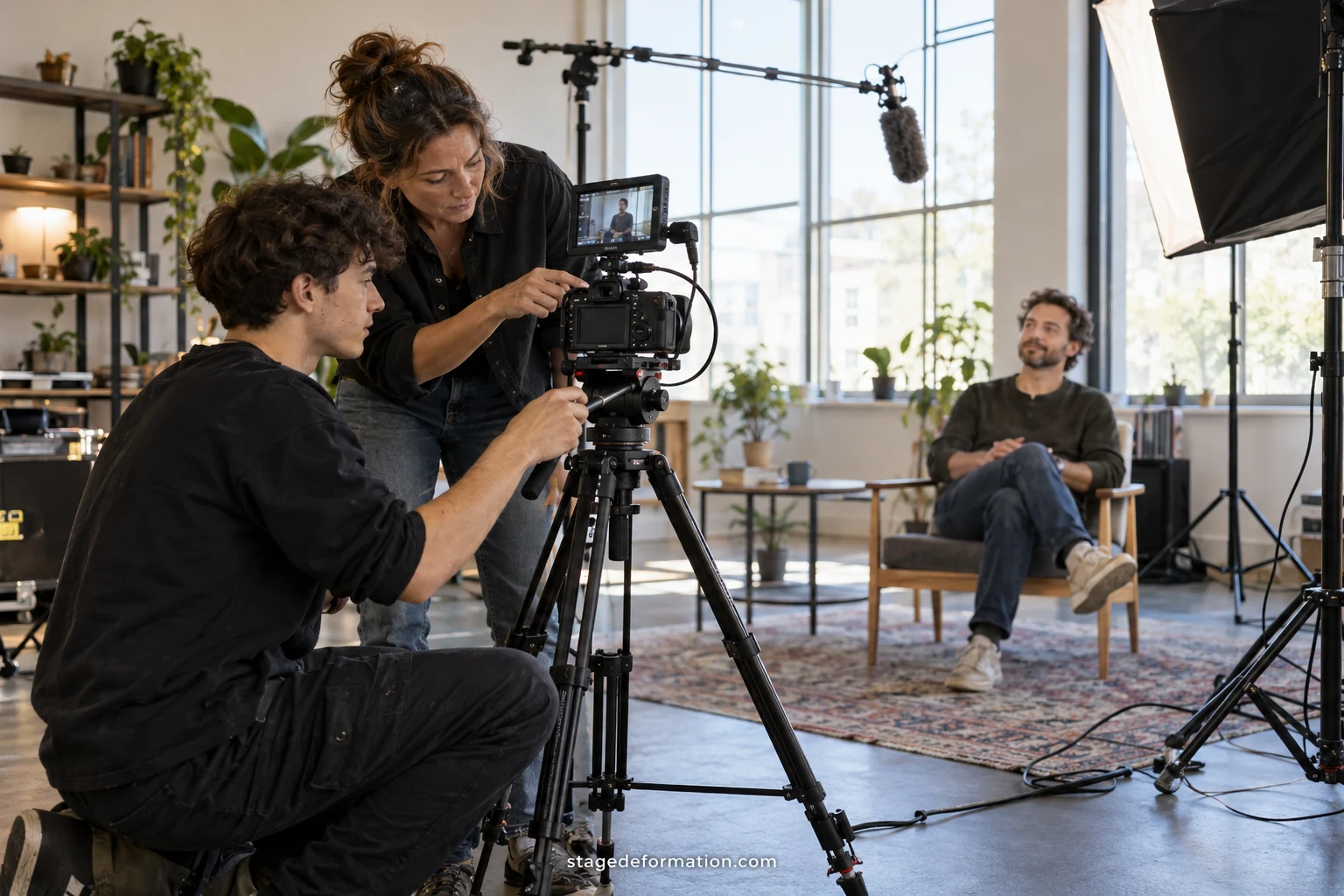
Photography or audiovisual: two worlds that overlap
Photography and audiovisual work are often put in the same drawer because they share light, framing and technical rigour. Yet an intern’s daily life is not the same. In photography the team is often small: a photographer, sometimes an assistant, a stylist or a retoucher. In audiovisual work, production mobilises highly specialised roles: direction, camera, sound, editing, production and logistics.
Before you start looking, ask yourself a simple question: do you want to learn to make an image on your own, or to be part of a chain in which everyone depends on the others? Both choices are legitimate. The second teaches coordination and set discipline; the first teaches autonomy, the relationship with the client and the management of the whole chain, from shooting to delivery.
The types of organisation that take on interns
The possibilities are wider than you might imagine. Each offers a different kind of learning:
- Studios and independent photographers: advertising, product, portrait and fashion work, with plenty of direct contact with the creator.
- Production companies: fiction, documentary, advertising and music videos, with shooting crews and a tight schedule.
- Agencies and corporate communications departments: corporate films, social media content and brand photography.
- TV channels, radio stations and online media: news, magazines, reports and on-screen graphics.
- Equipment rental companies and post-production labs: technical preparation, colour grading, backups and quality control.
An equipment rental company, for example, is an excellent school for learning to recognise a lens, a tripod or a cinema optic, which a film set does not always show.
What you are really given to do
A beginner intern is not placed behind the main camera on the first day, and that is normal. The most common tasks revolve around preparation and support: charging and checking batteries, setting up a stand, holding a reflector, scouting a location, putting away memory cards, noting the shots filmed and accompanying a guest on set.
These tasks seem modest, but they teach the essentials: anticipating, staying discreet and understanding why a setting changes with the light. In post-production, the internship may involve sorting rushes, syncing sound, preparing an edit, cutting out subjects or basic retouching. Ask at the interview how much time will be spent observing and how much on supervised practice.
Skills to show before you even arrive
No team expects an intern to master everything. They expect reliable basics and real curiosity. Three sets of skills weigh in the decision:
- Technical: exposure, depth of field, white balance, notions of framing, shot types and continuity, and basic sound recording.
- Software: a photo development program, an editing program and a few notions of colour grading or mixing.
- Professional behaviour: punctuality, listening, team spirit and the ability to work long days without losing precision.
A person who can name what they do not yet know, and who asks how to proceed, inspires more trust than one who improvises confidently with expensive equipment.
Building a portfolio that really works
The portfolio is your best application, provided it is selective. Ten to fifteen images, or two or three well-chosen short clips, are worth more than a long accumulation. For each piece of work, give the context, your exact role, the equipment used and what you would do differently. A production manager will read this note more attentively than the work itself, because it shows your lucidity.
Look after consistency too: a series on one theme, controlled settings and measured retouching. If you are aiming at audiovisual work, add a short film with its own sound, even a simple one: a professional ear quickly detects careless sound. Finally, do not put any image of a third party online without clear permission.
Image rights, permissions and copyright
This is the point that separates a reliable intern from a careless one. Anyone recognisable in a photo or video has a right to their image: their consent is needed, preferably in writing, stating the use and the duration. Locations, visible artworks, brands and music raise other rights questions.
In a professional organisation, these permissions are handled by production, but you must understand the logic. Before using an extract or an image in your portfolio, always ask whether distribution is permitted, and in what form. An answer such as “yes, but without the faces” is common and must be followed to the letter. Copyright in what you create during the internship also depends on what has been agreed; it is better to clarify this at the start.
Managing files: a skill that opens doors
In imaging, losing a file can ruin a day of shooting. Data management is therefore a highly valued skill, and it is quickly learned. Remember a few reflexes: copy memory cards onto at least two media before formatting them, check that the copy opens properly, name files according to a clear convention, and note what has been copied and by whom.
A rule often quoted in the imaging trades is to keep three copies on two different media, one of them off site. Some productions employ a specialist in data management on set; watching their work is a rare chance to learn a highly sought-after technical job.
Fictional example: a week in a small production company
Here is an illustration, with rounded and hypothetical figures. Léa, a second-year student, does an eight-week internship in a company that makes corporate films. In the first week she observes the preparation of a two-day shoot: equipment list, work schedule and location scouting.
During the shoot she is given charge of the cards and backups, and of note-taking on the shots. At the end of the week she sorts about three hundred clips and prepares a first pass through the rushes. The editor explains her choices. After eight weeks, Léa has a commented extract, a naming convention she knows how to apply and two contacts who agree to read over her applications. No salary comes with it by magic, but what she gains is concrete.
Internship framework, stipend and alternatives
In France, an internship that forms part of a course rests on a three-party agreement signed by the student, the school and the host organisation. Beyond a length set by regulations, a stipend is due; its minimum amount changes over time and should be checked with your school or official sources. Small imaging companies sometimes pay above the minimum, but do not promise it.
If an internship is hard to get, other routes exist: work-study, which combines an employment contract and training, schools that require periods in companies, or voluntary work at festivals and on short films. The important thing is to choose a setting where you are really supervised, not just available.
Frequently asked questions
Do I need to go to a specialist school to get an internship in imaging?
Not necessarily, but an internship almost always forms part of a course: a vocational diploma, a degree, a specialist school or a university programme. An organisation will accept you more easily if an agreement is possible. A serious portfolio and a clear motivation often weigh as much as the name of the institution.
What personal equipment do I need to own?
Generally, no expensive equipment. Organisations supply cameras, lighting and work computers. A good computer, durable drives and memory cards are useful, but do not buy anything before asking what is expected. Using unfamiliar equipment without instructions can in fact cause problems.
How do I contact a production company or a photographer?
Send a short, personalised message with a link to your portfolio and the possible dates of the internship. Show that you know their work by citing a specific production. Follow up once after about ten days. Generic applications sent to a whole list get few replies.
Is an internship in imaging always paid?
Not always. In France a stipend is compulsory for internships exceeding a length defined by regulations, with a minimum that changes over time; below that threshold it may not be due. Travel or meal costs may also be covered. Find out before you sign.
Can I use images from the internship in my portfolio?
Only with the host organisation’s consent, and often that of the people filmed or photographed. Ask in writing which images can be shown, with what limits and for how long. Many productions allow a short extract or a showreel, but not confidential content.
What are the most frequent mistakes during the internship?
Touching equipment without being invited to, formatting a card before checking it, arriving without having read the work schedule, or photographing behind the scenes without permission. Asking questions at the right moment, noting instructions and staying discreet on set remain the best reflexes.
Can the internship lead to a job?
It is possible, but nothing is guaranteed. In imaging, many teams recruit through networks and recommendations. A successful internship gives you contacts, a reputation for reliability and sometimes an offer of an assignment or work-study. Keep in touch afterwards with a short thank-you message.