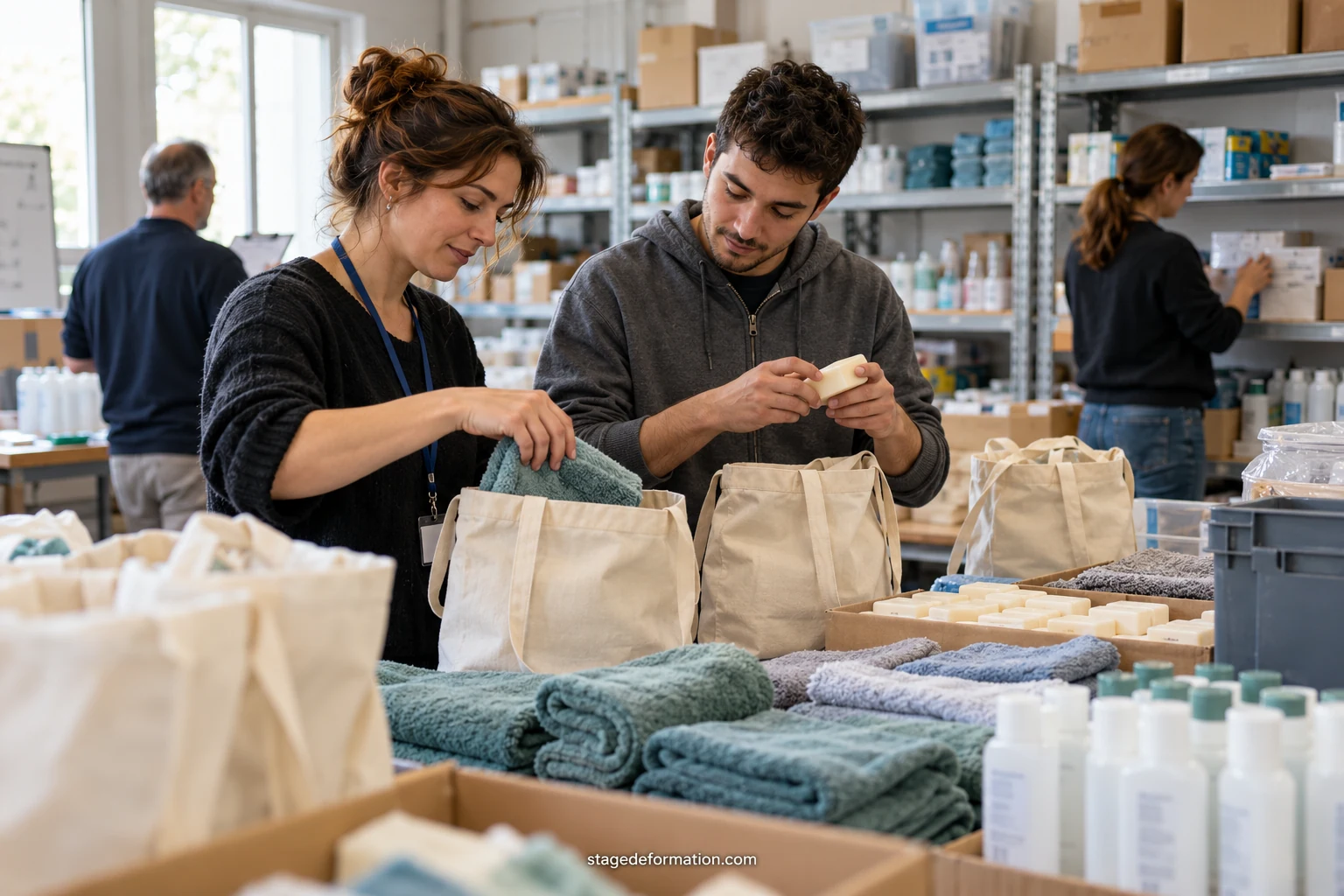
A sector much wider than the humanitarian field
When people mention humanitarian work, they often picture a posting to a crisis zone. The reality of the sector is broader and more administrative. A solidarity organisation employs specialists in logistics, finance, fundraising, communication, legal affairs, human resources, monitoring and evaluation, and advocacy. Many of these posts are at head office, in France.
Local charities, for their part, work in food aid, housing, homework support, health, social inclusion, culture or sport. These are smaller organisations in which an intern touches many functions. To find your direction, you therefore need to tell apart international solidarity, local social action and associational life in the broad sense.
Internship, volunteering, voluntary service, civic service: do not mix them up
These frameworks are different and carry different rights. An internship is attached to a course of study, governed by an agreement with an educational institution, and provides for a stipend beyond a length of time set by the regulations. Volunteering is a free, unpaid commitment, with no relationship of subordination, outside any school framework.
The civic service (service civique) is a voluntary commitment by young people, with an allowance, for a limited period, on missions of general interest. International solidarity volunteering is for people who leave for a mission abroad with an approved association, under a specific status. Before accepting an offer, ask clearly which of these frameworks applies: social protection, allowances, insurance and obligations all depend on it.
The most common internship tasks
- Fundraising and partnerships: following up donors, preparing grant applications, online campaigns.
- Logistics and purchasing: tracking stock, preparing shipments, simple calls for tender.
- Programme monitoring: indicator tables, reports to funders, preparation of field missions.
- Communication and advocacy: writing content, monitoring the news, organising events, dealing with the media.
- Running associational life: welcoming and coordinating volunteers, organising drop-in sessions.
- Administration and finance: data entry, reconciliations, preparing accounts, supporting documents for grants.
These tasks are valuable: they show how a project is funded, monitored and reported on, which conditions all later work in the field.
The field: on what conditions?
Going abroad on an internship is neither automatic nor always advisable. Serious organisations require experience and preparation before sending anyone into a difficult setting, and few accept an inexperienced student in risky places. Some training courses in humanitarian logistics do, however, include placements in developing countries, with local associations or NGOs, with support.
If a trip is on the cards, check the supervisor on site, security preparation, repatriation and health insurance, accommodation, which costs are covered, and the visa rules. Steer clear of offers that ask you to pay to “take part” in a project without clear supervision: enthusiasm is no substitute for safety or for your presence being truly useful.
Finding an organisation and applying
Begin with the platforms and networks of organisations, then move on to the organisations’ own websites, which often publish their internships with an application calendar. The large organisations receive a great many applications: a precise, well-argued request sets you apart.
- Choose a cause and a public that really matter to you.
- Identify five to ten organisations of different sizes.
- Describe in one sentence what you can contribute (data processing, writing, languages, event organisation).
- Propose a realistic format: length, availability, possibly remote work.
A motivation based on solidarity becomes convincing when it comes with an understanding of the concrete work involved: spreadsheets, reports, reminders, coordination.
Ethics and respect for the people supported
Working with people in difficulty requires rules. Respect for dignity, confidentiality of people’s situations, consent for any photograph or testimony, and caution on social media are essential. An intern does not publish photographs of beneficiaries, especially children, without agreement and a clear framework.
You must also avoid the “saviour” attitude. Solidarity organisations stress the role of local actors, listening to the needs people express, and accountability to funders. A useful intern learns, prepares, supports, and admits what they do not know.
Example of a head-office internship, for illustration
A master’s student in project management spends four months with a medium-sized NGO, in the programmes department. He updates a tracking table covering ten projects in several countries, collects reports from local partners and flags delays to his manager. He also prepares a summary for a donor.
After two months he is asked to organise a lessons-learned workshop with about fifteen colleagues. He finds that the quality of a mission depends first of all on reliable data and clear roles. The figures in this example are fictional and given only to fix ideas.
Preparing your internship and making the most of it afterwards
Before you start, read the organisation’s activity reports, its values and its projects. Ask for a document setting out the tasks, the supervisor, the working pattern and the practical conditions. During the internship, keep a log of the tasks you carry out and the skills you use.
Afterwards, turn the experience into concrete achievements on your CV: tracking indicators, writing grant files, coordinating volunteers. This precision helps with applications to charities and to companies alike, where project management and adaptability are valued. If the sector appeals to you, consider specialist training, a civic service or a first contract next.
Frequently asked questions
Is a humanitarian internship always abroad?
No. A large share of the posts in a solidarity organisation are at head office or in local branches in France: fundraising, communication, finance, programme monitoring. Field postings exist but generally require experience, preparation and solid supervision.
Can you be paid for an internship with a charity?
A stipend is due when the internship lasts longer than the threshold set by the regulations, whose minimum changes over time. Some small charities have limited means, but that does not exempt them from the law. Ask for the amount and the costs covered before signing the agreement.
What is the difference between a volunteer and an intern?
The intern is attached to a course of study and signs a three-party agreement, with a supervisor and educational objectives. The volunteer commits freely, unpaid and outside any school framework. Both can coexist in a charity, but they do not have the same rights or obligations.
Do I need a specialist qualification to work for an NGO?
Not necessarily. Organisations recruit varied profiles: management, law, logistics, languages, health, communication. A specialist course can ease access to some operational posts, but experience in a charity or a project is often decisive, especially for field roles.
How can I avoid dubious “voluntourism” offers?
Be wary of offers that charge a high fee to take part, promise instant experience without asking for any skills, or stay vague about the local organisation and the beneficiaries. Check that the organisation exists, its references, its supervision and whether your mission is truly useful to the people concerned.
When should I apply for an internship at a large NGO?
Several months before your desired start date, because large organisations receive many applications and plan their placements well ahead. Watch their application calendars and send a targeted request rather than a general application. A polite follow-up after a few weeks is acceptable.