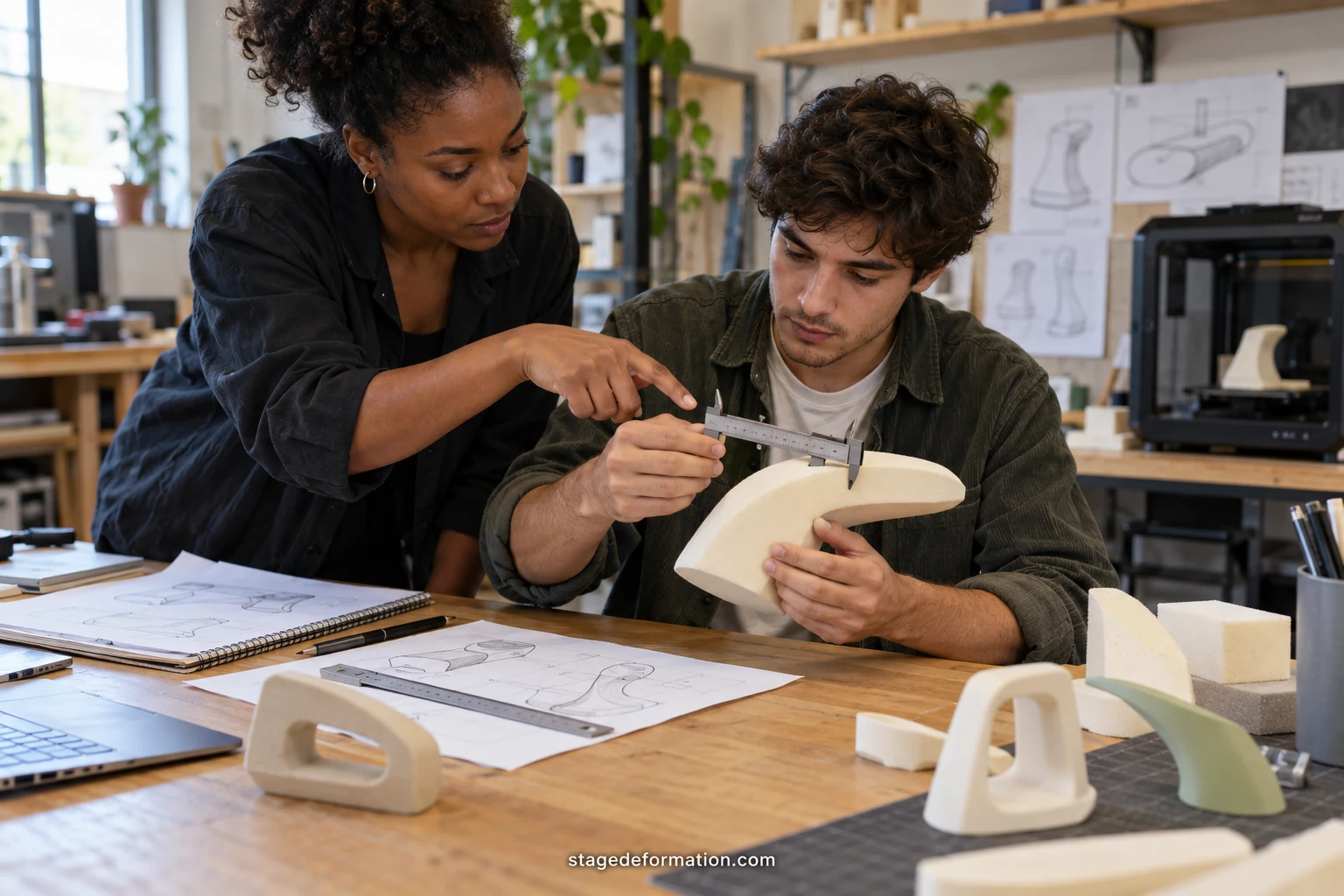
What a product designer actually does
The product designer creates everyday or professional objects: furniture, household appliances, tools, toys, sports equipment, medical devices, packaging. The starting point is not an attractive shape but a need: how the object is gripped, understood, maintained, carried, repaired or thrown away. The designer holds together three requirements that often pull in opposite directions: use, technical feasibility and the identity of the brand.
They work with engineers, production managers, marketing teams and sometimes the users themselves. An internship lets you see how these viewpoints meet in a project and understand why a successful object is the result of accepted compromises, not of one brilliant isolated idea.
Where to do a product design internship
Several types of organisation take on interns, each with its own pace and its own lessons.
- Design agencies: varied projects for different clients, with strong exposure to presenting and negotiating with the client.
- In-house studios in industrial companies: following a product across several cycles, with direct contact with production.
- Engineering offices and manufacturers: a more technical role, with detailed design, tolerances and assembly.
- Furniture publishers and object brands: collections, materials, and relations with workshops and craftspeople.
- Laboratories, fab labs and school workshops: experimentation, rapid prototyping and design research projects.
Depending on the organisation, you will deal more with user research, drawing or manufacturing. Ask what share of each activity you will have during the internship.
Tasks an intern may be given
- desk research and benchmarking: existing products, materials, public patents and trends in use;
- observation and interviews with users, with a summary of the difficulties they encounter;
- sketches, idea boards and 3D modelling of several options;
- making mock-ups and prototypes in foam, cardboard, wood, 3D printing or other techniques;
- preparing client presentations, with renderings and a justification of the choices;
- talking to the engineering office or suppliers to check what can be made;
- writing sheets describing materials, dimensions and finishes.
An intern is rarely responsible for a complete product, but can carry one stage: exploration, volumes, the detail of a mechanism or the study of one particular use.
The prototype: a tool for learning, not a final version
Many students imagine the prototype as an almost perfect copy of the future product. In practice, several are made, at very different levels of finish, each answering a precise question: does this handle sit well in the hand, does this volume fit in a bag, do these two parts fit together without a tool?
A quick mock-up in cardboard or foam is often enough to decide. The functional prototype, which is more expensive, comes in when the hypothesis to be checked justifies it. In your portfolio as in an interview, explain the question asked, the test carried out, the result and the decision taken. This reasoning matters more than the visual quality of the model.
Pay attention to workshop rules: which machines are allowed, what protective equipment is needed and which materials need careful handling. An intern uses a tool only after training and with the supervisor’s consent.
Courses that lead to these internships
The pathways are diverse: the French DN MADE in object design, five-year design schools, industrial design courses, engineering schools with a design option and applied arts programmes. Each institution has its own character, more oriented towards innovation, craft, industry or research.
As an example, a public school such as ENSCI-Les Ateliers offers a diploma for industrial designers and states on its website how organisations looking for an intern can get in touch. L’école de design Nantes Atlantique, for its part, presents a product design major in its post-secondary programme. Compare the programmes, the place given to projects with partners, the periods spent in companies, the internship calendar and the workshop equipment available.
A designer’s portfolio: show the problem before the form
Recruiters read a product design portfolio looking for a method. For each project, start from the problem studied rather than from the final rendering.
- The context: who is the object for, and in what conditions is it used?
- The exploration: sketches, discarded ideas, references and first tests.
- The tests: mock-ups, user feedback and the changes decided.
- The solution: volumes, materials, assembly, dimensions and realistic renderings.
- Your role: state what you did alone or as part of a team.
Also show a few photos of real models, taken in good light. They prove that you can make things and not only draw them.
Finding an internship and preparing for the interview
Schools often have networks of former students and partner companies. Add to these the careers pages of manufacturers, design agency websites, trade fairs and exhibitions. An unsolicited application to a studio whose work you know is more convincing than a mass mailing.
In an interview, expect to be asked to comment on an everyday object: what is it for, what works, what would you improve and under what manufacturing constraints? Prepare two or three examples. Be ready as well to talk about how you work in a team, how you take criticism and how you handle a short deadline.
The internship is governed by an agreement with your school. In France, beyond two months a stipend is compulsory; its minimum is set by regulations that change over time, so check it for the period concerned.
Illustration: a handle design for a garden tool
Fictional example, with rounded figures. In a small studio, Malik, an intern, works on the handle of a pair of secateurs intended for amateur gardeners who complain of hand pain. In the first week he observes five people using the tool and notes their movements and the moments of discomfort.
In the second week he draws about ten profiles, then makes three of them in dense foam, in different sizes. He has them tested by his colleagues and by two outside users. The third profile suits best, but the engineering office points out a moulding difficulty at one curve. Malik then proposes a slightly simplified variant. His final presentation retraces these stages: problem, tests, adjustment, decision.
Common mistakes and ways to improve
- Starting from the form. An attractive but unusable object does not impress a recruiter.
- Ignoring manufacturing. Talk to the engineering office or the supplier as early as possible.
- Hiding failures. An abandoned idea that you explain shows your capacity for analysis.
- Neglecting workshop safety. Follow the instructions and ask before using a machine.
- Forgetting sustainability. Materials, repairability and end of life are among the questions companies raise.
- Not documenting. Photograph every stage, with the organisation’s consent.
Hold regular reviews with your supervisor: they help you choose what deserves to be explored in depth and what is worth leaving aside.
Frequently asked questions
Do I need to be able to draw by hand to become a product designer?
Sketching remains a very useful tool for thinking, for exploring quickly and for communicating an idea, but it does not have to be perfect. Teams above all expect you to express an intention clearly, freehand or through modelling, and to justify the choices you make.
What is the difference between product design and industrial design?
The two terms overlap to a large extent. Industrial design stresses the design of objects meant for mass production, while product design can also mean small runs, furniture or more craft-based objects. Schools and companies use both, depending on their history.
Can I do a product design internship without knowing 3D?
Some organisations accept a beginner level, especially in the exploration phase. But 3D modelling, or at least the ability to make mock-ups, is very often expected. It is better to be honest about your level and to show what you can already do.
Can I use my internship projects in my portfolio?
Only with the host organisation’s consent. A product that is not yet on the market remains confidential, and some elements belong to the company or the client. Agree with your supervisor on what can be shown, when and in what form.
Is work-study available in product design?
Yes, in some schools and for certain levels of study. It gives you an employment contract and longer experience in the same organisation, but the offer varies between institutions and from year to year. Ask your school about the calendar and its partner companies.
What materials does an intern handle in the workshop?
Depending on the organisation: cardboard, foam, wood, plastics, light metals, resins or 3D printing filaments. Access to machines depends on the workshop rules and on prior training. Your supervisor will tell you what is allowed and which protective equipment is compulsory.