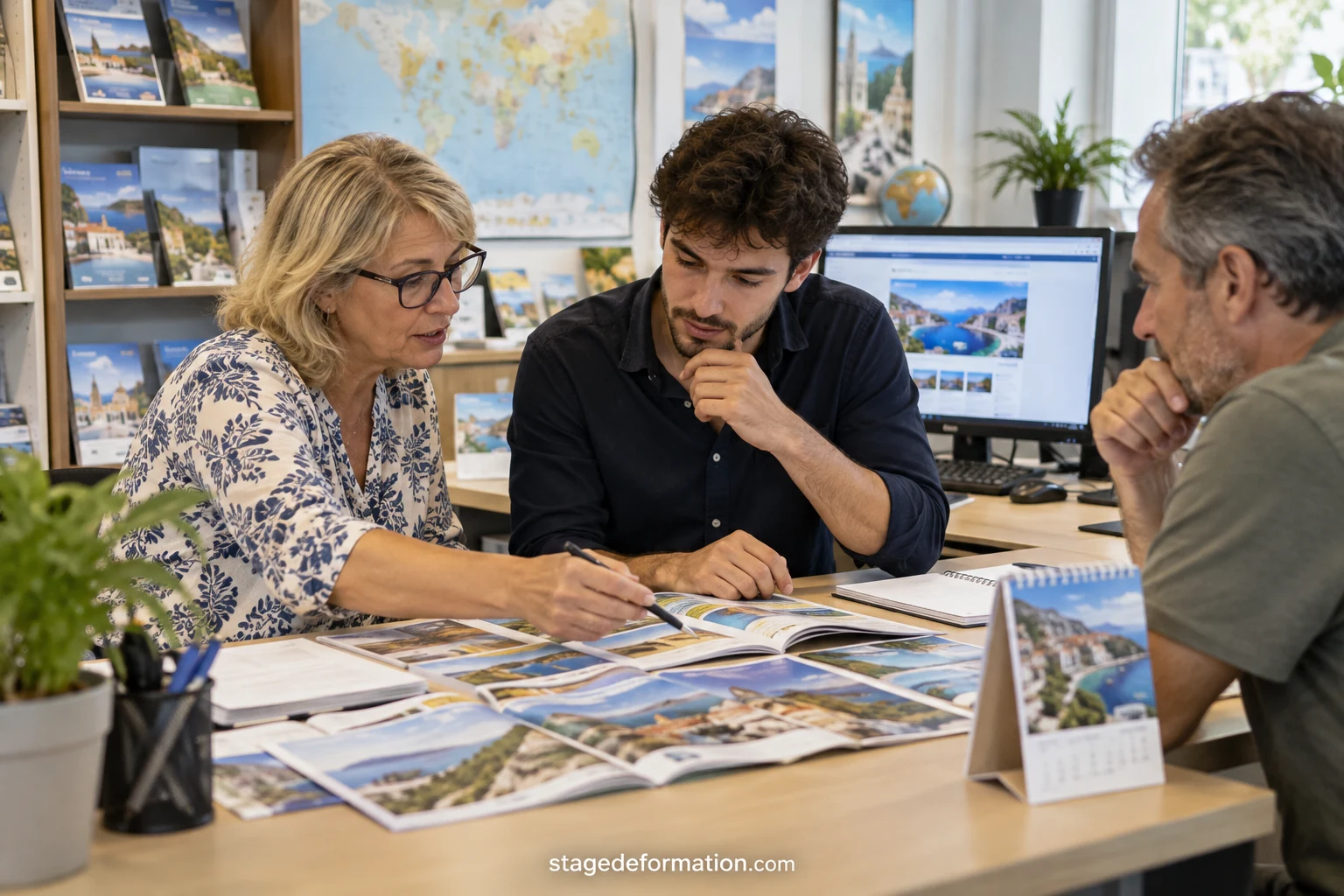
What the travel sector really covers
The word “tourism” groups together very different activities. The high-street travel agency sells holidays and tickets to individuals. The tour operator designs packages, negotiates with hoteliers and carriers, then resells them. Tourist offices inform visitors about an area, while incoming agencies organise the reception of groups from abroad. Business travel, finally, manages professional trips within budget limits and a company travel policy.
Before looking for an internship, ask yourself which world attracts you: advice at the counter, production, distance selling, reception, or promoting a destination. Each calls for different qualities: listening and selling for advice, rigour and negotiation for production, people skills and languages for reception.
Possible tasks for an intern
An intern does not commit the agency alone, but can contribute to many useful tasks. Depending on the organisation, you might be given, for example:
- researching and comparing flights, accommodation and transfers for a client’s project;
- preparing quotes and travel booklets, checked by a consultant;
- answering the telephone and welcoming people in the shop, rephrasing the request precisely;
- updating destination sheets and supplier contact databases;
- running social media or a newsletter, where the agency has one;
- following up files after the sale: changes, reminders about documents, traveller feedback.
What matters is to define these tasks in the agreement or with the tutor, so as to avoid an internship reduced to filing or answering the switchboard.
From a vague wish to a precise request
A client rarely arrives with a specification. They say “something relaxing for the family” or “a long weekend that is not too expensive”. The job is to turn this intention into criteria: dates, length, overall budget, number and ages of travellers, mobility, interests, comfort level and tolerance for long connections.
Expectations are sometimes contradictory: an exotic holiday in high season on a small budget, for example. The consultant does not impose their own taste; they explain the trade-offs and suggest two or three reasoned options. During your internship, practise asking open questions, then rephrasing to confirm what you have understood before searching for anything.
Keep a template for a discovery sheet, even a simple one. It will stop you forgetting a point the client considers obvious, such as a dietary requirement or a very young child.
Checking a proposal line by line
An attractive proposal can hide a costly error. A thirty-five-minute connection between two terminals, a late arrival at a hotel whose reception closes, a local tax to be paid on the spot or baggage that is not included can turn a tempting quote into an unpleasant surprise.
Work in order: departure times and days, real journey times, services included and excluded, conditions for changes and cancellation, insurance offered, formalities. For the latter, rely neither on memory nor on an old file: passport requirements, electronic travel authorisations and health conditions can change, and the check must be made at the date of travel with the appropriate official sources.
A useful habit is to reread the quote as if you were the client, with their naive questions: “Where do we sleep the first night? Who comes to collect us?”
Professional framework and the agency’s obligations
A professional selling trips and holidays is subject to consumer-protection rules. In France, travel agencies and operators are in principle registered in a register kept by the public tourism promotion body, and must show guarantees, notably financial cover and professional liability insurance. The tourist package is subject to a precise information regime: the client must receive clear details before committing. Other countries have their own rules, so check the framework that applies where you will work.
The intern does not need to know every text, but must understand why wording matters. Advice given imprecisely can make the agency liable. That is why internal checks exist: an experienced consultant reads your proposals before they go out.
If your tutor introduces you to these rules, take notes; they are part of the job and will be valued at an interview.
Courses and internships according to your level
Several pathways lead into the sector. In France these include the BTS in tourism, certain BUT degrees oriented towards sales, professional degrees and masters dedicated to tourism management. Specialist schools also prepare for travel professions, including through work-study. Languages, geography, sales and customer-relationship management make up the common core.
Internships depend on the course: an observation placement early in training, an advisory placement in an agency during a BTS, a production or marketing placement in a degree or master. Lengths are set by each qualification; any stipend follows the regulations in force and depends on the time spent in the company.
Work-study appeals more and more to agency networks, which recruit their future consultants this way. It brings experience and a salary, but it demands that you know where you want to go from the first year.
Looking for your internship: where and how
First draw up a list of targets: independent agencies, franchise networks, tour operators, transport companies, tourist offices, hotels, leisure parks and online platforms. Favour those that match your plans and your geographical area.
Apply with a CV centred on languages, trips you have genuinely prepared, customer-contact experience and the digital tools you master. In the letter, mention a destination or a product from the agency and explain what you could bring. On the phone, keep it brief; in a shop, turn up at a quiet time.
Bear seasonality in mind: agencies are very busy at the start of the year, when summer bookings are made, and teams then have less time to train anyone. An off-peak internship, calmer, sometimes offers better supervision.
A simulated example of a file to build
By way of illustration, imagine a couple and an eight-year-old child who want to go away for five nights in spring with an overall budget of 2,000 euros, without a car. The intern begins by checking the dates and constraints, then prepares two options: a city reachable by direct train from their region, and a nearby seaside break with an arranged transfer.
For each option, the intern compares the total cost rather than the advertised price, adds local travel, likely meals and conditions for changes, then writes a summary table in a neat document, not forgetting the points to watch. The consultant reads it, adjusts a time, and the client chooses. The figures are fictional, but the method is that of a reliable file.
Common mistakes and good habits
Among the classic pitfalls: promising the client availability that is not confirmed, copying a sales description without checking it, forgetting to say what is not included, or answering a complaint with irritation. Another trap is favouring the destination you know over what the client is asking for.
The good habits are simpler. Write down what you check, give the date of the last update of a piece of information, ask for validation before anything is sent and keep a record of exchanges. After the internship, ask for feedback on your strengths and on what to improve, then build it into your next CV.
Frequently asked questions
Do I need to speak several languages for an agency internship?
It is not always compulsory, but English is very useful and a second language is an asset, especially for welcoming foreign clients or for production work. State your real level on your CV and be ready to show it in an interview or a short exchange.
Can an intern sell trips?
It depends on the agency. Often the intern prepares, compares and suggests, while a consultant validates and closes the sale. Some organisations give more independence after a few weeks. Tasks should be agreed with the tutor, particularly because of the agency’s liability towards the client.
Where can I do an internship if I do not like selling?
The sector offers other options: producing holidays, managing hotel contracts, communication, welcoming visitors in a tourist office, cultural mediation, event organisation or analysing visitor data. Talk to your tutor to discover these roles, which are less visible from the shop floor.
Is the internship paid?
In France, beyond a certain length of time in the same company, regulations provide for a stipend whose amount changes: check the rule that applies at the date of your agreement. Very short observation placements are generally not paid.
How can I stand out without experience?
Show that you can find reliable information and present it neatly. For example, prepare an itinerary for your family or a group of friends, with timetables, budget and alternatives. This personal work proves your eye for detail better than a list of qualities on a CV.
What are the prospects after a successful internship?
An internship can lead to a work-study place, a consultant’s contract or a move towards production, events or business travel. It also helps confirm or rule out a plan. A job offer is never guaranteed, but a good relationship with your tutor opens doors.