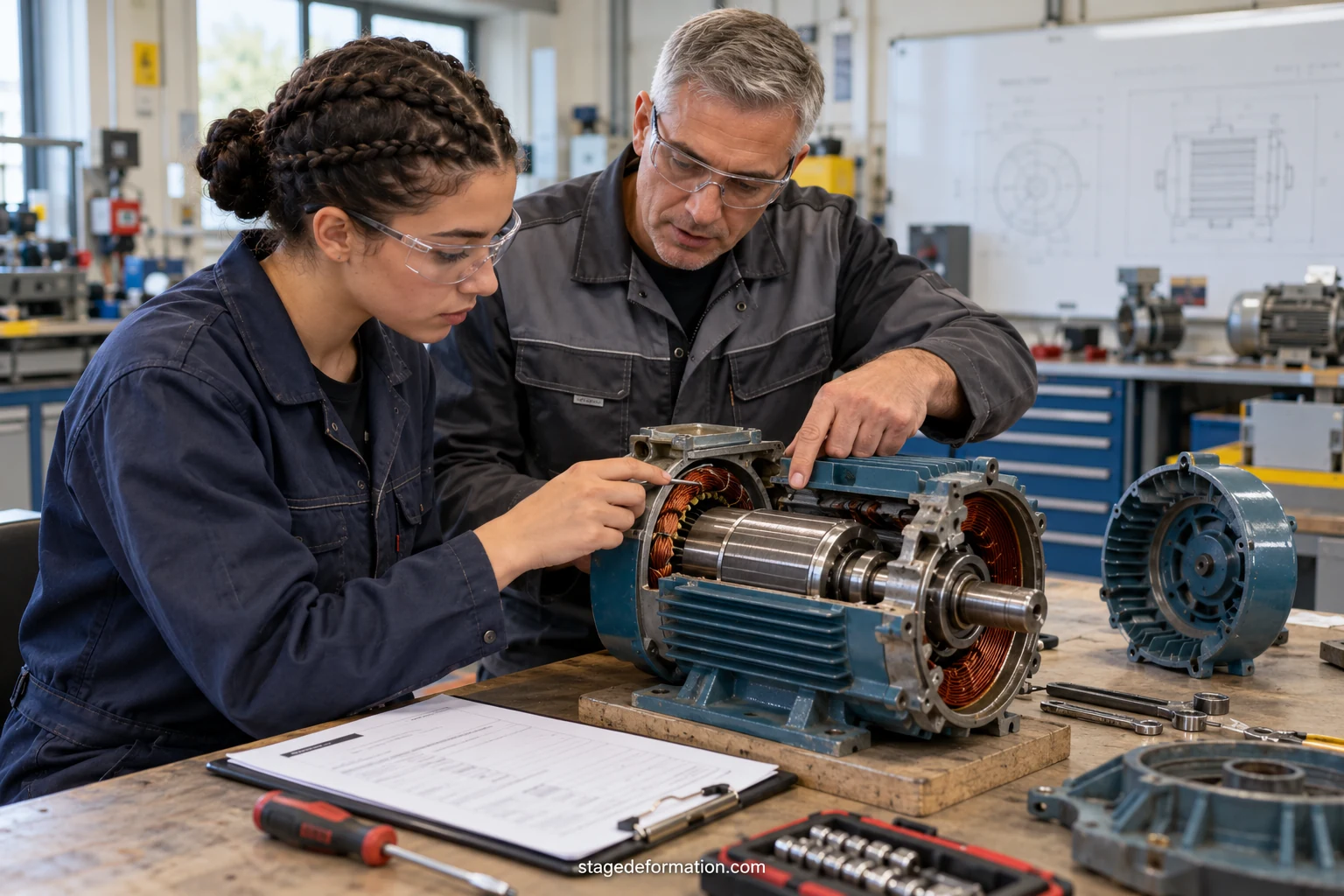
What the PFMP means in a vocational baccalaureate
In the French vocational route with school status, internships have an official name: périodes de formation en milieu professionnel, or PFMP. They are part of the qualification’s curriculum, just like lessons and workshops at school. The vocational baccalaureate lasts three years, and workplace periods add up to 22 weeks in total, according to the information published when the vocational route was reformed.
A PFMP is not just a time for discovery. Its purpose is to apply the skills listed in the qualification framework under real conditions: genuine machines, customers, deadlines, safety constraints. The school prepares it, follows it and assesses it, and the host business contributes by welcoming the student and through its supervisor’s opinion.
During these periods the student remains a school pupil. They are not an employee, have no employment contract and stay covered by the protection rules that apply to students in training.
Spreading the periods across the three years
The precise spread of weeks is set by each school, within the national framework. The general idea is to take on responsibility step by step:
- In the first year (seconde), the student discovers the environment, observes the movements and takes part in simple tasks under supervision.
- In the second year (première), they take charge of more complete activities and use the technical vocabulary of the specialism.
- In the final year (terminale), they work more independently, sometimes on assignments that foreshadow a real job.
It is helpful to vary the businesses from one year to the next: a small craft firm followed by a larger company lets you compare how organisations work. Some schools require this variety, others merely recommend it.
Final year: entering work or continuing studies
Since the reform, students in the final year of a vocational baccalaureate choose between two pathways at the end of the previous year. Those who want to work as soon as they have the baccalaureate see their workplace periods extended by about half. Those aiming for a BTS or another course follow, instead, a preparation module of about four weeks, with reinforced lessons in general and vocational subjects.
This choice is made with the teaching team, in light of the student’s file and plans. A student who is undecided can use their periods in the second year to test business life: if the atmosphere, the pace and the tasks appeal, the work-entry option becomes more natural. If, on the other hand, they mostly enjoy understanding the reasons behind techniques, further study is often a better fit.
Validating the agreement and the assignments before you start
Before each period, the business, the school and the student (or a legal guardian if they are under 18) sign an agreement. It states the dates, the hours, the planned activities, the names of the supervisor and the lead teacher, and the safety conditions.
Have the assignments read by a teacher of your specialism. A business can be excellent for one period and poorly suited to another: a garage that is useful in the second year for learning routine maintenance may offer too little diagnostic work for the final year. Put these questions to the host:
- What kinds of jobs or files will you give me?
- Who will be my day-to-day contact?
- What protective equipment is provided?
- How will the assessment opinion be given?
Allowance and pay: what changes depending on the route
Since the start of the 2023 school year, students in the vocational route are entitled to an allowance paid by the State for their workplace periods, provided they attend lessons and placements regularly. When the reform was introduced, the announced amounts were 50 euros per week in the first year, 75 euros in the second and 100 euros in the final year. They may change, so confirm them with the school.
An apprentice is in a different situation: they sign an employment contract, receive a wage set as a percentage of the minimum wage according to age and year of training, and spend far more time in the business. In return they have less classroom time and must find their own employer before or during the course.
Keeping useful evidence for assessment
The logbook or the documents requested by the school serve to prove what has been learned. Do not leave them until the end. After each day or each week, note three things: the aim of the task, the means used (tools, procedure, people consulted) and the result obtained.
Record your difficulties too, and what you took from them. A panel appreciates a candidate who can explain a mistake and correct it more than a student who presents only successes. If the business allows it, attach photos, diagrams or measurement readings, taking care to protect the data of the business and its customers.
If a lasting gap appears between the planned assignments and what you actually do, warn the lead teacher quickly: the school can step in before the period is wasted.
An illustrative example: a vocational baccalaureate in electrical trades
Take the case of Aïcha, a student on a vocational baccalaureate in electrical work. Suppose, for the sake of the example, that she does six weeks in the first year, six in the second and ten in the final year.
In the first year she accompanies a site team at a craftsman’s firm: locating conduits, fitting sockets, watching how distribution boards are handled. In the second year she joins a company that maintains office buildings and learns to carry out simple checks. In the final year, a local manufacturer gives her the wiring of a small cabinet under a technician’s supervision.
Every week she notes the task, the tool, the result and one point to improve. When the time comes to choose between work and a BTS, these notes give her concrete reference points.
Mistakes to avoid and alternatives
- Choosing the nearest business without checking that it works in the specialism.
- Starting without a signed agreement.
- Staying passive and simply watching for the whole period.
- Neglecting safety rules or protective equipment.
- Keeping a conflict with the supervisor to yourself instead of discussing it with the school.
For those who prefer a longer immersion, an apprenticeship remains a serious alternative for the same qualification, especially in sectors where employers train their future staff directly, such as industry, construction or the motor trade. Training centres run by the professional branches help you spot businesses ready to take on apprentices.
Frequently asked questions
How many weeks of PFMP are required in a vocational baccalaureate?
According to the information published at the time of the reform, workplace periods amount to 22 weeks over the three years of the vocational baccalaureate, with an extension in the final year for students who choose work entry. The exact spread depends on the school and the specialism.
Who finds the host business, the school or the student?
It varies from school to school. In many schools the student searches on their own, with help from teachers, who then approve the placement. Some schools have regular partners. In every case, the school’s agreement is essential before anything is signed.
Is the PFMP paid?
Since 2023, students in the vocational route receive an allowance paid by the State for their workplace periods, subject to regular attendance. It varies with the year of training and may change. This allowance is not a wage, unlike an apprentice’s pay.
Can you do several periods in the same business?
Yes, if it lets you work on different skills each time and the school agrees. Going back to the same employer can build trust and open up hiring prospects, but changing places helps you discover several ways of working.
What should I do if I have not found a business by the planned date?
Tell the lead teacher or the head of workshops very quickly. The school often knows partner businesses and can suggest a replacement solution. The longer you wait, the fewer choices remain, especially in trades where places are limited.
What is the difference between a school-based and an apprenticeship vocational baccalaureate?
At school, the student keeps school status and alternates lessons with workplace periods. As an apprentice, they are an employee, sign a contract with an employer and split their time between the business and a training centre. The qualification is the same; only the organisation changes.