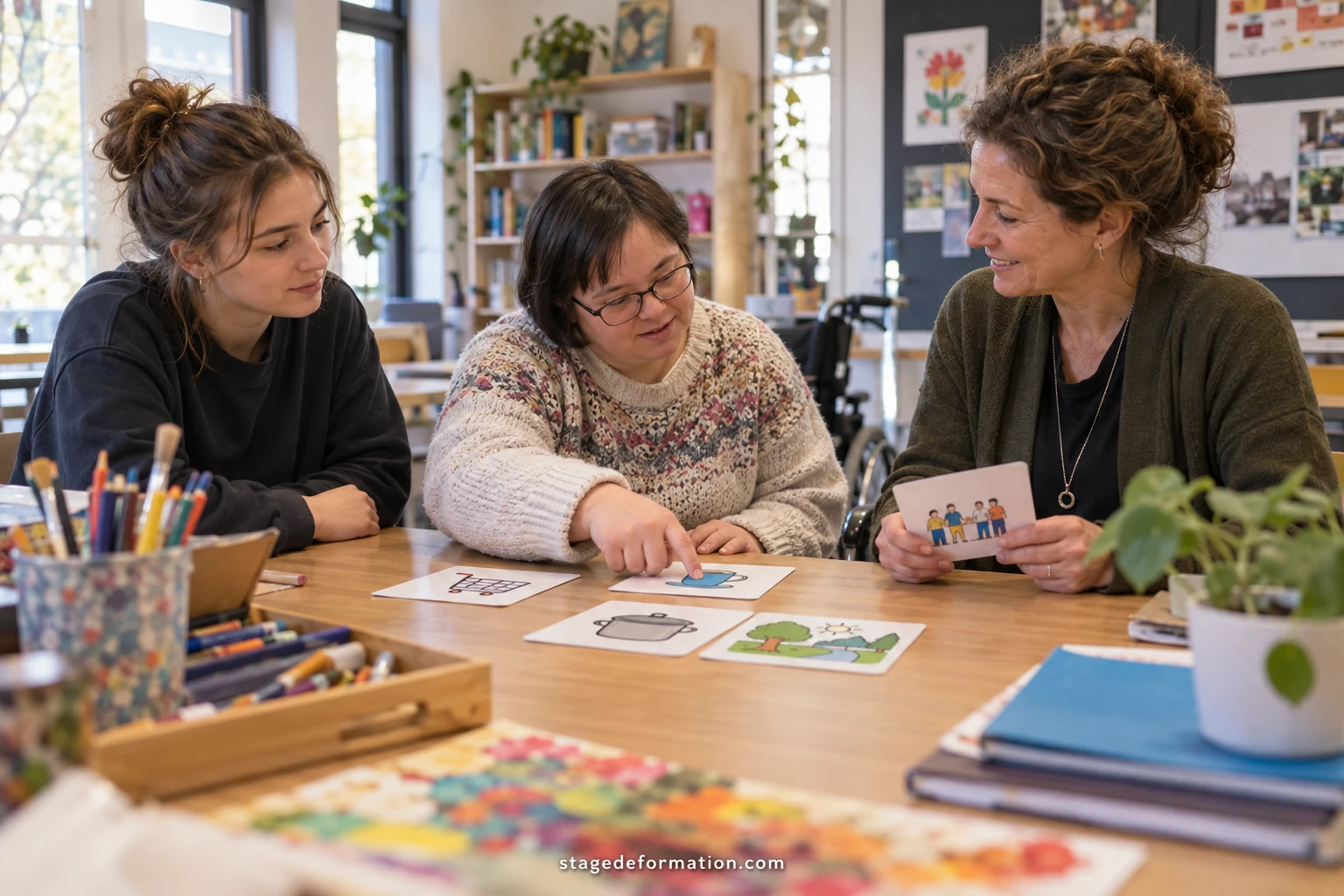
A field where you learn through relationships
Social work brings together professions that support people in difficulty or living with a disability: children placed in child protection, teenagers who have dropped out of school, adults with disabilities, dependent older people, families in precarious situations. Special education is a branch centred on developing independence and everyday life skills, with a plan tailored to each person.
Unlike other fields, learning does not come first through technical gestures but through the quality of the relationship, observation and the ability to work in a team. That is why internships play such a major role: they let you check whether the job fits your values and your personal balance, and they help you build a professional stance.
For a school pupil or an adult changing career, a first immersion placement is often the best way to find out whether this field suits you before committing to several years of training.
The qualifications that lead to an internship or work-study
Several levels exist side by side, and the choice depends on your profile and your plans. The names below are French qualifications.
- The state diploma for educational and social support workers (DEAES): level 3, with no previous qualification required, and a written and oral admission test. A full course lasts two years at most and alternates classes and placements; one training institute in the Paris region, for example, states 525 hours of classes and 840 hours of placement for a complete pathway.
- The state diploma for educational monitors: a level 4 course centred on day-to-day educational support.
- The state diploma for specialist educators: level 6, equivalent to a bachelor’s degree, prepared over three years in a regional institute of social work, with entry through Parcoursup from the baccalauréat.
- The BUT in social careers, which can lead towards special education with further study.
Bridges exist between these diplomas, with possible exemptions depending on your background. The training centre or institute sets out the exact conditions.
Internship or apprenticeship: two ways into the profession
In the first case, the student keeps trainee status for limited periods, under an agreement between the school and the host organisation. In the second, they sign an employment contract with an employer and alternate between training and work.
According to an OPCO Santé document on work-study in the social sector, in France the apprenticeship contract is aimed at young people aged 16 to 29, with possible exceptions beyond that, while the professionalisation contract targets in particular young people aged 16 to 25, jobseekers aged 26 and over and some recipients of social minimum benefits.
- An internship suits those who want to explore, discover several groups of people supported or complete a course without a long commitment.
- Work-study suits those who want a salary, a gradual integration into a team and continuous experience in the same setting.
A work-study trainee’s pay depends on age, contract and the applicable collective agreement: it is set by regulation and changes over time, so check with the training centre and the employer.
Where internships take place
Organisations are many, and the people they support shape what you learn.
Child protection
Children’s homes, residential units and day-care services: the educator supports young people with schooling, leisure, family ties and preparation for independence.
Disability
Medical-educational institutes, supported living homes, social-life support services and sheltered-work establishments: the aim is to support learning, communication, group living and inclusion.
Integration and inclusion
Shelters, charities helping homeless people, organisations supporting young people in difficulty, and work-integration schemes.
Other settings
Care homes for older people, community-based preventive youth work in neighbourhoods, community-based services for young people under court supervision, and cultural or sports associations with a social purpose.
Each place has its own organisational project, which you can ask to see. It explains the team’s values, organisation and methods.
Professional stance: the right distance
What most distinguishes an intern in the social field is their stance. It is built by observing, asking questions and accepting guidance.
- Respect the people you work with: address them by first name or surname according to the organisation’s custom, and respect their privacy, their pace and their choices.
- Keep the right distance: be warm without becoming a friend, do not confide your personal problems and do not exchange private contact details.
- Respect confidentiality: case files, life stories and court decisions are discussed only within the team, in a useful and controlled way.
- Use handovers: spoken and written, they let the whole team understand what has happened.
- Know when to ask for help in case of conflict, verbal aggression, too strong an attachment or a situation that overwhelms you.
Reflective practice sessions, where they exist, are valuable: you learn to analyse your own reactions without judging them.
Tasks you may be given and limits to respect
Tasks vary with the level of training and the organisation. An intern may accompany meals, outings, leisure activities, homework, journeys or appointments, in liaison with the key worker. They may also suggest an activity that fits the organisation’s project, once the supervisor has approved it.
Several acts are generally out of reach: taking an important educational decision alone, managing a resident’s personal money, administering medication, passing on information about a case outside the organisation, or staying alone with a group without the team’s agreement. In organisations that host minors, suitability checks may be requested before the placement begins.
A good sign of success is being able to explain why an activity was proposed, what it brings to the people involved and what could be adjusted. That counts for more than a full timetable.
Finding a placement: method and timing
Training institutes often guide their students and have networks of partner organisations, but personal efforts count.
- Find out the placement periods required and the training objectives for each year.
- Identify the charities and establishments in your area, including those that do not advertise vacancies, and look at their recruitment pages.
- Phone to ask for the name of the team or service manager, then send a short email with your CV, letter and dates.
- If possible, offer to visit or talk, to understand the organisation’s project.
- For work-study, contact the training centre to find out which employers are recruiting and what the application steps are.
Applications are often more numerous at the start of the academic year. Starting several months before the new term is wise, especially for work-study, where an employer has to be found before the contract can be signed.
A sample letter and interview, in context
Imagine an applicant for a two-month internship in a children’s home. In the letter, they explain why this group of young people interests them, mention experience at a summer camp or in homework support, and say what they want to learn: the place of the family, daily-life routines, coordination with the school.
In the interview, a common question is: “What would you do if a young person refuses to take part in an activity?” The expected answer is not a technique but an attitude: listen, try to understand the reason, ask the team for advice, and offer an alternative without forcing or humiliating anyone. Another question often concerns limits: what if a young person confides a serious secret? Here again, the point is not to promise to keep silent and to pass the information to the team following the organisation’s rules.
It is better to show your doubts honestly than to display a confidence that would ring false.
Common pitfalls and how to avoid them
- Wanting to “save” people instead of supporting their independence.
- Becoming so attached to a young person or a resident that you lose the necessary perspective.
- Promising something the organisation cannot deliver.
- Sharing anecdotes on social media, even without names.
- Staying silent when the behaviour of a professional or another intern raises questions, instead of talking to the key worker or the institute.
- Neglecting your own tiredness: irregular hours, tense situations and weekends take energy.
To protect yourself, prepare questions for each review, keep a personal internship diary and make use of reflective practice sessions. An internship in the social field is not only about learning gestures: it is also about learning about yourself.
Frequently asked questions
Do I need a qualification to do an internship in social work?
Not always. Discovery placements are open to school pupils or adults changing career, depending on the organisation. For a training internship, the student must be enrolled on a course that provides the agreement. Organisations hosting minors or vulnerable people may ask for additional checks before you arrive.
How much practical training does a specialist educator do?
The three-year course alternates classes at the institute with placement periods in several settings. The exact length of placements, how they are spread and the types of site targeted are set by the diploma framework and by each institute. Check the training handbook or contact the placements office directly.
Can I train through work-study to become an educator or support worker?
Yes, some social-sector courses are open to apprenticeship or professionalisation contracts, depending on the training centre. Signing a contract with an employer is essential. Ages, conditions and pay depend on the type of contract and the rules in force, so check with the centre and the employer.
Is an internship in the social field paid?
Beyond a legal length of placement, a gratification is in principle compulsory, but its minimum amount is set by regulation and changes over time. Situations vary by organisation and course. Read the agreement before signing and ask your school or university, which knows how it applies.
What should I do if a situation during my internship becomes too difficult?
Do not stay on your own. Speak quickly to your supervisor or key worker, then to your tutor at the institute. Discussion sessions exist to analyse difficult situations. Asking for support is a professional skill, not a sign of weakness, and it also protects the people you are supporting.
How can I tell whether this career suits me?
An observation placement or volunteering helps you test your reactions to dependence, strong emotions and teamwork. Also ask professionals about the hours, the constraints and the rewards. Interest in people and the ability to listen count for more than apparent ease.