Two families of trades that often go together
The plumber deals with water: supply, drainage, sanitary appliances, taps and mixers, hot water cylinders. The heating engineer or thermal installer deals with heat: boilers, radiators, underfloor heating, heat pumps, controls. In many companies, the same team covers both areas, which explains why the two words appear together in job adverts.
Customers expect new installations, renovation, maintenance and emergency repairs alike. The trade is therefore very varied: a single day can go from a bathroom to the plant room of a block of flats, then from a gas boiler to a heating system using renewable energy.
Work-experience placement, period in a company or apprenticeship
Depending on your situation, several frameworks are possible.
- A discovery placement, lasting a few days, to follow a professional and understand the variety of sites.
- Periods of training in a company built into a CAP or a vocational baccalaureate in France, with a named tutor and objectives set by the school.
- An apprenticeship contract, with employee status, alternating between the company and a training centre, and pay that depends on age and year of training under the rules applying in 2026.
Apprenticeship is often well received in this sector, because companies want to train staff in precise skills that are acquired through practice.
Qualifications according to your plans
In France, two CAP specialisations correspond to this field: the CAP installateur sanitaire for water and drainage, and the CAP installateur thermique for heating. The vocational baccalaureate in energy and climate installations trains you to fit and commission more complete systems, while a vocational baccalaureate in energy-system maintenance leans more towards servicing and repairs.
Professional titles for thermal and sanitary installers, offered by training centres, are aimed at adults retraining and young people who have left the school system. A BTS specialising in fluids, energy and environments then makes it possible to aim for roles as a technician, project manager or design office engineer.
Course titles can change from one year to the next: ask the training centre for the current list.
Reading a network before cutting a pipe
Before drilling or soldering, you need to understand the logic of the system: where the cold water comes from, where the meter is, which circuits distribute hot water, how waste water is drained away with a sufficient slope. In heating, you identify the heat source, the circulating pump, the valves, the expansion vessel and the emitters.
At the beginning, an intern spends time reading simple plans, taking measurements, identifying diameters and materials (copper, multilayer, PEX, PVC) and preparing the equipment for a job. This phase may seem slow; yet it avoids many fitting errors.
The skills you learn in the workshop and then on site
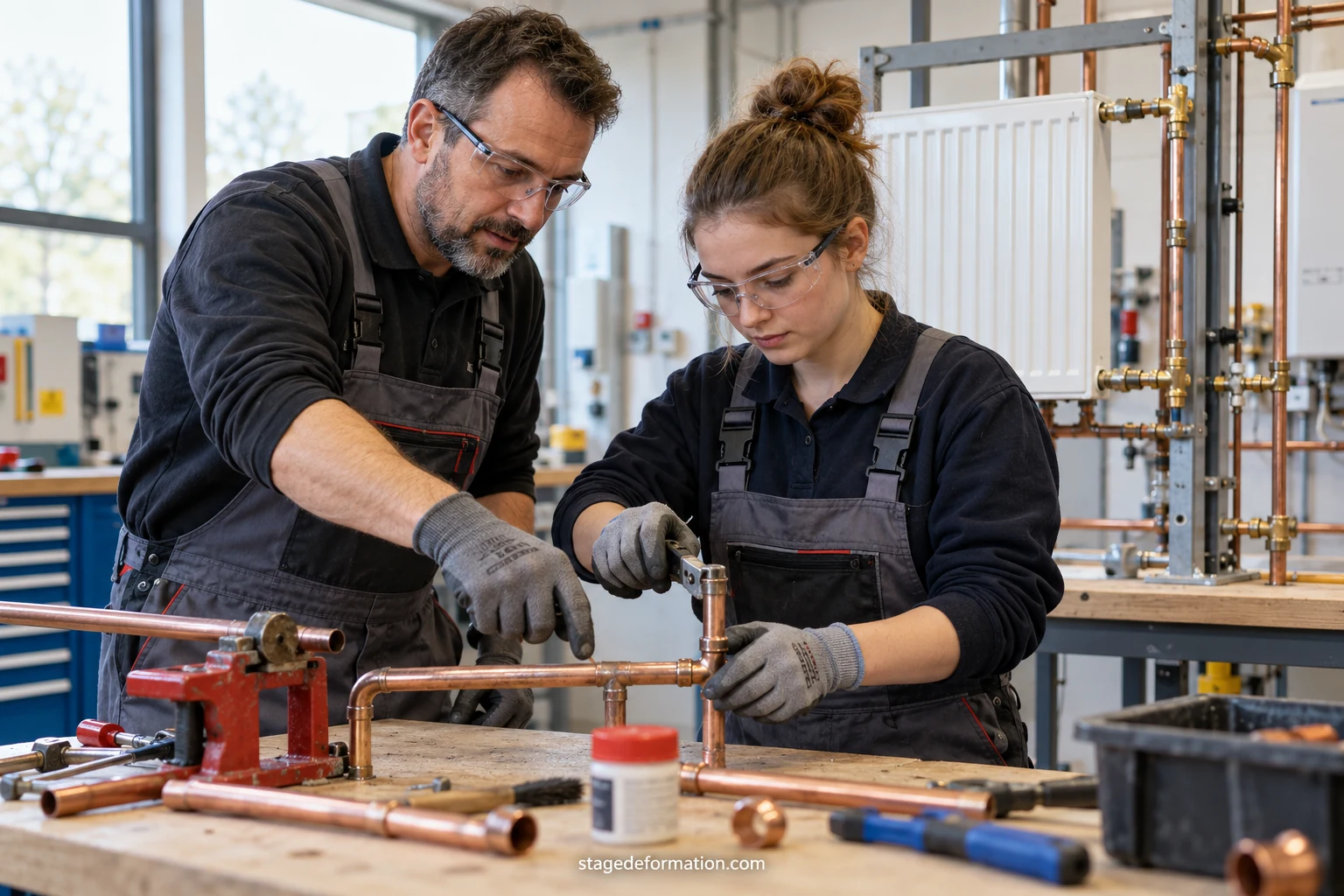
A training workshop lets you practise safely on test benches before moving on to a real installation. The basic skills include:
- cutting and bending a tube, deburring it and calibrating it;
- making a joint with a crimp fitting, compression fitting or brazing, depending on the material;
- fixing pipes with clips and respecting the falls;
- installing a washbasin, a WC or a shower;
- carrying out a pressure test and checking for leaks before the partitions are closed.
In a company, you are first given simple preparation and fitting tasks. Filling the system with water and commissioning the equipment remain the responsibility of an experienced professional.
Gas, high temperatures and other special frameworks
Some operations fall under a specific regulatory framework. Work on gas installations requires certified skills and particular procedures; it cannot be improvised, and an intern takes part only under the direct supervision of a qualified professional. Brazing uses a flame and calls for precautions against burns and fire. Heat pumps and air conditioners, which use refrigerant fluids, require a certificate of competence for handling them.
For minors, work subject to restrictions is possible only within a precise educational framework. Find out before the placement begins what is permitted, to avoid misunderstandings with the company.
Renovation, new build, emergency repairs: three working atmospheres
On a new-build site, everything is accessible, the ducts are planned and the work is organised in phases with the other trades. In renovation, you have to cope with old pipework, mixed materials and restricted access, sometimes in an occupied home. In emergency repairs, the plumber visits private customers for a leak, a boiler breakdown or a dripping tap: customer relations and the ability to diagnose quickly are decisive.
The energy transition adds a fourth dimension, with old boilers being replaced by more efficient systems, connections to heat networks or the installation of solar thermal panels. Companies carrying out energy renovation work often need specific qualifications, which may guide your choice.
Finding a company and introducing yourself
Start with the craftsmen in your area, the installation firms whose branded vans you see on sites, and the contacts of your training centre. A phone call made early in the morning, when the teams are getting ready, sometimes works better than a letter. Mention the qualification you are aiming for, your availability and a concrete reason: interest in ecology, a taste for repair work, DIY experience.
At the interview, show that you understand the service side of the job: you go into people's homes, you travel with equipment, you explain what you are doing. Punctuality, appearance and politeness weigh heavily in a hiring decision. If a driving licence or the ability to drive a van is an asset, mention it.
An illustrative example and mistakes to avoid
By way of illustration, imagine a young person in the second year of an apprenticeship with a bathroom renovation company. On a Monday, he helps remove an old washbasin and identifies the supply pipes. On Tuesday, he prepares the multilayer tubes and fittings for the new basin. On Wednesday, with his tutor, he carries out the pressure test before the wall is closed again. The durations are fictional, but the progression is typical: prepare, fit, check.
Common beginner mistakes are neglecting the leak test, overtightening a fitting, cutting without locating the right stop valve, or failing to protect the customer's floors. It is better to ask one question too many than to cause water damage.
Frequently asked questions
Do you need to like DIY to become a plumber and heating engineer?
An interest in technical and manual work helps, but is not essential at the start. What counts is curiosity, care and a desire to learn. Many apprentices discover the trade during their training. You do, however, have to accept working in tight, sometimes damp spaces and getting dirty.
Can an intern work on a gas installation?
In principle, no, except under the direct supervision of a qualified professional and within the planned training framework. Gas requires strict certification and procedures. An intern may observe, prepare equipment or help with peripheral tasks, but must not make connections or commission anything alone.
What is the point of preparing a CAP before a vocational baccalaureate?
The CAP lets you acquire the basic skills quickly, with the possibility of entering work at the end of the second year. It can then be followed by a vocational baccalaureate or a further specialist certificate to broaden your skills. Going straight to the vocational baccalaureate means a longer, more theoretical path that is open to supervisory roles.
Is emergency repair work reserved for experienced professionals?
Most often, yes, because it requires quickly diagnosing a fault without always knowing the installation. An apprentice can, however, accompany a technician on a round, watch the diagnostic method and take part in simple tasks. It is an excellent school for customer contact and for understanding common faults.
Can you do an internship in a large company rather than a craft business?
Yes, but large installation companies often take interns for specific periods and according to their needs. Tasks there are more specialised. A small firm generally offers more direct contact with the owner and a wider variety of tasks. Comparing the two is a good idea if your calendar allows it.
What happens at the end of an apprenticeship contract?
The contract ends on the planned date, after the exam. The company may offer a job, a new contract to prepare a higher qualification, or nothing at all. Plan ahead by talking with your tutor several months earlier, and use your training network to look for other companies if necessary.