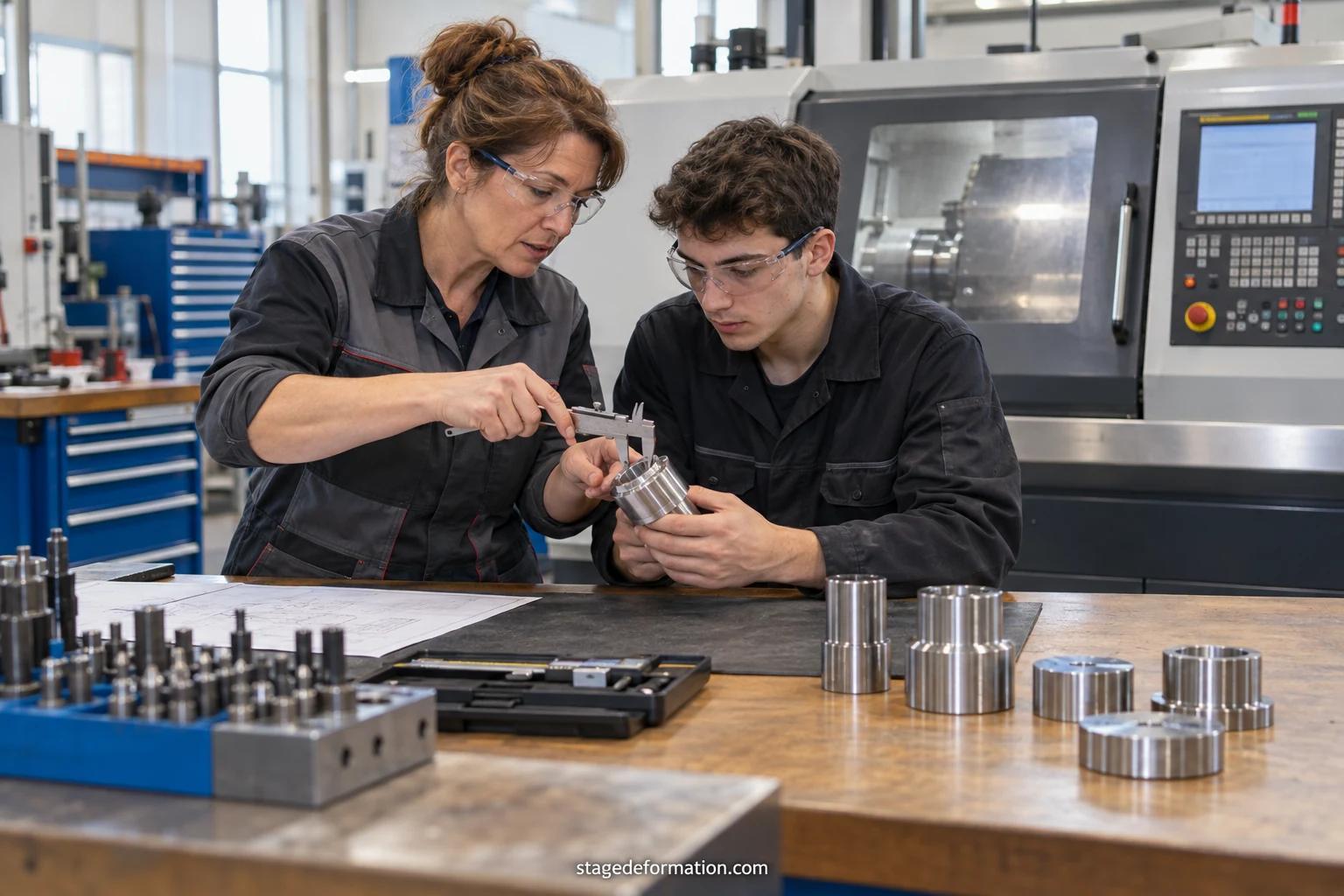
What the field covers: design, methods, manufacturing, inspection
Industrial mechanics covers everything involved in producing metal parts and assemblies, whether in volume or one at a time: brackets, shafts, moulds, tooling, housings and machine components. The same product passes through several trades, and it helps to know which one you are aiming for before you start looking for an internship.
- The design office draws the part, chooses the material and sets the dimensions and tolerances.
- The methods office decides the manufacturing sequence: which operations, in what order, with which tools and machines.
- The workshop makes the part by machining, turning, milling, grinding, sheet-metal work or assembly.
- Inspection checks that the dimensions and finish match the drawing.
An internship may involve just one of these roles or cross several. Saying in your application whether you are aiming for design, machining or methods avoids a misunderstanding with your supervisor and shapes the tasks you are given.
Reading a drawing: the skill that opens every door
A part drawing brings together views, dimensions, tolerances, surface finish and a material. Being able to read it without hesitation is what separates an observer from someone who can take part. A young person who can spot a functional dimension, or who understands what a tight tolerance or a perpendicularity symbol means, shows that they think like a manufacturer.
To practise before an internship:
- take drawings you have seen in class and explain out loud how you would make the part;
- pick out, on a real object, the surfaces that fit with other parts and those that are free;
- get used to the units, the fits and the basic vocabulary: bore, shaft, clearance, interference, chamfer, radius.
Your supervisor will appreciate it if you ask what a part is for in the overall assembly before making it: understanding its function gives meaning to the precision required.
The workshop: machines, tasks and roles open to an intern
A machining workshop typically has lathes, CNC machining centres, milling machines and grinders, and sometimes presses, welding stations or surface treatment areas. An intern is not handed a machine straight away: you begin by observing, preparing, measuring, deburring, cleaning, putting tools away and reading the production file.
Depending on your level of training and the company's rules, progress may look like this:
- getting to know the workstation and the safety instructions;
- preparing materials and tools, and recording settings;
- assisting the operator during a set-up or a batch changeover;
- making a small batch under supervision, if management allows it;
- inspecting the first parts and recording the results.
Work on dangerous machinery is subject to special rules for minors in training in France. The company and the school know them: trying to get ahead of that framework is pointless and risky.
Measuring and inspecting: precision has to be proven
A part is only conforming once it has been measured with a suitable instrument under controlled conditions. Calipers, micrometres, dial indicators, gauges, surface plates and sometimes a coordinate measuring machine: each instrument has its own range of accuracy and its own precautions for use.
Before taking a measurement, a good habit is to ask yourself four questions: which dimension am I checking, with which instrument, at what temperature and against which reference? A part that is still warm from machining cannot be measured like one that has stabilised, and an instrument that has not been verified gives false confidence.
Results are recorded on an inspection sheet or in a table. If several parts drift gradually towards the tolerance limit, the operator corrects the process before producing scrap. Observing and documenting that drift will say more about your learning than a list of machines you merely glimpsed.
Training routes that lead to the trade
Several qualifications and certificates lead to industrial mechanics trades, with periods in a company or a work-study format.
CAP to vocational baccalaureate level
Courses in machining technician, mechanical product manufacturing or tooling prepare you for roles as a setter-operator or workshop technician. They include periods of training in the workplace, or can be done as an apprenticeship.
Two- and three-year higher education level
The BTS qualifications in industrial product design or manufacturing, and the BUT in mechanical and production engineering, prepare you for methods, production and design roles. The BUT includes internships and can be followed on a work-study basis.
Professional titles and engineering degrees
Professional titles for machining technicians are also open to adults retraining. Some engineering schools offer an apprenticeship track to train technical managers. Course names, levels and entry requirements change, so check the details with each provider.
Internship, apprenticeship or compagnonnage: what is the difference
An internship takes place as part of a course of study, with an agreement between the pupil or student, their school and the company. It is not an employment contract; any pay is governed by regulations that set a minimum which changes over time.
An apprenticeship is an employment contract alternating with training at a training centre. It suits people who want to learn manufacturing in real conditions, with a salary set as a percentage of the minimum wage depending on age and year of contract. In a trade where skill is built through repetition, the length of the alternation is an advantage.
Compagnonnage is a third route: organisations of journeymen offer work-study training in technical trades and a guided pathway, sometimes with accommodation in a shared house. It requires genuine commitment to this approach, with its own rules of life and mobility.
Choosing between these routes depends on your age, your plans and how far you are willing to move.
Applying to a workshop or a design office
Mechanical engineering firms are often small subcontracting businesses located outside the big cities. They recruit locally and respond better to a direct approach than to an anonymous application.
- Identify the workshops in your area from trade directories and industry networks.
- Contact industrial training centres, which know the companies looking for apprentices.
- Go to open days and careers fairs.
- Offer to make a short workshop visit before you apply.
A precise CV names the machines you have used in class, the drawing or computer-aided manufacturing software you have worked with, the measuring instruments you can handle and the projects you have completed. If possible, attach a photograph of a part made in a training workshop. For the interview, prepare a concrete example: a part you made, the difficulties you met, and how you checked the result.
An illustrative example: one part, three observations
As an illustration, imagine an intern placed beside a CNC lathe that is producing a shaft whose diameter must stay within a tolerance of a few hundredths of a millimetre. The values are invented.
- Before the run starts, they note the drawing reference, the revision index and the material of the batch.
- The operator sets up the machine; the intern measures the first part and writes the value on the sheet.
- After a few dozen parts, they notice that the measurement is creeping towards the upper limit.
- They tell the operator, who checks the tool wear and corrects the setting.
The intern adjusted nothing alone, but observed, measured, recorded and raised the alarm. That is exactly what is expected of someone in training, and it is what feeds a serious internship report.
Mistakes to avoid during the training period
- Using a machine without your supervisor's permission, even for an operation that seems simple.
- Neglecting protective equipment: glasses, safety shoes, ear protection, hair tied back, no jewellery near rotating parts.
- Measuring a hot part, or using a dirty instrument, and then drawing conclusions.
- Mixing up two revision indexes of the same drawing and making the part to an out-of-date version.
- Not asking about the function of the part.
- Staying passive: offering to help with tidying, preparation or entering inspection data is appreciated.
Finally, keep a logbook of the parts you have seen, the processes you have observed and the vocabulary you have learned. It will help with your report, with your next interview and with deciding between manufacturing, methods and design.
Frequently asked questions
Do you need to enjoy technical drawing to succeed in industrial mechanics?
You need at least to be willing to read it, because the drawing is the common language between design, manufacturing and inspection. You do not have to draw like an engineer, but understanding views, dimensions and tolerances is essential. The skill builds up gradually during training and in the workshop.
What is the difference between industrial mechanics and industrial maintenance?
Industrial mechanics is about making parts and assemblies, from design through to inspection. Industrial maintenance looks after, repairs and improves the equipment that does the producing. The two share a mechanical foundation, but the day-to-day tasks and the mindset differ.
Can an intern operate a machine tool alone?
It depends on their age, level of training, the company's authorisations and the safety rules that apply. Most often, an intern observes, prepares and measures before handling a machine under the supervision of a designated employee. The supervisor's instructions always come first.
Can you study for a mechanics qualification as an apprentice?
Yes, many qualifications and titles in mechanical production can be studied on a work-study basis, from CAP and baccalaureate level up to engineering degrees. You do still need to find an employer and be admitted by a training centre. Age limits and calendars should be checked with the provider.
What career options are there after industrial mechanics training?
Jobs range from setter-operator to methods technician, from quality inspector to draughtsman-designer, and then to production manager with experience. The mechanical industry recruits in subcontracting, automotive, aerospace, energy and equipment. Vacancies vary by region and by year.
What should an internship report in mechanics include?
Present the company, the part or process you followed, the manufacturing resources, the drawing with its main requirements and the inspections carried out. Add a personal analysis: difficulties met, deviations observed and what you learned. Respect any confidentiality the company asks for, particularly on customer drawings.