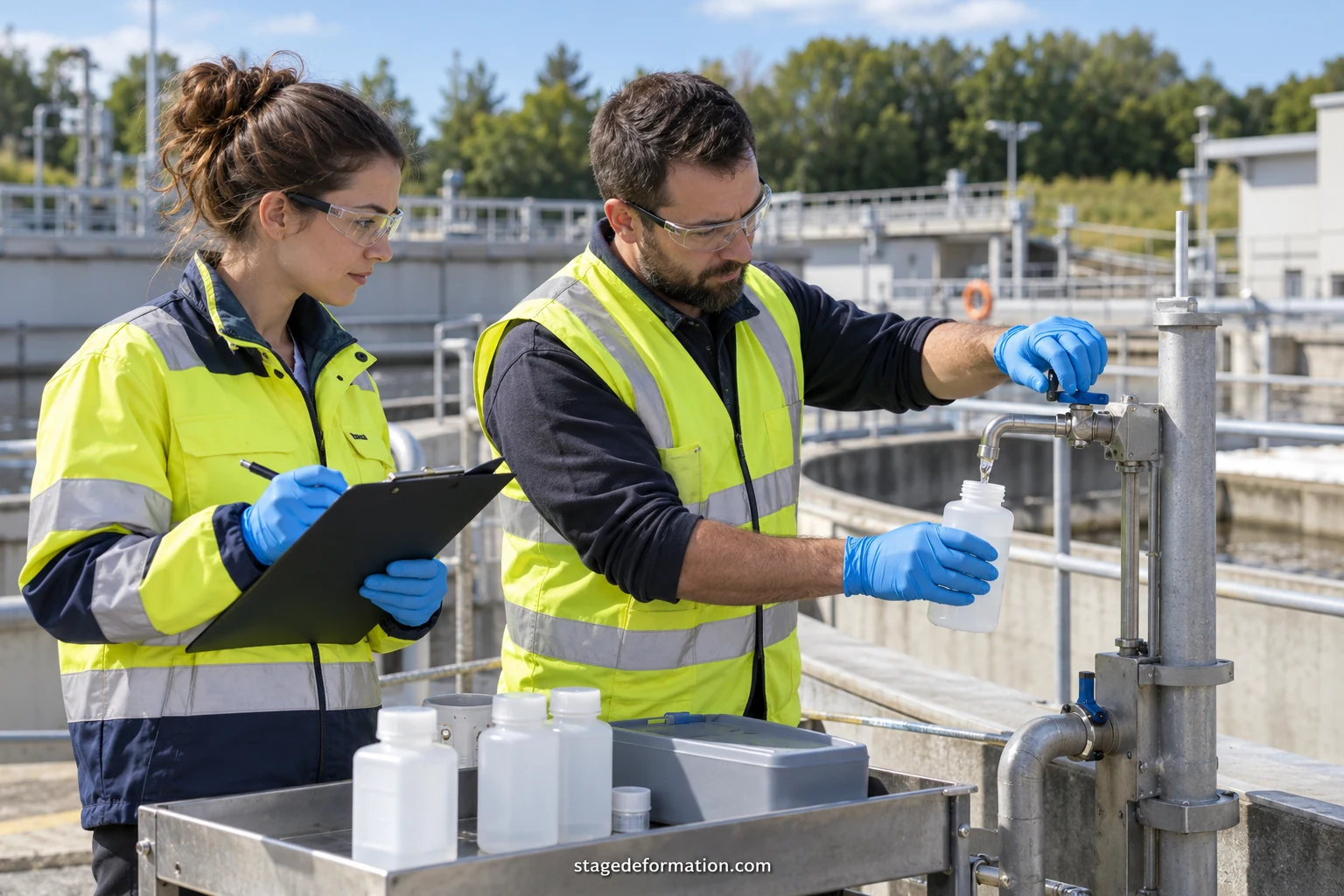
Three families of trades behind environmental services
When you turn on a tap, sort your packaging or pass a collection lorry, you see the end result of a technical system. Internships let you discover what goes on behind the scenes, which falls into three broad families.
- The water cycle: abstraction and production of drinking water, distribution networks, wastewater collection, treatment plants, stormwater management.
- Waste management: collection, recycling centres, sorting centres, composting platforms, recycling, energy recovery and landfill.
- The environment in the broad sense: monitoring the quality of a natural setting, impact studies, regulatory support for sites, public awareness.
These worlds share one point: you work with processes and indicators, not just observations. A useful internship means understanding what goes in, what comes out and how you check that the result complies.
Who hosts interns and apprentices
Employers are split between the public and the private sectors, often linked by delegation contracts.
- Local authorities and joint boards: publicly run water and sanitation services, collection services, recycling centres, cleansing and environment departments of municipalities and groups of municipalities.
- Service companies: operators of networks and plants, and of collection, sorting and treatment.
- Recycling companies: sorting and preparing metals, plastics, paper, wood or demolition materials.
- Industrial firms: sites with their own treatment plant or an environment department in charge of discharges and waste.
- Consultancies and laboratories: sampling, analysis, diagnostics and regulatory monitoring.
Each employer offers a different angle. A public water service shows you a whole local public service, a private operator shows contractual performance, and a laboratory shows how reliable measurements are. Depending on your level, you will be mostly in operations, in a laboratory or in an office.
Qualifications from vocational certificates to the professional degree
The routes are many, with a strong presence of work-study.
- At vocational baccalaureate level, courses linked to pollution management and environmental protection, or to cleaning trades, prepare you for operating tasks.
- At BTS and BTSA level, courses devoted to water trades, water management and control, or environmental services lead to technician posts.
- At bachelor and professional degree level, routes devoted to waste treatment and management or to environmental processes train site or project managers.
- Certifications and continuing training offered by specialist bodies complete the path of employees and jobseekers.
Course titles change and the number of places varies. To find out whether a course offers work-study, look at the school’s own course sheet, not only at the qualification.
Understanding a process before following its figures
In a wastewater plant, the effluent goes through pretreatment that removes large debris and sand, then through biological treatment in which micro-organisms break down the pollution, then through a stage that separates the sludge. In a sorting centre, materials arrive on conveyors where sorters and machines separate them. In a drinking-water unit, the resource is filtered and disinfected before being distributed.
For each of these processes, ask for a simple description in five parts: what goes in, the stages, the equipment, what comes out and the checks. Draw the diagram with your supervisor’s help: it will be the backbone of your report.
An internship gains value when you can explain, in your own words, why a stage exists and what happens if it fails. That understanding, more than the number of tasks done, impresses an employer.
Measurements, readings and anomalies: putting figures in context
The sector produces a lot of data: flow rates, pH, turbidity, chlorine and pollutant-load parameters for water; incoming tonnages, rejection rates and quality of sorted materials for waste. But an isolated figure means nothing without its context: date, sampling point, rain or production conditions, method used.
During your internship you may be involved in entering readings, checking that a table is consistent or preparing a monthly summary. A few habits prevent mistakes:
- note the unit and date of every value;
- ask how the measuring instrument is calibrated;
- report an abnormal value to the manager rather than correcting it yourself;
- distinguish a measurement anomaly from a genuine operating incident.
The operator then follows thresholds set by regulation and by its permits. Those thresholds depend on each installation: do not try to draw a general rule from a single site.
Safety: confined spaces, gases, vehicles and machinery
Water and waste installations carry their own risks: falls into basins, toxic or explosive gases in networks and tanks, treatment products, moving vehicles, noise, dust, biological hazards, cuts in sorting centres. Access to some areas, such as confined spaces, is reserved for trained and authorised people.
The intern generally receives a safety induction at the start, suitable personal protective equipment and traffic instructions. Follow them scrupulously: high-visibility vest, safety shoes, gloves, goggles, and any vaccinations recommended by occupational health or the school.
For minors, certain dangerous tasks are banned, or allowed only under training-related exemptions, with special supervision. In practice you will visit and observe a great deal before handling anything, and you will never work alone in a risk area. A safety question is never out of place.
An example of an internship for a BTS student (illustration)
Take the hypothetical case of a BTS student hosted for eight weeks by a sanitation board that runs several treatment plants. In the first week he goes with a technician on inspection rounds and learns to read the diagram of each structure. Over the next two weeks he takes part in sampling under supervision and copies the results into the monitoring table.
Halfway through, his supervisor gives him a specific task: compare two months of readings from one plant and spot the days when the outlet values drift from the average. He cross-checks the data with the weather and maintenance shutdowns, then presents a summary at a team meeting.
At the end of the internship he hands in a report containing the process diagram, the reading method, his observations and some simple suggestions for improvement. Even though none of his conclusions is decisive, the work shows his rigour and supports his case for a work-study placement the following year.
Applying, timing and internship conditions
When you apply, target a precise activity rather than writing to “an environment company”. An effective letter states the field you want (drinking water, sanitation, sorting, collection), the period, your course and what you want to understand. Attach a clear CV and mention, where relevant, your driving licence or any authorisations you already hold.
Local authorities and large companies often have earlier request calendars than small organisations: find out several months before your desired date. The internship requires an agreement signed by the school, the host organisation and you. A stipend becomes compulsory beyond a length of time set by the regulations, at a rate that changes: check it with your school.
In work-study, the employment contract sets the pay, which depends on age and year of training. Also ask whether the site requires on-call duty, shift hours or weekend work, because these constraints are common in operations.
Frequently asked questions
Do I have to be very good at chemistry or biology for a water internship?
Scientific basics are useful, especially for understanding the parameters monitored, but nobody expects a beginner to be an expert. What matters is showing rigour, curiosity and the ability to learn. Depending on the post, maintenance, logistics or data analysis may also dominate.
Can I do an internship in the waste sector without being on an environmental course?
Yes, several profiles are welcome: logistics, quality and safety, sales, management, computing, maintenance. Sorting centres and recycling platforms also need mechanical, electrical or administrative skills. State what you could contribute in your application letter so the organisation can picture your task.
Does an intern have access to all the installations?
No. Access depends on level of training, age, safety rules and the authorisations required. Some areas, such as confined spaces or tanks, are reserved for trained people. The supervisor arranges visits and gradual observation, and decides which tasks to entrust to you according to the risk.
What is the difference between working for a public water service and for a private operator?
A public service depends directly on a local authority and follows local public-service rules. A private operator often works under a delegation contract and must meet performance commitments. For an intern, the structure mainly changes the organisation of work, the people you deal with and how much you see of the contractual side.
What documents should I prepare before the first day?
Check that the agreement is signed and that you know the site’s exact address, the arrival time and the contact person. Bring safety shoes if they are not supplied, proof of identity and, if necessary, an insurance certificate. Also ask about any vaccination or medical requirements.
Does an environment internship lead to a job?
No hiring is guaranteed, but an internship lets you understand a trade, build a network and show you are reliable. Several employers recruit former interns or work-study students when a post opens. Keep in touch with your supervisor and ask for advice on the most useful courses to take next.