A chain of trades wider than the lorry
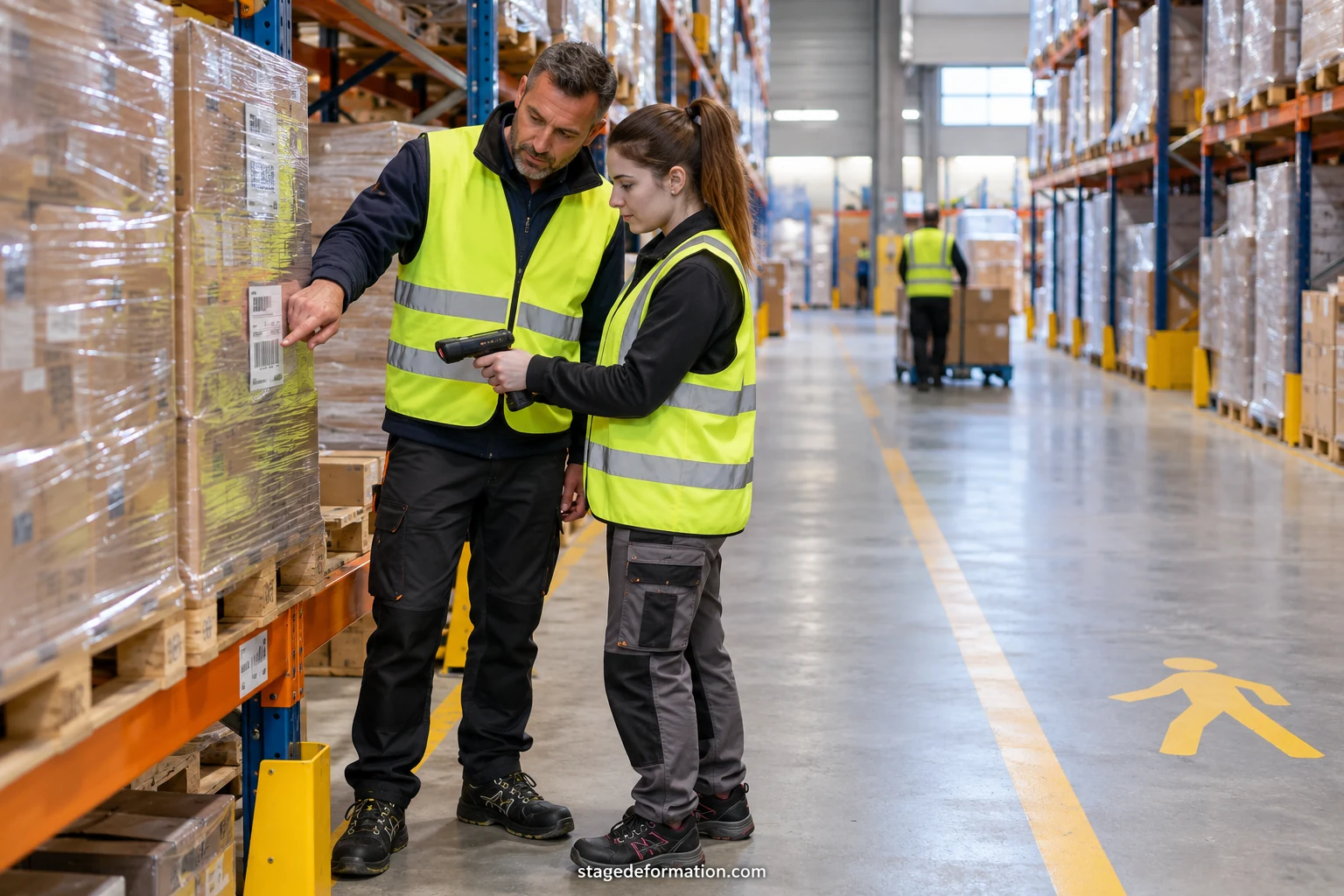
In the public mind, freight transport comes down to the driver and the vehicle. In practice, the chain includes many roles: goods-in clerk, warehouse operative, order picker, forklift driver, dock worker, freight forwarder, customs declarant, stock controller, operations manager. Each acts at a precise moment in an order's journey and depends on the others for the parcel to arrive complete and on time.
Logistics refers to the organisation of flows of goods and information; transport is the movement part of it. An internship can focus on either, or on the link between the two. Before looking for a placement, decide whether you prefer the physical work of the warehouse, on-screen coordination in operations, or the commercial and administrative side.
The qualifications that lead to these jobs
In France, several qualifications can be prepared as an apprentice. The CAP opérateur logistique and the vocational baccalaureate in logistics train people for warehouse jobs. The BTS in transport management and associated logistics prepares for operations, round planning and customer follow-up. Professional bachelor's degrees, bachelors and master's degrees in supply chain extend these paths towards supervisory roles or running a distribution platform.
Professional titles, for example warehouse forklift operator, road haulage driver or road transport operations manager, are also aimed at adults and people retraining, often with a practical part in a company. Several specialist organisations offer these courses, both in initial and continuing training. Entry requirements and durations should be checked with each one.
Internship or apprenticeship: choosing according to your plans
An internship serves to discover a sector or to complete a compulsory period of training. It is covered by an agreement signed with the school, it is limited in time and its purpose is educational. Beyond two months in the same company, a minimum gratification is due in France, with an amount set by regulation and reviewed regularly.
An apprenticeship is an employment contract: the apprentice alternates between periods at a training centre and periods in the company, receives a wage expressed as a percentage of the minimum wage according to age and year of training, and prepares for a qualification or professional title. In logistics, employers recruit a lot through work-study and value young people who have already proved themselves during an internship. The two approaches therefore complement each other rather than compete.
Following an order from start to finish
The best way to understand the trade is to follow a complete order. Observe how it enters the system, how the warehouse prepares it, which documents go with it and how the carrier takes it over. Each stage includes checks: correct quantity, condition of the parcel, right reference, legible label, delivery slot respected.
Ask to see the same flow from two angles: the physical stock, with pallets and locations, and the information recorded in the management tools. When the two differ, the team has to understand why. This reconciliation is at the heart of the trade and makes an excellent subject for an internship report.
Warehouse, transport operations, administration: three internship settings
In a warehouse, an intern helps with receiving, checking, putting away, order picking and stocktaking. He or she learns storage rules, how to read labels and how to use handheld terminals. In transport operations, the intern observes vehicle allocation, round planning, real-time delivery tracking and the handling of delays. In administrative departments, the intern deals with transport documents, invoices, declarations and exchanges with customers.
- Warehouse: rigour, stamina, team spirit, respect for instructions.
- Operations: responsiveness, organisational skills, a liking for the phone and the screen.
- Administration: accuracy, ease with spreadsheets and management software.
These three worlds work side by side every day, and a good intern quickly learns to speak the language of the other departments.
Understanding a discrepancy: delay, wrong quantity, missing reference
A delay, a missing parcel or a wrong reference triggers a methodical investigation. The reflex is to reconstruct the story: at what point did the information change, who handled the goods, which document is authoritative? Note the timeline, find where the discrepancy appeared and observe how the team corrects it: recounting, calling the carrier, adjusting the stock record, informing the customer.
An intern who can tell this reasoning leaves a lasting impression. It shows an understanding that logistics depends as much on accurate data as on physical strength, and that a tiny error at goods-in can become a costly dispute at delivery.
Warehouse safety and driving equipment
A warehouse is an environment where trucks, pedestrians, pallets and lorries move around together. Safety shoes and a high-visibility vest are generally required, as is strict respect for pedestrian walkways and handling instructions. Learn the correct lifting techniques and report any hazard.
Driving forklift trucks follows rules that are separate from simply being present as an intern. It requires training and a driving authorisation issued by the employer, which often relies on a safe-driving aptitude certificate (CACES in France) or an equivalent assessment. For minors, restrictions apply to certain machines and driving tasks. An intern therefore never gets onto a vehicle without explicit authorisation, however willing he or she may be.
An illustrative example: five weeks to understand a distribution hub
Take a BTS student hosted for five weeks in a road haulage company with a parcel warehouse. In the first week, the student follows goods-in: checking pallets, scanning labels, putting away. In the second, the student moves to picking and notes the most frequent errors. In the third, the student observes operations and attends the allocation of the next day's rounds.
In the fourth week, a customer reports a missing parcel. The student helps trace the parcel in the system, discovers a reference error at goods-in and takes part in the call to the customer. In the last week, the student writes a sheet describing the chain of checks and suggests a double scan. This example is fictional, but it shows how to link observation, analysis and a realistic proposal.
Applying successfully and avoiding missteps
Transport and logistics companies reply quickly to clear applications. A one-page CV mentioning your training, your experience however brief, any licences you hold and your availability is enough. In your message, explain why this sector attracts you, with a concrete example: a warehouse visit, a summer job, an interest in supply chains.
Avoid claiming skills you do not have, especially driving equipment. Be punctual, because warehouse shifts sometimes start very early, and show that you accept teamwork and deadline pressure. Dedicated work-study platforms, training centres and the companies themselves post offers regularly: look at them several months before the start of the academic year.
Frequently asked questions
Can you do an internship in logistics without a particular qualification?
Yes, for a discovery placement or one linked to a course, it is enough to be enrolled in an institution that signs the agreement. The company expects above all punctuality, seriousness and respect for safety instructions. Technical skills are acquired on the job, under the guidance of a tutor.
Is an intern allowed to drive a forklift truck?
No, not simply because of being on an internship. Driving requires suitable training and an authorisation issued by the employer, which often relies on a CACES or an equivalent assessment. Additional restrictions exist for minors. Without written authorisation, an intern must not get onto a vehicle.
What is the difference between logistics and transport?
Logistics organises all flows of goods and information: supply, storage, picking, distribution. Transport is one component, centred on carriage by road, rail, sea or air. Many jobs combine the two, for example in operations or platform management.
Which qualifications prepare for these trades through work-study?
There are the CAP opérateur logistique, the vocational baccalaureate in logistics, the BTS in transport management and associated logistics, then professional bachelor's degrees, bachelors and master's degrees in supply chain. Professional titles also exist for forklift operator or road haulage driver. Each institution sets out its admission conditions and its work-study rhythm.
Is warehouse work suitable for women as well as men?
Yes. Handling equipment, mechanical aids and the way work is organised allow any trained person to do these jobs. Companies in the sector recruit at all levels, and operations, planning or stock management roles rely above all on rigour and communication.
How much does an apprentice in logistics earn?
The wage depends on age, year of training and sometimes the applicable collective agreement. It is calculated as a percentage of the minimum wage and changes with regulations. The apprenticeship contract and the training centre state the exact amount for your situation, which should be checked before you sign.