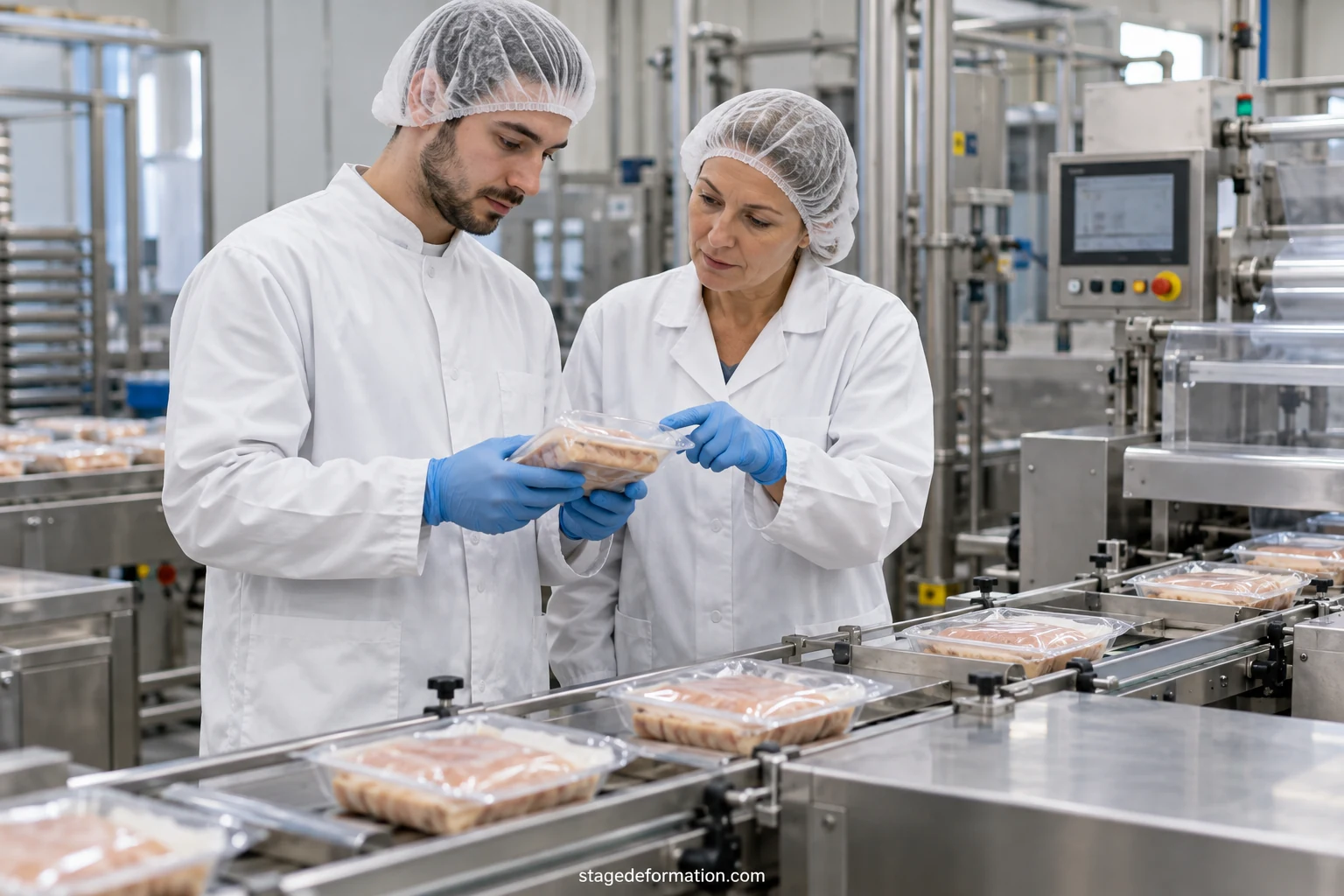
What the food industry really covers
Biscuits, dairy products, cured meats, ready meals, drinks, tinned goods and frozen foods: food manufacturing is one of the largest industrial sectors in France. It is made up of big groups, but also of a majority of small and medium-sized firms spread across every region. This variety explains why two internships with the same job title can have nothing in common.
A meat-cutting workshop, a dairy, an industrial bakery and a drinks plant all work with different processes. Temperatures, shelf life, microbiological risks, production speed and how often the product being made changes cannot be compared from one site to the next.
Before you start looking, ask yourself which product and which type of process appeal to you. That precision makes an application much easier for a site manager to read and to act on.
A product's journey, step by step
Following the path of a single batch is the best way to see where each job fits.
- Receiving raw materials: checking temperatures, labels and certificates, and assigning a batch number.
- Storage: respecting the designated zones, rotating stock and keeping risky products apart, allergens in particular.
- Production: weighing, mixing, cooking, cooling, fermenting or sterilising, depending on the recipe.
- Packing: filling, sealing, labelling, printing the date and batch code, and detecting foreign bodies.
- Dispatch: palletising, picking orders and keeping traceability records.
At every stage someone decides, measures or records something. For an intern, the most instructive thing is to follow one batch from start to finish over a full day: you see how the factory really works far better than from any organisation chart.
Roles open to interns and apprentices
Production and line operation
Feeding a machine, making simple adjustments, noting down settings, replacing consumables and changing formats. The first days are usually spent shadowing an experienced operator.
Quality and laboratory
Sampling, weight and appearance checks, temperature and acidity readings, tracking non-conformities and keeping records. This is where you learn hazard-control thinking: identify a critical point, set a limit, check it and correct it.
Maintenance and methods
Watching how breakdowns happen, planned greasing, taking part in workstation improvements, timing tasks and analysing line stoppages.
Product development and purchasing
Trials in a pilot workshop, technical data sheets, comparing suppliers and following specifications. These roles tend to call for a level equivalent to three to five years of higher education.
Logistics
Stock management, planning shipments and monitoring use-by dates.
Hygiene and workwear: the rules that govern everything
In a food production unit, hygiene is not just one instruction among many: it is part of the product. European and French regulations govern food safety, and each site turns them into its own internal procedures.
- Full workwear: a coat or overalls, a hairnet, sometimes a mask, overshoes or boots depending on the zone.
- No jewellery, watch or nail varnish, and hair and beards covered.
- Hand washing and disinfection at the designated points, movement through airlocks, and respect for clean and dirty zones.
- Immediate reporting to your supervisor of any illness, wound or digestive symptom.
Some sites run a hygiene training session on the first day, or even ask you to complete a health questionnaire. These rules can seem restrictive, but they protect consumers and are closely checked during customer audits. Showing care and rigour from the interview onwards is a real advantage.
Checks, traceability and decisions: why the figures are recorded
A weight, a temperature or a batch number is never recorded for nothing. A good habit for an intern is to ask: "What happens if this value goes outside the limit?"
Companies usually describe their method through food safety management plans built on the HACCP system, together with certification standards demanded by the large retailers. These set out who to alert, what to block and how to find the products affected.
Traceability makes it possible to go back from a pack to its ingredients and to see who it was delivered to. If something goes wrong, it limits the scale of any recall. If you are ever trusted with entering these records, be careful: a badly completed entry can cost the value of an entire batch.
Watching cleaning and product changeovers is also instructive. It shows how the team avoids cross-contamination and keeps production running smoothly.
Qualifications and routes in, from vocational certificates to engineering degrees
- CAP and vocational baccalaureate: operator or line technician in the food industries and processing bio-industries, and sometimes baking, pastry or butchery depending on the sector you target.
- BTS: specialisms linked to quality in the food industries and bio-industries, to production or to industrial maintenance.
- BUT and professional bachelor's degrees: biological engineering, physical measurements, production management and added value in the food industries.
- Engineering schools and master's degrees: food science and technology, processes, quality and innovation.
- Vocational qualification certificates: short courses created by the industry and suited to certain production jobs.
Many of these courses are available as apprenticeships. The contract then gives you employee status, an apprenticeship supervisor and a work-study rhythm agreed with the training centre. An internship, by contrast, is governed by an agreement between the school, the company and the intern.
Finding a host company near you
Factories are not always located in towns, so search within a realistic distance of home and take into account working hours, which can be unusual.
- Regional food industry associations and trade unions present the companies in their area.
- Sector training centres hold lists of partner companies and organise careers fairs.
- Educational institutions (vocational schools, university institutes of technology, colleges) often have long-standing contacts.
- Job sites dedicated to apprentices let you filter by sector and level.
Think too of less visible companies: a small firm making regional products sometimes gives more responsibility than a large, highly structured site. Prepare a short speculative application with one sentence about the product made, one about your studies and your availability.
Worked example: four weeks in a dairy's quality control
Here is a fictional scenario with rounded figures. A vocational baccalaureate student does a four-week internship in a medium-sized dairy that makes yoghurts and desserts.
- Week 1: hygiene training, a tour of the zones, shadowing a filling operator and first temperature readings.
- Week 2: weight checks on the line, and observing two recipe changeovers and the cleaning that goes with them.
- Week 3: helping to prepare samples for the laboratory and to check labelling.
- Week 4: following one batch from the arrival of the milk to dispatch, then a review with the tutor.
The student comes away with a precise logbook, useful for the report and for telling a future employer what they can already do.
Mistakes that cost dearly
- Turning up with jewellery, nail varnish or unsuitable clothing and having to go home.
- Underestimating the pace: early or shift hours, standing for long periods, and cold or hot environments.
- Touching a machine without authorisation: many items of equipment carry risks of cuts or crushing, and young minors are subject to special rules.
- Hiding a digestive symptom or an injury for fear of causing a nuisance.
- Not asking what the checks are for.
- Forgetting to verify the dates, hours, any allowance and the tutor's name in the agreement or contract.
A good intern is recognised by discretion, punctuality and the quality of their notes, much more than by how easily they talk.
Frequently asked questions
When is the best time to look for a food industry internship?
Start looking three to six months before the period you want. Some production is seasonal, such as tinned fruit and vegetables, and companies plan their placements well ahead. Contacting the human resources department or the quality manager early greatly improves your chances of getting a reply.
Do I need a medical certificate or training before starting?
It depends on the company and the role. Many sites run hygiene training on the first day and ask you to report any health problem. Some require a certificate of fitness. Ask when the agreement is being drawn up so that there is no unpleasant surprise on your first day.
Can an intern run a machine alone?
As a rule, no, especially at the start. Interns observe, help and repeat actions under the supervision of an experienced operator. Machines carry mechanical risks, and permission to use them depends on training, age and the employer's decision. Minors benefit from specific protections.
What is the difference between a production role and a quality role?
In production, you make and pack goods at a set pace by following instructions. In quality, you check, document and propose corrective actions. The two functions complement each other. Many professionals begin in production before specialising, which gives them real knowledge of the shop floor.
Is an apprenticeship possible without any food industry experience?
Yes, many apprentices discover the sector when they start their course. Companies look mainly at motivation, punctuality and the ability to follow strict rules. Even so, a short discovery placement or a project done in class helps to show your interest.
How should I describe my internship on a CV?
Name the type of product and workshop, then list specific actions: temperature readings, weight checks, following a batch, helping with an end-of-run clean. Avoid vague wording. If possible, mention the hygiene rules and quality standards you saw applied.