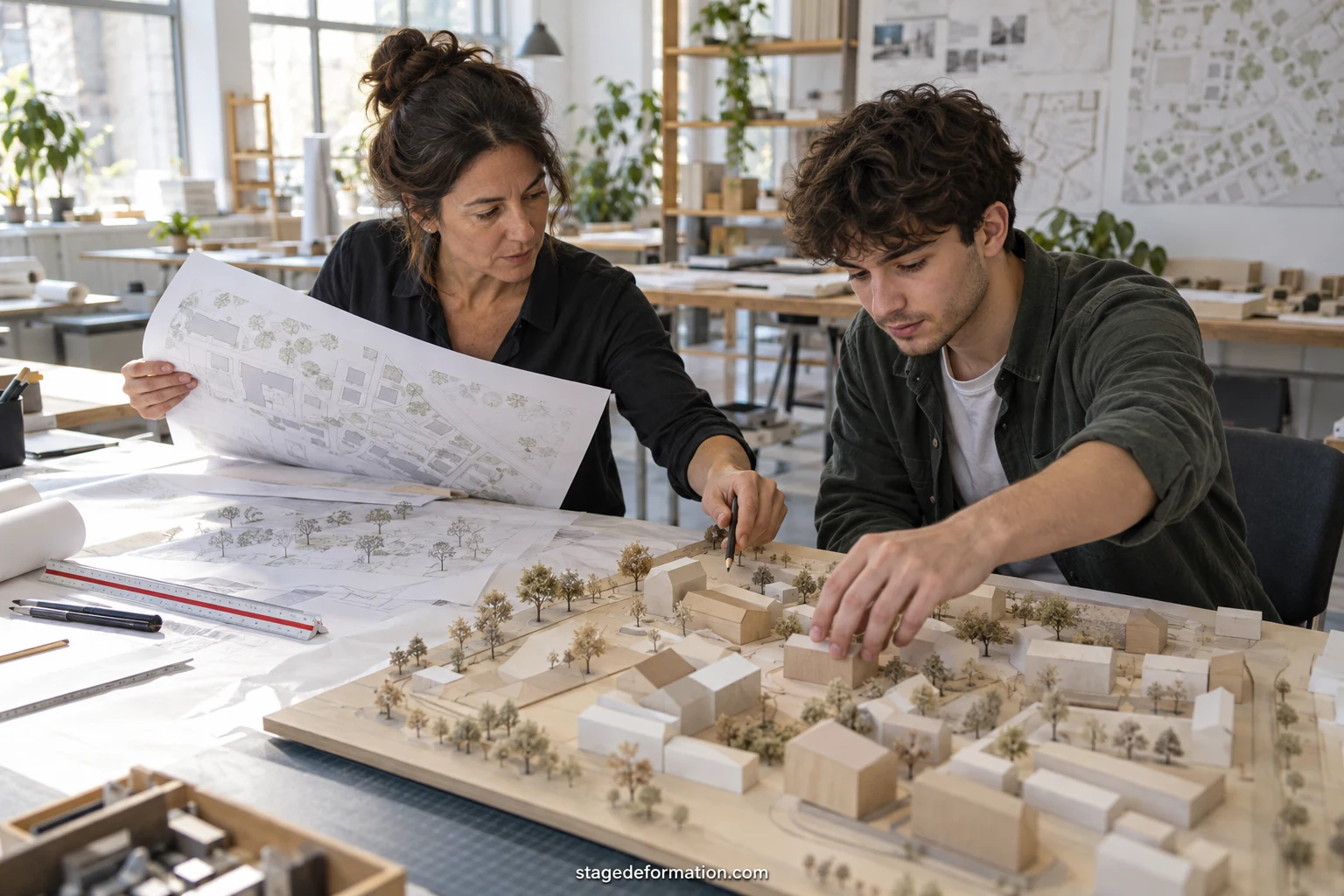
Two neighbouring professions, different internships
The architect designs buildings and oversees their construction; the urban planner thinks at the scale of a neighbourhood, a municipality or a region, considering uses, travel, housing and public spaces. The two professions meet in development projects, but their internship settings are not the same. An architecture practice works on planning applications, sketches and building sites. A local authority planning department processes permits and prepares planning documents. An urban planning agency carries out studies for the elected officials of an area.
Before applying, define the scale that attracts you: the individual building, the neighbourhood or the wider territory. This precision avoids scattered applications and lets you explain what you want to observe.
Internships in the architect's course
In France, the national schools of architecture, which award the state diploma in architecture, build compulsory internships into their programmes. By way of example, ENSA Paris-Malaquais describes on its website, for the bachelor's cycle, a two-week "worker" or "site" placement in a construction or production company, followed by a four-week "first practice" placement in a design or architectural production organisation. At master's level, a "practical training" of at least two months full-time must be validated before the final-year project.
These rules vary from one school to another: duration, timing, type of host organisation, conditions for validation. Always consult your school's internship handbook before accepting an offer, because a placement carried out outside the planned conditions may not be validated.
Internships in urban planning courses
Urban planning is learned mainly in master's programmes at universities and specialist institutes, sometimes as a continuation of a path in geography, regional development, political science or landscape. Internship durations are often between two and six months at the end of the master's, with shorter periods in the first year. Work-study arrangements are more frequent in this field than in schools of architecture, particularly with local authorities and consultancies.
The calendar and expectations depend on the course director: some master's programmes require a study report, others a research dissertation based on fieldwork. Ask for the guidelines before signing the agreement, so that you choose an internship that feeds the report expected of you.
Where an intern can be hosted
The possibilities are wider than people think. Beyond architecture practices of every size, you can aim for project-management firms, construction companies, technical consultancies, developers and social landlords, local authority planning departments, urban planning agencies and, in France, the CAUE (councils for architecture, urban planning and the environment). The latter are local bodies that support residents and local authorities in their projects.
- Architecture practice: sketches, models, planning application files, site supervision.
- Local authority: reading local development plans, consultation, public spaces.
- Urban planning agency: diagnostic studies, mapping, territorial observatories.
- Company or social landlord: housing programming, coordination of the parties involved.
Realistic tasks for a student
In a practice, an intern seldom draws a complete building, but may survey an existing structure, redraw plans, produce sections and elevations, build a model, prepare presentation boards or attend site meetings. In a planning organisation, the intern contributes to an area diagnosis, maps data, writes a summary, prepares a public meeting or lists current projects.
The essential point is to understand why things change. A plan is modified because a neighbour objects, a regulation requires a setback, a budget tightens or a use has evolved. Ask to know the reasons for a correction, rather than simply carrying it out in the software. Site visits and the documents you can reuse in your report are agreed with your internship supervisor.
Putting together an application that stands out
The portfolio is the central piece of an application in architecture. Choose five to eight pieces of work, each presented with a short text: context, intention, your personal role, tools used. Take care over layout, scale and the legibility of drawings, because a practice judges your rigour as much as your creativity. Attach a one-page CV and a letter that names precisely a project by the practice that you have looked at.
For urban planning, favour a more written file: an annotated map, a diagnostic note, an extract from group work. State the software you can use, for example for computer-aided drawing, modelling or geographic information systems, without overstating your level: you will quickly be asked to demonstrate it.
Searching, following up, finding out about the organisation
Good internships are prepared several months in advance, because practices receive a great many unsolicited applications. Look in your school's notices, the offers of professional networks and the jobs pages of federations of local bodies and, above all, target practices whose work you like. An email addressed to a specific person, with the portfolio as a light attachment or a link to an online version, gets more replies than a mass mailing.
Follow up once after about ten days. Before an interview, look through the organisation's projects, pick one that struck you and prepare two questions about its way of working. Finally, check the pay: beyond two months, a minimum gratification is due in France, with an amount set by regulation that changes over time.
An illustrative example: two months in a planning department
Imagine a master's student in urban planning hosted for two months by the planning department of a medium-sized town. The first week is spent reading the local development plan and visiting the areas where projects are planned. The student then receives a precise assignment: list the pedestrian routes around a school and propose three scenarios to make them safer.
The student measures pavement widths, photographs the crossings, interviews parents at the school gates, then produces maps and a short diagnosis. In a meeting, the elected councillor rules out one of the scenarios for budget reasons, which teaches the weight of trade-offs. This example is fictional and simplified, but it illustrates a formative, well-defined assignment that the report can describe precisely.
Pitfalls to avoid and possible next steps
The most common mistakes: accepting an internship that does not meet the school's criteria, ending up confined to tidying drawings with no contact with the project, not keeping authorised records of your work, or circulating plans without the organisation's agreement. A client's documents are confidential: always ask what you may reproduce in a report.
After graduation, paths vary: employment in a practice, the further authorisation needed to practise in your own name, project management, programming, competitions, operational planning, advice within a local authority. Each internship builds a professional network that is useful later, provided you remain a valued contact: a written thank-you and a message with news a few months later often make the difference.
Frequently asked questions
Is an internship in an architecture practice compulsory?
For architecture studies, yes: schools require internships in the bachelor's cycle and at master's level, with durations and conditions specific to each. For urban planning master's programmes, an internship generally comes at the end of the course. Your institution's regulations remain the reference, before you accept any offer.
How long is a practical-training internship in an architecture master's?
By way of example, a school such as Paris-Malaquais indicates a minimum of two consecutive months full-time, to be validated before the final-year project. Other schools set different durations. Ask your school's internship office to find out its current rules.
Can you do an urban planning internship without having studied architecture?
Yes. Many students come from geography, regional development, law, political science or environmental studies. What matters to a local authority or an urban planning agency is the ability to read a territory, analyse data and write a clear summary.
Which software do you need to know to be accepted?
Organisations often expect the basics of computer-aided drawing and modelling, sometimes mapping for urban planning. The level asked varies greatly. It is better to state honestly what you can use and to show that you learn quickly than to display a list of tools you have used only once.
Is the internship paid?
Beyond two months in the same organisation, a minimum gratification is compulsory in France, at an amount set by regulation and reviewed periodically. Below that, it depends on the organisation. Some practices, particularly small ones, have limited means: raise the question neutrally in your first exchange.
Can you do your internship abroad?
Often yes, and many schools encourage it. The agreement must be signed by all parties before departure, and the school may ask for a document from the host country confirming the placement. Also plan for insurance, accommodation and, depending on the country, the permits needed to work there.