Two neighbouring trades, two different daily realities
Hairdressing and beauty therapy often share the same shopping arcades and a taste for dealing with people, but the work is different. A hairdresser cuts, colours, styles and advises, at a quick pace, spending long hours on their feet and serving clients who come back regularly. A beauty therapist carries out facial and body treatments, waxing, make-up, hand and foot care, and sells cosmetic products.
In both cases, the relationship with the client is central, and so is hygiene. If you are undecided, an observation placement of a few days in each world is worth more than any advice: you quickly see whether you prefer working on the shape and movement of hair, or on care, wellbeing and a gentle touch.
Taster internship or apprenticeship: do not confuse them
Several different situations hide behind the word internship. An observation placement, often offered to school pupils, is meant to give a feel for the atmosphere of a salon or institute without carrying out real treatments. In France, the period of training in the workplace built into a vocational school diploma aims at precise skills and is covered by a signed agreement.
An apprenticeship, by contrast, rests on an employment contract: the apprentice is an employee, alternates between the business and a training centre, and works towards a qualification. This last route is very common in the beauty trades, because it lets you learn on real clients with an apprenticeship tutor. Always say in which capacity you are approaching a business, because what the professional expects changes completely.
Qualifications and how they build on each other
In France, the usual entry point is the CAP, a two-year vocational certificate taken after lower secondary school, either at a vocational school or as an apprentice. There is a CAP in hairdressing and a CAP in beauty therapy, cosmetics and perfumery. They can be followed by a professional certificate or a master craftsperson certificate, which prepare you for managing a team and setting up on your own.
Other qualifications exist: the vocational baccalaureate, the BTS for management in the cosmetics sector, and specialisation certificates in specific techniques. In these trades, working as a self-employed person is tied to a recognised professional qualification in France; find out the exact conditions before dreaming of opening a salon. The best approach is to build your path step by step.
Finding a salon, an institute or a training centre
A good approach is to start with the training centre: it knows the businesses that take on apprentices, sometimes organises meetings and helps you understand what is expected. In France, the chambers of trades and crafts also keep lists of centres and support schemes. Trade associations and their job boards are a second source.
Do not forget direct approaches: call in at salons and institutes in your neighbourhood with a CV in hand, at a quiet time of day, never on a Saturday afternoon. Show that you have looked at the work of the business, mention a treatment you like, and offer a trial of a few hours. Small teams often respond faster to a visit than to an email.
Preparing for the trial and the interview
Many professionals offer a half-day trial before committing. It is used to check three things: your punctuality, your welcoming manner, and your ability to be useful without being asked. Arrive in clean, simple clothes, with your hair tied back if needed, short nails, no strong perfume, and a smile.
At the interview, prepare answers on three points: why this trade, what you have already done with your hands (sewing, make-up, DIY, caring for a relative), and how you handle a busy day. Be ready to talk about the constraints: long hours, working Saturdays, standing all day, contact with products. Honesty is better received than a show of enthusiasm.
Hygiene, safety and respect for clients
These trades involve the skin and hair of people who trust you. Tidying up, disinfecting tools, washing hands, wearing gloves when needed and respecting the development times of products are part of the craft as much as technique. Colouring, bleaching or treatment products can be irritating or cause allergies; precise rules govern their use, notably for minors.
Your role as a beginner is to do only what is planned, at the level planned, with the person supervising you present. Listening to the client's request, keeping private what clients say and respecting everyone, whatever they look like, count as much as the technical skill.
Practising before moving on to real clients
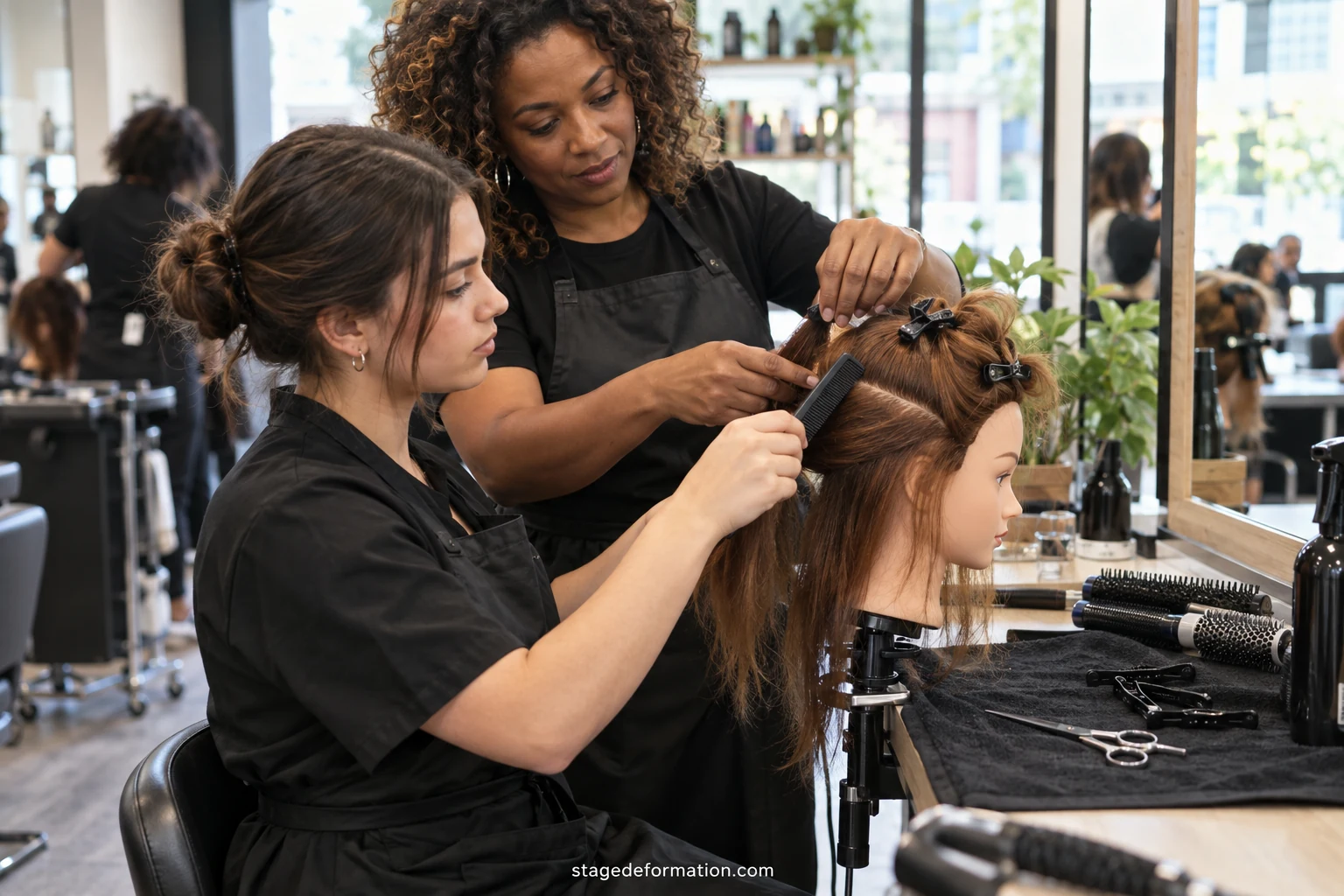
Training heads, practice hands and simulation exercises in a workshop let you work on a movement without risk. A trainee hairdresser repeats blow-dries, plaits and roller sets; a trainee beauty therapist practises massage, manicures and make-up techniques on consenting models. This stage builds confidence and reassures the team.
At home, you can also work on observation: looking at the shape of a face, the direction of hair growth, skin tone. Keep a technique notebook, with drawings, products used and mistakes met. After a few months, this notebook becomes a precious memory, which you can show a future employer to illustrate how serious you are.
A fictional example: a first year as an apprentice
Here is an illustration, with rounded figures. Ines, sixteen, signs an apprenticeship contract in a salon with six staff to prepare for a CAP. She spends about three weeks out of four at the salon and one week at the training centre. In the first months, she greets clients, prepares towels, does shampoos and cleans the workstations.
Around the fourth month, her apprenticeship tutor entrusts her with simple blow-dries for regular clients, then with colours as an assistant. By the end of the year, Ines can do a simple cut on a training head and manage an appointment from start to finish under supervision. She is not yet independent, but she has real progress to talk about.
Pay, contract and alternatives
In France, an apprentice receives a salary calculated as a percentage of the minimum wage according to age and year of training; rates and amounts are set by regulations and change, so check them with the business or the training centre. The contract states its length, the working hours, the apprenticeship tutor and the periods of classes.
If you cannot find a contract straight away, other solutions exist: a placement as part of a vocational school course, initial training in a centre with periods in a business, or a professionalisation contract for adults changing careers. Ask the training centre for advice: it can support your search, but it cannot promise to find a business for you.
Frequently asked questions
From what age can you prepare a CAP as an apprentice?
In France, apprenticeship is generally open to young people from sixteen, sometimes fifteen on leaving lower secondary school under precise conditions, up to an age limit set by regulations. Adjustments exist for certain situations. The training centre will tell you the conditions that apply to your case.
Do you have to choose between hairdressing and beauty therapy from the start?
Yes for the qualification, because the two CAP certificates are separate, but not for exploring. An observation placement in each sector helps you decide. Some careers later move towards management, training or product sales, which widens the options after a few years of experience.
Can you carry out treatments on clients right from the start?
Not without supervision. At first, the apprentice watches, prepares and helps, then performs simple tasks under control. More technical treatments come with progress, and depend on the level set in the contract or agreement. Avoid attempting techniques you have not mastered just to please.
How do you cope with Saturday hours?
Saturday is a very busy day in these trades, and it is often worked. Hours must respect the rules that apply, especially for minors, and appear in the contract. Discuss it at the interview to avoid misunderstandings, and check which rest days are planned during the week.
What costs should you expect when starting out?
Depending on the centre and the business, you may have to buy a uniform, a tool kit or practice equipment. In France, some aids exist for apprentices, notably for equipment and transport, under the rules in force. Ask for the exact equipment list before buying anything so you do not spend needlessly.
What should you do if the atmosphere in the salon does not suit you?
Speak first to the apprenticeship tutor or the manager, then to your contact at the training centre. Note the facts precisely and calmly. A change of business is sometimes possible, but it needs a procedure and the support of the centre; do not leave your post without asking for advice.