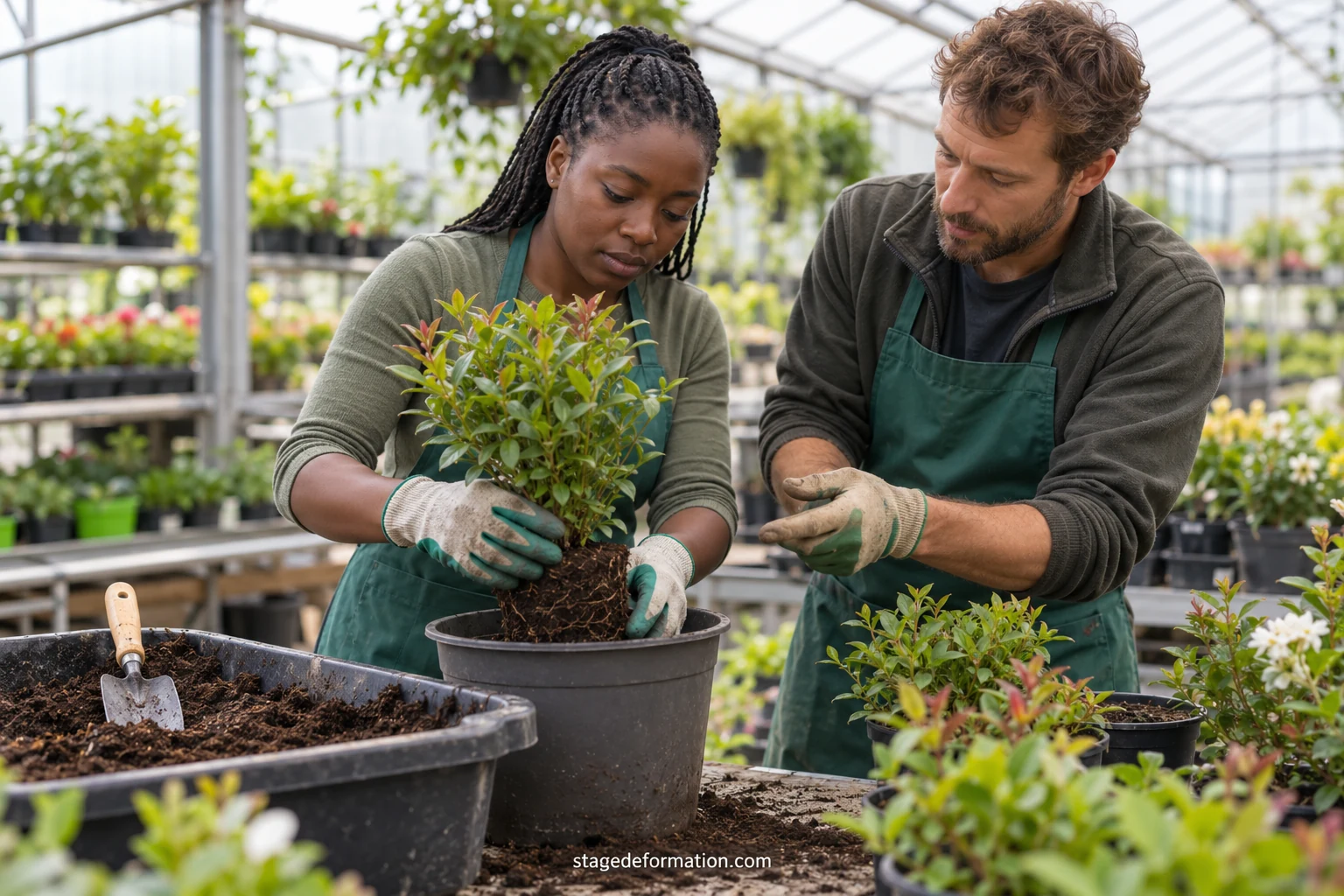
Two neighbouring worlds: growing plants or designing spaces
The word “horticulture” refers first of all to production: sowing, taking cuttings, potting on, monitoring crops in a greenhouse or in the open, preparing plant orders. Landscaping concerns the creation and maintenance of outdoor spaces: private gardens, residential blocks, parks, sports grounds, the grounds of businesses or public buildings.
These two worlds sit side by side, but the days in them are not alike. In a nursery, time is measured in growth cycles and order calendars. In a landscaping firm it is split into jobs, with teams moving from site to site, plans to follow and clients to satisfy.
Before looking for an internship, decide whether you want to observe the life of the plant, learn how to build a garden or understand the upkeep of a large site. That choice avoids disappointment and guides how you write your applications.
The organisations that host interns and apprentices
The sector is varied, and each type of employer offers specific learning.
- Nurseries and horticultural businesses: production of trees, shrubs, bedding plants or pot plants, with a lot of handling and precise monitoring.
- Landscaping firms: garden creation, planting, light earthworks, automatic irrigation, regular maintenance.
- Local authority green-space departments: park maintenance, flower displays, tree management, with a public-service approach.
- Garden centres: customer advice, setting up displays, knowledge of the plants on sale.
- Golf courses, cemeteries, estates and gardens open to the public: fine maintenance and high aesthetic standards.
It may be worth the same person trying two contrasting worlds, for example a nursery in the first year and a garden-creation firm in the second.
From the CAPa to the BTSA: the qualifications of the field
Courses for plant-based trades are numerous and often run as work-study, either through apprenticeship or through supervised placements.
- The CAPa landscape gardener teaches the basic skills: planting, pruning, maintenance, lawn sowing, small-scale landscape masonry.
- The vocational baccalaureate in landscape works prepares you to supervise a small site and to read a plan.
- The vocational baccalaureate in horticultural production trains you to run crops in a greenhouse or outdoors.
- The BTSA in landscape works aims at roles such as site manager, technician or team leader, with some design work.
Public agricultural colleges, rural family schools and private school networks offer them, but how places open up and how recruitment works vary from one place to another. Contact the schools in your region directly to find out about apprenticeship places.
The calendar: every season brings its own tasks
An internship in horticulture or landscaping is not the same from one quarter to the next. Spring is the big season for planting and mowing: jobs multiply and greenhouses are full of pots and plants waiting to be dispatched. Summer is mostly about watering, weeding, regular mowing and watching for disease. Autumn is the season for planting trees and shrubs, clearing fallen leaves and preparing the soil. Winter is calmer: pruning, equipment maintenance, and masonry or fencing jobs.
If you want to see every side of the trade, plan several periods in different seasons. If you have only one, ask the organisation what you will really be able to observe at that time. An internship in the depths of winter can be valuable for learning pruning and tool care, but less so for planting.
Learning to read the plant and the site
A good gardener does not simply carry out orders; he or she observes. A yellow leaf may signal too much water, a deficiency or a disease. A badly planted shrub may last two seasons and then die for lack of drainage. The internship is the chance to learn how to link every action to a diagnosis.
To make progress, get into the habit of asking three questions about every task:
- What is the state of the plant and the soil before I act?
- Why this action, at this moment, with this tool?
- What will we see in a few weeks that tells us whether it was the right choice?
Write down plant names in a notebook, with their exposure, water needs and flowering period. After a few weeks you will be able to recognise several dozen species, which employers value highly. Photographing the plantings, with the organisation’s permission, also helps illustrate your report.
Tools, products and safety on site
Landscaping jobs involve machinery: ride-on mowers, hedge trimmers, brush cutters, sometimes chainsaws. Greenhouses expose you to heat and humidity, warehouses to repeated handling. Risky actions are many: prolonged postures, flying debris, noise, vibration.
The intern wears the protective equipment indicated (safety shoes, gloves, goggles, ear defenders) and operates a machine only after it has been explained and the supervisor has agreed. For minors, certain dangerous tasks are banned or allowed only under training-related exemptions, with suitable supervision.
Plant protection products are strictly regulated, and professional use requires specific training. Local authorities and many private firms in any case prefer alternative methods: mulching, mechanical weeding, biological control. An intern should not handle such products without a clear framework; if you are offered the chance, ask for the authorisation to be confirmed in writing by your school.
Applying: show your powers of observation
A convincing application in this sector is short and concrete. State the qualification you are preparing, the period, your mobility (a car driving licence is often useful, since teams travel) and your experience, however modest: a family vegetable plot, helping in a garden, volunteering with a community garden association.
Visit the company’s website to see its projects, then mention a project or type of job that appeals to you. In a nursery, take an interest in the ranges grown. With a local authority, find out the application period, often more tightly regulated and earlier than with a craftsman.
At interview, avoid promising boundless passion for every plant; it is better to say what you can do, what you want to learn and how you cope with physical outdoor work in all weathers.
Illustrative example: six weeks in a landscaping firm
Imagine a vocational baccalaureate pupil hosted for six weeks by a landscaping firm with eight employees. In the first week he goes with a maintenance team to private clients: mowing, hedge trimming, collecting green waste, learning plant names. In the second week he helps prepare a planting job: reading the plan, marking out, bringing in soil, setting out the plants.
Halfway through, the team leader gives him responsibility for a small area: watering, observing the plants, recording what takes and what fails. In the last weeks he writes up the job on a sheet, with sketches and a list of the plants. This work forms the basis of the internship report and a concrete example for future applications.
In this example the intern has not driven heavy machinery or used any sensitive product: most of the progress comes from observation, regularity and the quality of the logbook.
Pay, agreement and further study
An internship is covered by an agreement signed before it starts. A stipend is compulsory beyond a length of time set by the regulations; the amount changes, so it is wise to check it with your school. In an apprenticeship the person is an employee and receives pay that depends on age and year of training, sometimes with more favourable rules in the sector’s collective agreement.
Hiring aids for apprentices exist for companies, but they change with public decisions; do not count on them to win over an employer, and above all show how serious you are.
After a CAPa or a vocational baccalaureate you can work as a skilled worker or go on to a BTSA. Some then move towards site management, setting up a business or ornamental tree care. The internship often lets you test these prospects before committing.
Frequently asked questions
What is the difference between a horticulture internship and a landscaping internship?
Horticulture is mainly about producing plants: sowing, taking cuttings, growing under glass, preparing orders. Landscaping concerns designing and maintaining outdoor spaces for private individuals, businesses or local authorities. The tasks, hours and skills involved differ, which is why you should state your goal before applying.
Do I need to know plant names before I start?
No, but you will gain by learning a few dozen quickly. Use a notebook, note the species you meet with their exposure and needs, and ask your supervisor to check your identifications. Employers appreciate curiosity and visible progress from one week to the next.
Is a driving licence essential?
Not always, but it is very useful. Landscaping firms travel from site to site and some nurseries are far from public transport. If you do not yet have a licence, say at the very first contact how you plan to reach the workplace, to avoid an unpleasant surprise on the first day.
Can I do an internship with a local authority in green spaces?
Yes, many municipalities, inter-municipal bodies and départements host interns in their green-space departments. Requests often have to be submitted well in advance, by letter or form. Supervision there is generally structured, with precise safety instructions and maintenance methods that respect the environment.
What physical risks should I expect?
Outdoor work exposes you to heat, cold, rain, repeated postures and carrying loads. Add the risks from machinery and possible allergies to pollen or insect stings. Wear suitable clothing, drink enough water and tell your supervisor about any discomfort rather than pushing on.
Can an internship lead to an apprenticeship in the same company?
It is common, because the company has already seen how reliable you are. Nothing is automatic, however: an apprenticeship contract depends on the employer’s needs, the availability of an apprenticeship master and enrolment at a training centre. If you enjoy the experience, say so halfway through and ask what is possible.