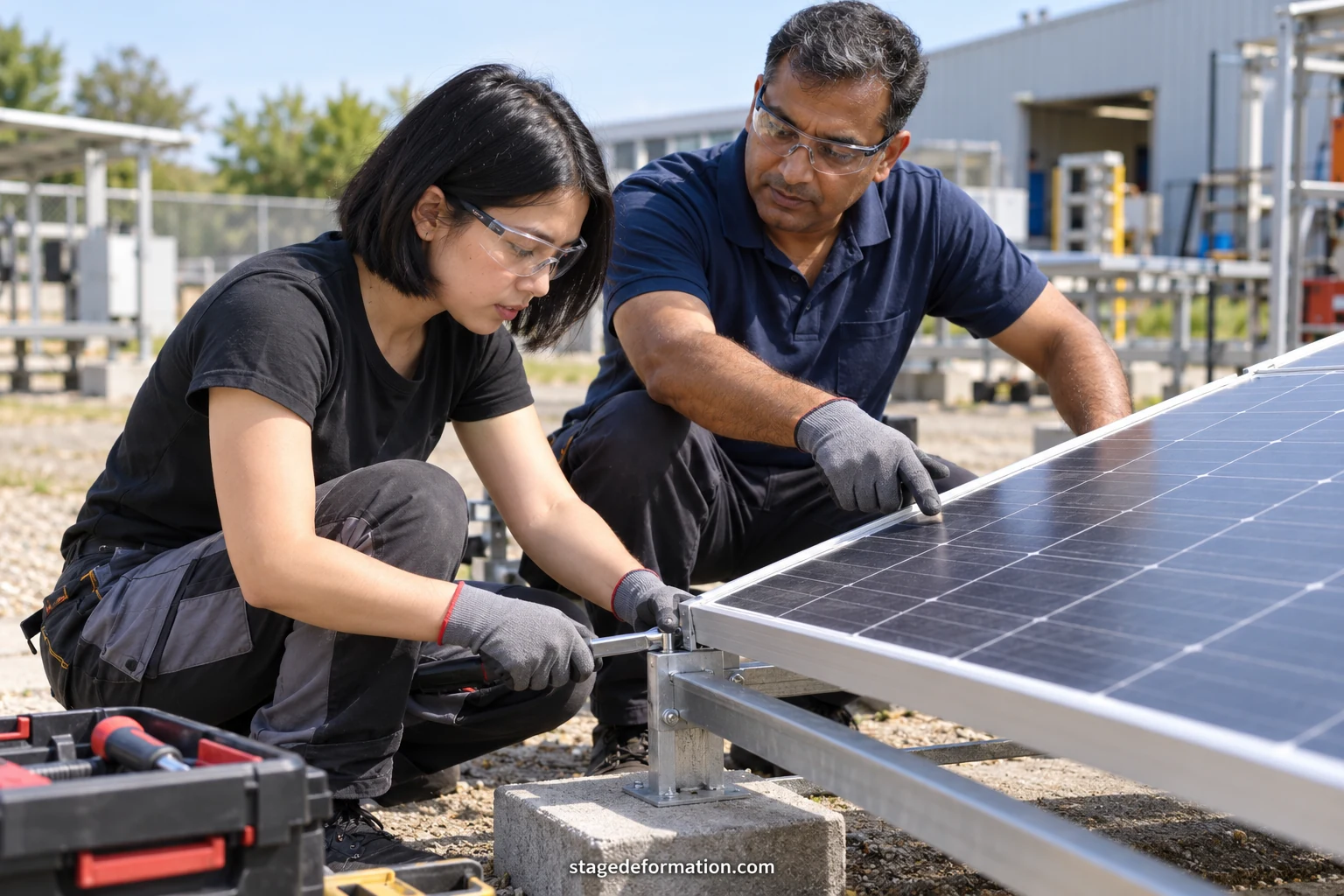
One sector, several families of trades
To talk about renewable energy is to talk about realities on the ground that have almost nothing in common. A site fitting photovoltaic panels on a warehouse, a wind farm in operation, a wood-fired boiler house feeding a heating network or a heat pump installation in a private home call for neither the same tools nor the same teams.
For an internship or an apprenticeship contract, it helps to think in terms of three broad families of functions:
- design studies: sizing an installation, comparing scenarios, estimating the expected output, putting together a technical file;
- installation: preparing and following a site, wiring, connecting, commissioning, checking;
- operation: monitoring how it runs, interpreting data, organising maintenance, dealing with breakdowns.
Each company has a different mix of these three blocks. A design consultancy will be very focused on calculation and documentation, an installer on the site, an operator on supervision and data.
Choosing a sector before you apply
An application that says “I want to work in renewables” rarely survives a first reading. It is better to name a technology and explain why it attracts you.
- Solar photovoltaic: studying roofs and shading, wiring diagrams, installation, grid connection, monitoring of output.
- Solar thermal and heat pumps: hydraulics, control systems, sizing for hot-water or heating needs.
- Wind: project development, machine maintenance, height and safety constraints that are very tightly regulated.
- Biomass, biogas, geothermal: processes, supply, running plants, relations with local areas.
- Hydroelectricity: operating structures, maintenance, managing flows and environmental constraints.
If you hesitate, favour a small, versatile company for a first internship: you often see the whole chain there, from the preliminary visit to commissioning, which helps you decide on a specialisation.
What an intern or an apprentice can really do
Tasks depend on the level of study and the team, but a few examples come up regularly.
In the design office
Reading consumption data, entering data into simulation software, comparing several configurations, writing technical notes, updating equipment libraries. A well-handled spreadsheet and a habit of checking are worth far more than impressive vocabulary.
On site
Accompanying an installation team, locating utility networks, visual checks, site photographs, filling in acceptance forms. Work on roofs or electrical equipment follows strict rules: a beginner takes part only within the framework provided, with the protective equipment and supervision needed.
In operation
Reading output curves, spotting gaps between forecast and actual results, preparing maintenance visits, keeping a history of incidents. It is a valuable place to learn that an announced result always depends on assumptions: weather, orientation, the state of the equipment, how the site is used.
Training paths that lead to these trades
Renewable energy can be prepared by varied routes, from vocational certificate level to engineer. No single qualification is required: employers recruit according to the function sought.
- Vocational routes: CAP and vocational baccalaureate in electricity, maintenance or heating and cooling engineering, sometimes with a complementary mention or a specialisation devoted to renewable energy.
- BTS and BUT: electrotechnics, fluids and energy, electrical engineering and industrial computing, thermal engineering and energy, often available as apprenticeships.
- Professional degrees: routes centred on energy management, photovoltaics or energy control in buildings.
- Engineering schools and master’s degrees: energy engineering, electrical engineering, heating and cooling, environment, with many work-study courses.
Apprenticeship has a concrete advantage: you alternate classes and company for one to three years, with an employment contract, a salary and an apprenticeship master. An internship, for its part, remains a supervised period of immersion governed by an agreement between the school, the host organisation and you.
Authorisations, safety and limits on the tasks given
This is the most sensitive point in the sector. Working near an inverter, an electrical panel or a roof requires specific safety training.
- The electrical authorisation is issued by the employer after training suited to the level of work. An intern without authorisation does not carry out switching operations or work on a live installation.
- Work at height requires collective or personal protection, training and supervision. For pupils who are minors, special rules limit dangerous tasks.
- Protective equipment (helmet, shoes, gloves, harness where needed) must be supplied and explained.
Ask the question at the interview: “Which tasks will be done by observation, and which under direct supervision?” A serious company answers without embarrassment. A vague reply, or a promise that you will “do what everyone does” on a job at height, should make you cautious.
Finding an internship or an apprenticeship contract
The market is more open than it looks, provided you search in the right places.
- Local installers and design consultancies: consult the member directories of trade bodies and target companies close to home.
- Operators and project developers: renewable electricity producers, maintenance companies, wind and solar farm managers.
- Local authorities and energy boards: energy and climate departments, shared energy advisers, heating networks.
- Apprentice training centres: their teaching teams know which companies regularly take on apprentices.
- Fairs and forums: direct meetings with recruiters, useful for getting a named contact.
Start your search early. For a work-study start in September, the first applications are prepared several months ahead, and small companies often decide at the last minute.
Building an application that convinces a technician
A technical manager reads a CV in a few seconds. He or she looks for proof of curiosity and rigour rather than grand principles.
- Cite a concrete project: sizing a small installation for a course, a model, a building’s consumption survey, an electrical assembly done in a workshop.
- State your tools: spreadsheet, drawing software, simulation tools, reading diagrams.
- In the letter, specify the sector you are aiming for, the function you want and the length of time you are available.
- Attach your school’s standard agreement or state the work-study calendar.
At the interview, prepare two simple technical questions: “How do you track the difference between forecast and observed output?” or “Which software do you use for studies?” They show that you have understood where the difficulty of the trade lies.
Illustrated example: a ten-week internship in a design consultancy
Take a fictional case, with rounded figures. A university-technology-diploma (BUT) student joins, for ten weeks, a small design consultancy specialising in solar for commercial buildings.
- Weeks 1 and 2: getting to know the tools, reading old files, observing a roof visit.
- Weeks 3 to 6: reworking consumption data for three buildings, comparing two panel layouts, writing a summary note.
- Weeks 7 to 9: comparing, on a site already equipped, the output forecast by the study with the output measured, with a list of possible causes of the gap.
- Week 10: presentation to the team and review with the supervisor.
This kind of task produces a deliverable the student can show in later applications, while respecting the confidentiality of company data.
Frequent mistakes to avoid
- Applying everywhere with the same text, without naming the technology or the function.
- Confusing an observation internship with a technician’s job: the level of autonomy is different.
- Accepting a task that needs an authorisation or equipment you do not have.
- Forgetting to ask how the company compares forecasts with actual results, when that is the heart of the trade.
- Neglecting the agreement or contract: check dates, tasks, hours, any stipend and the supervisor’s name before you start.
- Believing the sector recruits only engineers: many technical posts are open at levels from baccalaureate to three years of higher education.
Finally, keep a record of what you learn week by week. A logbook helps you write the internship report and talk about your experience precisely at interview.
Frequently asked questions
Do I need a specific qualification to do an internship in renewable energy?
No, no single qualification is required. Companies host pupils and students in electricity, heating and cooling engineering, maintenance, energy engineering or environment. The key is to show a coherent link between your course, the sector you have chosen and the possible tasks, for example a project done in a workshop or in class.
Can an intern work on a roof or an electrical installation?
Only within a precise framework. Work at height and on electrical equipment requires training, protection and supervision, and the electrical authorisation is issued by the employer. A beginner observes first, then acts under direct supervision. The rules are stricter still for minors: ask your school and the company.
What is the difference between an internship and an apprenticeship contract?
An internship is a period of training in the workplace governed by an agreement, with no employment contract. An apprenticeship is an employment contract alternating with classes at a training centre, with a salary and an apprenticeship master. Stipend and pay amounts are set by regulation and change: check before signing.
Where can I find companies that host young people in solar or wind?
Member directories of trade bodies, apprentice training centres, job fairs and the recruitment pages of federations are good starting points. Add a local search: installers, design consultancies, wind and solar farm operators, local authorities with an energy department.
What if the company only gives me administrative tasks?
Some documentation work is normal, particularly in a design office. But if the tasks stray for long from what is in the agreement, speak first to your supervisor, then to your teacher in charge or the internship office. The aim is to readjust the programme, not to break off immediately.
When should I start looking for a work-study placement in this sector?
As early as possible, ideally six to nine months before the start of the year. Many companies decide late, but those seeking an apprentice at the beginning of the school year are already looking at applications in spring. Rely on the training centre for contacts and to proofread your file.
Does renewable energy lead to a job after the internship?
No hiring is guaranteed. A successful internship or work-study placement does improve your chances, however: you know the team, the tools and the safety requirements. Needs vary by region and with the pipeline of projects, so widen your search to several sectors and several types of employer.