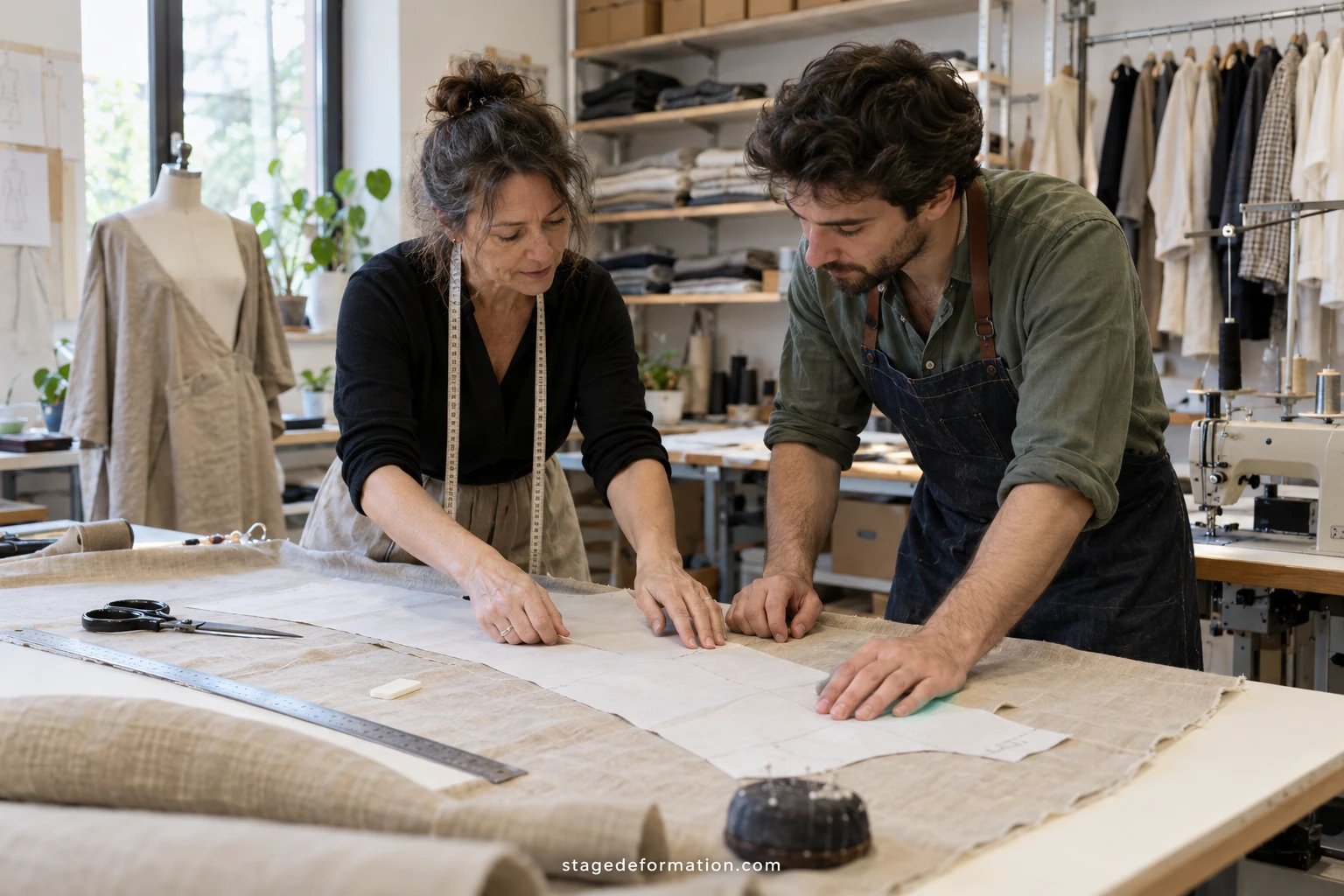
Three neighbouring trades: seamstress or tailor, pattern maker, production operator
These trades are often confused, although they do not hold the same place in the chain that produces a garment.
- The sewer (couturier or couturière) assembles the cut pieces, works on the finishing and adjusts the garment. In haute couture or in draped, flowing garments, a piece can be made almost entirely by hand.
- The pattern maker turns a sketch into a pattern: drawing the pieces, deciding the allowances, anticipating how the fabric will fall and preparing the size grading.
- The production operator works in series on specialised machines and follows a precise sequence of operations, with targets for quality and pace.
Related roles include cutter, presser-finisher, quality controller, workshop manager and production technician. Knowing these roles helps you ask for an internship or a contract that really fits what you want to learn.
The skills and techniques you learn in the workshop
Theory matters, but precision is built through supervised repetition. Depending on where you are placed, you may work on the following points.
On the pattern-making side
Taking measurements, drafting basic blocks (skirt, trousers, bodice), modifying a design, checking seam lengths, transferring construction marks, making a test toile and correcting it after the fitting.
On the sewing side
Setting up machines, choosing needles and threads to suit the fabric, straight stitching, hems, zips, pockets, linings, joining curved pieces, and pressing at every stage.
On the production side
Reading a technical sheet, respecting a sequence of operations, checking a batch, spotting fabric or stitching defects, organising the workstation and following safety rules.
Every movement has its reason. A good apprentice learns to explain why one seam goes in before another, instead of repeating an instruction without understanding it.
Qualifications and pathways: from the CAP to the bachelor
Several levels open the way into the trade, with different content. The names below are those of French qualifications.
- The CAP in fashion trades (a basic vocational certificate), especially the soft-garment or tailoring options, teaches assembly and finishing techniques. In France it can be taken at school or as an apprenticeship.
- The vocational baccalaureate in fashion trades or in sewing and garment production adds production organisation and the reading of technical documents.
- The BTS and higher-level diplomas prepare for design, product development and production follow-up.
- Bachelors and courses at specialist institutes offer pattern-making and design pathways, sometimes as a work-study programme.
Some luxury houses have developed apprenticeship programmes that combine classes at a school with work in the house’s own workshop. Entry conditions and the number of places change from one year to the next: check the websites of the institutions concerned for the arrangements currently in force.
Internship or apprenticeship: what changes in your daily life
An internship is a period of training in a workplace, governed by an agreement between you, your school and the workshop. It lasts a few weeks and aims to let you observe, try out techniques and validate part of your programme. In France a stipend becomes compulsory beyond a minimum length of stay, at a minimum set by regulations that change over time: check the amount when you sign.
An apprenticeship is an employment contract. You are an employee of the workshop or company, you attend classes at an apprentice training centre and you are paid according to your age and year of study, under the rules applying in 2026. The contract generally lasts from one to three years depending on the qualification you are preparing. It suits people who want a deep grounding in the craft, with time to improve on a wide variety of pieces.
In both cases the supervisor or apprenticeship master plays an essential role: how available they are to show and correct things largely determines the quality of what you learn.
Where to look: workshops, houses, alteration shops and production companies
There are more places that take learners than you might imagine, and each brings its own skills.
- Haute couture and flowing-garment workshops: precision, hand work and one-off pieces.
- Ready-to-wear and luxury houses: prototype workshops, development departments and quality control.
- Series production companies: line organisation, output and versatility on machines.
- Alteration shops and independent tailors: repairs, transformations, made-to-measure work and direct contact with the customer.
- Costume departments of theatres, opera houses and film: period reconstruction and adapting garments to the movements of the body.
- Chambers of trades and craft networks: introductions to apprenticeship masters near you.
For a first approach, turn up in person with a few sewn pieces, a one-page CV and a clear idea of your dates. Craftspeople appreciate candidates who show their work and ask practical questions about how the day unfolds.
Preparing your application: samples, trials and interview
Most workshops judge by the work itself. Bring two or three pieces for which you can describe every stage: a lined skirt, a shirt, trousers, an embroidered or altered piece. Show both the right side and the inside, because inner finishes reveal the care you took.
Your CV should state your level, the machines you have used, the types of fabric you have already worked with and any pattern-making software you know. In your letter, explain what attracts you to this particular workshop: its speciality, the type of garments, the clientele.
You may be offered a trial of a few hours or a day, in the form of a sewing test. Be punctual, work neatly rather than fast, and do not hesitate to ask for advice if an instruction is unclear. That exchange often matters more than the result of the test. For an apprenticeship contract you must also register the project with a training centre, which is why it pays to start several months before the new school year.
Illustrated example: four weeks around a shirt
As an illustration, with fictional durations, take a CAP trainee who spends four weeks in a small women’s clothing workshop.
- Week 1: he observes how the workshop is organised, learns to set up a machine and practises on fabric offcuts to get even stitching.
- Week 2: he cuts out the pieces of a shirt from a pattern, finding the grain line, and marks the stitching lines.
- Week 3: he assembles the shoulders, sleeves and collar under the seamstress’s supervision, pressing after each stage.
- Week 4: he takes part in the fitting, notices a hang problem under the armhole and watches the pattern being corrected.
With the workshop’s permission, he keeps photos of each stage for his progress notebook. He can then illustrate his internship report and show what he has really learned.
Frequent pitfalls and working conditions to check
- Underestimating posture: long periods sitting or standing, repetitive movements and lighting. Ask how the workshop provides for breaks and ergonomics.
- Using a machine without a demonstration: cutting machines, overlockers, pressing machines and industrial scissors call for a prior briefing on safety instructions.
- Trying to go too fast: precision comes before speed, which comes with repetition.
- Neglecting note-taking: writing down sequences of operations, settings and mistakes avoids repeating the same errors.
- Accepting tasks unrelated to the trade: if you are only given tidying or packing, talk to your supervisor and your school.
- Ignoring confidentiality: some pieces are designs not yet released; ask what you are allowed to photograph.
Before committing, it is useful to check with your school that the planned tasks match the skills required by your qualification.
Frequently asked questions
Can I do a sewing internship without a qualification?
An internship normally forms part of a training course, with an agreement signed by a school or college. Without a course, other options exist: a short period of observation in a workshop, an adult training course or an adapted contract. Contact a training centre or a chamber of trades to learn about the possibilities for your age and situation, before offering a trial to a craftsperson.
What is the difference between a sewer and a pattern maker?
The sewer assembles and finishes the garment, while the pattern maker designs the pattern from a sketch or a model. The two trades complement each other: a pattern maker must understand sewing to draft pieces that can be made, and a sewer must read a pattern to assemble it correctly. Some professionals do both, especially in small businesses.
Is an apprenticeship suited to these trades?
Yes, because it lets you learn the techniques over time, with a master, in a real production setting. The contract is an employment contract, with a salary and classes at a training centre. You need to find an employer before or during enrolment, so start looking several months before the new school year, especially for sought-after workshops.
Do I need to bring my own equipment?
It depends on the workshop. Many supply machines, cutting tables and large tools, but ask the apprentice to have their own scissors, tape measure, pins or tailor’s chalk. Ask before the first day and do not buy blindly: good equipment is expensive, and some workshops prefer their own brands.
How can I prove my level at a first meeting?
Show two or three pieces you have sewn and explain the stages. Show the inside of the garments, because the finishing reveals your rigour. If you know pattern-making software or a particular machine, say so. A concrete demonstration reassures more than a long list of qualities in a letter.
When is the best time to look for an apprenticeship master?
Several months before the start of the school year, often from spring, because workshops plan their hiring around their activity. Many receive few well-prepared applications, so a serious approach, with samples of your work and a precise start date, stands out. Training centres can also help you identify employers.