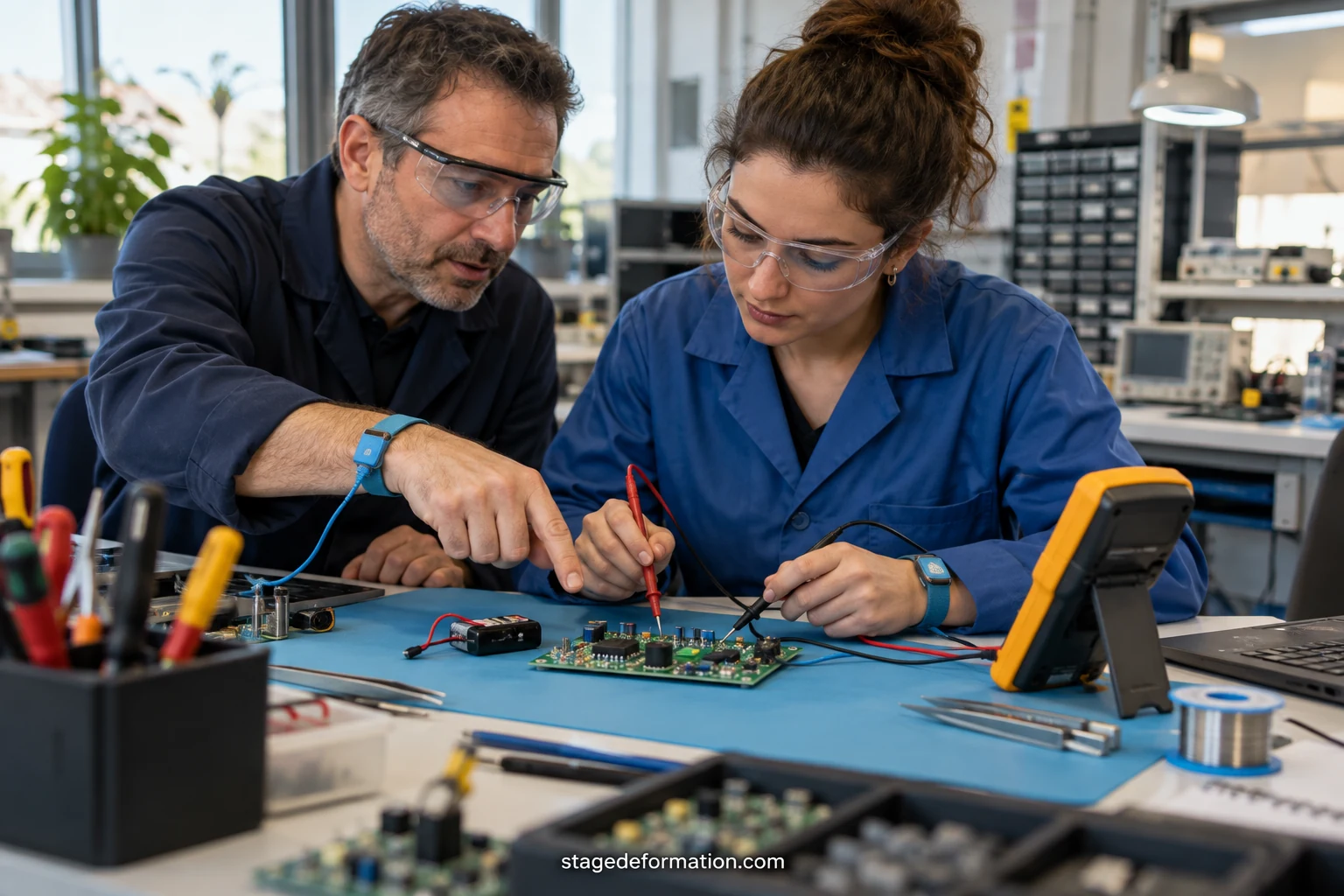
Two neighbouring trades, two different realities on the ground
Electronics and electrical engineering are often lumped together, but an intern's daily life is not the same in each. Electronics deals with weak signals: boards, sensors, microcontrollers, switch-mode power supplies, laboratory measurements. Electrical engineering deals with energy: motors, drives, transformers, distribution boards, control cabinets, industrial networks.
Between the two, a shared zone has grown: automation, photovoltaic inverters, charging points, on-board chargers, energy management equipment. A single department there may mix a wiring technician, a test engineer and a maintenance manager.
Before applying, ask yourself whether you prefer the soldering iron and the oscilloscope, or the torque wrench and the clamp multimeter. That simple question steers the choice of qualification, employer and assignment.
The qualifications that lead to these internships
There are many routes, and each sets a different internship rhythm.
- CAP and vocational baccalaureate in the electrical field (for example the vocational baccalaureate in electrical trades and connected environments): periods in a company of several weeks, focused on wiring, commissioning and troubleshooting.
- BTS (electrical engineering, industrial control and automatic regulation, digital systems): internships of a few weeks geared towards studies, testing or maintenance.
- BUT in electrical engineering and industrial computing: projects, internships at the end of the second and third years, and apprenticeship is possible.
- Professional bachelor's degree and engineering degree: an end-of-studies internship lasting several months, often in a design office or a test laboratory.
Several of these courses exist as apprenticeships. The work-study rhythm, the partner companies and any fees depend on each institution: the training centre or the school's placements office is the first contact to ask.
Internship or apprenticeship: what really changes
In France, an internship is a period of supervised practice covered by a three-party agreement signed by the pupil or student, the institution and the company. It is not an employment contract. Beyond two consecutive months, a payment (gratification) is due; the amount changes with the regulations and should be checked with the institution or the body handling your file.
An apprenticeship is an employment contract: you are an employee, you split your time between the company and the training centre, and your pay depends on your age and year of training, under the rules applying in 2026. It is in principle open to young people aged 16 to 29.
In a field where practice counts as much as theory, an apprenticeship lets you handle more equipment over time. An internship, by contrast, is better for trying out a trade or completing a school course. Many pathways combine the two: an observation internship in year 9 or 10, then a work-study contract after the baccalaureate.
Electrical authorisation: the rule that frames everything
As soon as someone approaches live installations or equipment, the employer must make sure they are trained in electrical risks. In France, this takes the form of the electrical authorisation (habilitation électrique), issued by the employer after training and a check of competence. The titles are distinguished by a letter and a number: B for low voltage, H for high voltage, 0 for non-electricians, R for troubleshooting work, S for simple interventions.
An intern therefore cannot simply "manage" alone on a cabinet. Depending on their level, they observe, prepare the tools, take readings under the guidance of an authorised person, or work on installations that have been locked out. Many vocational schools and training centres already include preparation for the authorisation; the host company completes it with its own site rules.
Ask at the interview which authorisation title is expected, who issues it and what personal protective equipment is provided. This question shows that you are serious, and it never works against you.
Typical tasks depending on the host department
In a laboratory or design office
Reading a diagram, recording signals, comparing a measurement with a specification, writing up a test report, helping prepare prototypes. The skills sought: rigour in note-taking, ease with an oscilloscope and a multimeter, and some notions of embedded programming.
In production and wiring
Assembling and wiring enclosures, checking boards, following manufacturing routings, tracing non-conformities. Clean workmanship and drawing reading count for more than theory.
In maintenance and troubleshooting
Looking for the cause of a machine stoppage, checking protections, replacing a component, keeping an intervention history. Here, diagnostic method matters more than speed.
In on-site commissioning
Testing installations before handover, checking rotation directions, setting up drives, recording the results. Travel is frequent.
Where to look: types of employer and networks
Internships and contracts are found in several worlds. Electrical equipment manufacturers and industrial energy management groups take on interns and apprentices in their factories, research centres and after-sales departments. Maintenance and installation companies, very present in the regions, mainly train technicians. Network operators, transport companies and the aerospace, automotive and rail industries also employ electronics specialists.
To widen your options, combine three approaches: employers' careers pages, the offers published by your institution, and speculative applications sent to small and medium-sized firms in your area after a phone call to identify the right contact. A small firm that makes cabinets or boards may give you more hands-on work than a large organisation, where the intern is sometimes confined to a narrow scope.
A worked example for planning your work-study contract
An illustration, with round, hypothetical figures: a BTS student plans a two-year work-study contract. They contact twenty companies in October, get five replies, attend three interviews and receive an offer in January. They sent their applications with a one-page CV, a ten-line letter and a list of their practical-work projects.
Had they waited until spring, they would have found fewer offers and more competition. Timing counts as much as profile: industrial companies plan their needs several months before the start of the academic year. This example is not a promise of results, but it is a reminder that a serious search is organised like a small project, with a tracking table, follow-ups and deadlines.
Preparing your CV, letter and interview
A technical recruiter wants to see what you can do, not only what you have studied. On your CV, list the circuits you have built, the instruments you can use, the diagram or simulation software you have worked with and any authorisations already obtained. One short line per project is enough: aim, tool, result.
In the letter, name the department you are targeting and explain why that product or process interests you. At interview, prepare two or three concrete situations: a fault solved in a practical session, a measurement that did not add up, a wiring error you corrected. Safety questions come up almost every time; answer with precise reflexes, such as checking for the absence of voltage before any intervention.
Bring a notebook, write down the answers, and ask at least one question about how tests are recorded. It reveals your interest in method.
Common mistakes and good habits
- Applying everywhere with the same text: a design department and a wiring workshop do not look for the same qualities.
- Neglecting safety: a "quick" action on an installation that has not been locked out can end the internship, or worse.
- Not recording measurements: without values or test conditions, a measurement cannot be used.
- Confusing apprenticeship and internship: the rights, the pay and the calendar differ.
- Ignoring the agreement: without a signed document before the start, no assignment can begin.
Conversely, ask your supervisor for feedback regularly, keep a logbook and prepare an end-of-period review. These habits help in writing the report and in getting a useful reference afterwards.
Frequently asked questions
Do you need a specific qualification to find an electrical engineering internship?
No, but the internship forms part of a course, because the agreement is signed with an institution. A vocational baccalaureate pupil in electrical trades, a BTS or BUT student, or an engineering student can each find an internship suited to their level. The tasks given vary with what they have learned and their authorisations.
Can an intern work on a live installation?
In principle, no, except within the strict framework set by the employer, with a suitable authorisation and supervision. Most often, the intern observes, prepares, measures with the power off or works on installations that have been locked out. The company's safety rules always come before the wish to move fast.
What is the difference between electronics and electrical engineering for an internship?
Electronics mainly concerns boards, sensors and low-power signals, with a lot of laboratory measurement. Electrical engineering concerns energy: motors, panels, drives, networks. Internships there are more oriented towards installation, maintenance or commissioning. Some posts combine both.
Is it possible to move from an internship to an apprenticeship contract in the same company?
It is common but never automatic. A successful internship shows you are serious and can lead to a work-study offer, if the company has a need and your course allows it. Mention your interest in the first few weeks and ask what you would need to demonstrate.
Which tools should I be able to use before applying?
A multimeter, an oscilloscope and a soldering iron for electronics; a multimeter, a clamp meter and wiring tools for electrical engineering. Some notions of reading diagrams and of a simulation program are useful. No employer expects perfection from a beginner, but they do expect rigour.
What should I do if I cannot find any internship after several weeks?
Widen your geographical area, phone small firms rather than relying on email alone, and ask the placements office or your teachers, who often know partner companies. Revise your CV too: add your practical projects and state the targeted department in each application.
Is payment compulsory for an electrical engineering internship?
In France it depends on the length of the internship, not the sector: beyond two consecutive months in the same company, the regulations provide for it. The minimum amount changes and should be checked with the institution or the official body before the agreement is signed.