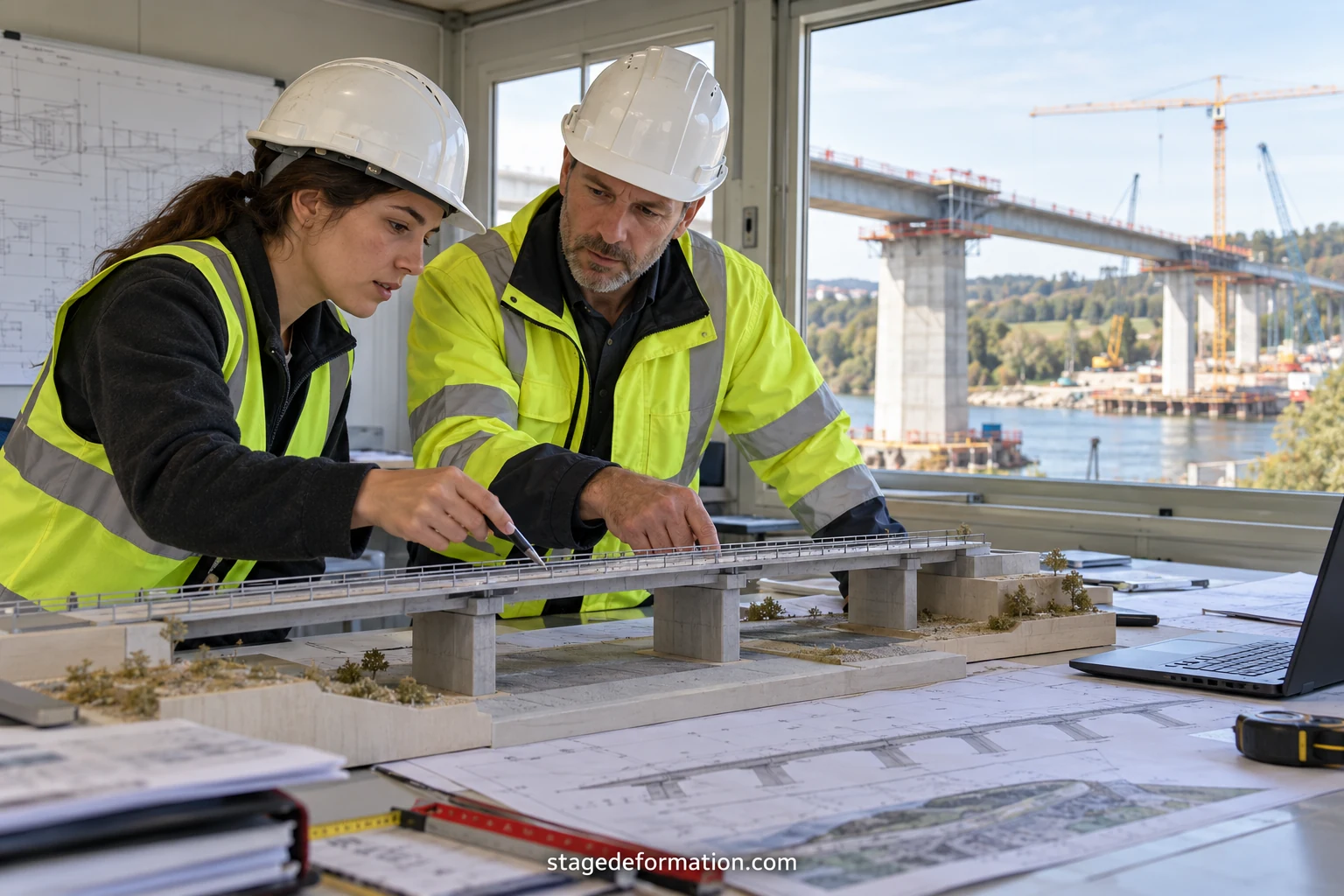
Three internships and one project: the logic of the course
The École des Ponts presents its engineering degree publicly as a sequence of three internships followed by a final-year project. The progression runs from the most practical to the most autonomous: first doing the work, then acting as an engineer, and finally producing a substantial piece of personal work.
- IPPEX, the professional immersion in an operative role, lasts four weeks in June.
- The engineer internship, between the second and third years, takes several forms: a short internship, a long internship or a research internship in a laboratory.
- The final-year project (PFE) takes at least seventeen weeks at the end of the third year.
Each stage answers a different question. Knowing which one applies to you stops you from offering an employer a topic that does not suit the time of year or the level expected.
IPPEX: learning how a company works from the shop floor
IPPEX means holding an operative position for four weeks in order to understand how an organisation lives, including its management and social side. The school gives examples such as production operative, construction-site worker, maintenance operative, order picker or self-service assistant.
This is not a second-rate placement. You learn to keep a pace, take instructions, and notice safety, fatigue and the relations between teams. A future engineer who has worn a high-visibility vest on a building site will later understand better why an execution plan is hard to apply.
To get the most from this immersion, be punctual, ask short questions, keep a daily log of a few lines, and identify at least one malfunction you could discuss with your supervisor at the end of the period. Perspective matters as much as physical effort.
The engineer internship: short, long or in a laboratory
Between the second and third years, the rules presented by the school offer several routes. The short internship runs from June to August, for at least ten weeks, around a functional project. The long internship lasts ten to twelve months from June, with at least forty-three weeks excluding leave; it can be done abroad, or in France as two periods of five to six months in two different organisations. The research internship takes place in a laboratory for about twelve weeks.
The choice depends on your plans. The long internship suits those who want lasting responsibilities and experience of more than one environment. The short internship lets you test a sector without a long commitment. The laboratory appeals to students unsure about going on to a doctorate or looking for a scientific culture.
Talk to your department before applying: some combinations, such as one period in France and one abroad, need early organisation.
The PFE: personal work, not just another internship
The school explicitly distinguishes the final-year project from an internship: it aims at personal work with an academic ambition, while also adding value for the host organisation. It lasts at least seventeen weeks, between February and September, in a company or a research body.
Two supervisors guide you, a teacher from the school and a contact at the host organisation. The work ends in a written dissertation and a defence before a panel, which includes at least the head of department or a representative, the project director and a scientific adviser from the host organisation.
This dual requirement has a practical consequence: a PFE topic must be useful to the employer and defensible before academics. Check that the company accepts at least partial publication of your results, or that a confidentiality agreement still allows a defence to take place.
How to find an assignment in engineering and construction
There are many natural sectors for a Ponts student: construction and public works, design offices, infrastructure managers, energy, transport, urban planning, the environment, finance, consulting and digital. The public works trade federation offers content on careers and training on its website, which helps you understand the different families of companies before you write.
The school lets employers post internship offers and points to resources through its Career Center, which relies in particular on an online platform. Consult them alongside your own direct searches.
- List the project owners, contractors and design offices in a region or working on a given type of structure.
- In each organisation, identify a specific department rather than a generic web portal.
- Contact an alumnus or a potential supervisor with a precise request.
Placement agreement and formalities: what to secure
Every period in an organisation, including IPPEX, rests on a three-party agreement between the student, the school and the host organisation. It must state the dates, assignments, location, supervisor, academic supervision, allowance and insurance. Follow the school’s signature procedure and do not start until everyone has signed.
Beyond two months in the same organisation, a minimum allowance is due in France; the amount is set by regulation and changes, so check it when you sign. For a building site, ask which protective equipment is required, what safety induction is given and exactly where you will work, as sites can change during an assignment.
For a period abroad under an agreement or with a local contract, plan for visa, health cover, accommodation and local employment rules several months ahead.
Illustrative example: a short internship on a river-crossing structure
Take, purely as an illustration, a second-year student hosted for ten weeks by a design office preparing the refurbishment of a small road bridge. The assignment: document the condition of the structure and compare two strengthening solutions.
- Weeks 1 to 2: reading the structure file, the inspection reports and the history of past work.
- Weeks 3 to 5: site visit, noting constraints on access, traffic and scheduling.
- Weeks 6 to 8: preliminary sizing of the two options, with rough estimates of costs and lane-closure periods.
- Weeks 9 to 10: summary note, discussion with the project manager and a list of checks still to be made.
This example shows that an infrastructure project links engineering, economics and organisation. The student does not decide the final choice but brings the trade-offs into the open.
Making constraints and your share of the decisions visible
A structure depends on the site, its uses, the funders, the neighbours, the regulations and the company that builds it. In your report, name these constraints and explain how they were weighed. An outside reader should understand why a solution was set aside.
Be precise about your own contribution. Write what you calculated, what you observed, what you proposed and what others decided. Supervisors and examiners value this honesty; they quickly tell the student who understands their place in a chain of decisions from the one who claims all the work.
Plan a short personal review: what the experience changed in your career plans and what you would do differently.
Common mistakes to avoid
- Neglecting IPPEX because the assignment seems far from the career you want.
- Proposing a PFE topic too close to an ordinary internship, with no ambition of personal work.
- Forgetting confidentiality, which can block the defence if it is not dealt with from the start.
- Not planning the dates: the long internship and the PFE fit around the academic calendar.
- Underestimating fieldwork: allow for transport, shifted hours and equipment.
For the exact rules for your year group, always confirm with your department and the internship office.
Frequently asked questions
How long is IPPEX at the École des Ponts?
According to the school’s public presentation, the professional immersion in an operative role lasts four weeks, in June. It means holding an operative position, for example production operative, construction-site worker or maintenance operative, in order to understand the company’s organisation from the inside.
What is the difference between the engineer internship and the PFE?
The engineer internship takes place between the second and third years and aims at performing an engineer’s role, in a company or a laboratory. The PFE, at least seventeen weeks long, is personal work with an academic ambition, supervised by two tutors, ending in a dissertation and a defence before a panel.
Can the long internship be done abroad?
Yes. The school states that the long internship can take place abroad, for six to twelve months, under an agreement or with a local contract. A combination with a period in France is also possible. Plan visa, insurance, accommodation and local rules several months before departure.
Is an allowance compulsory?
For an internship of more than two months in the same organisation in France, a minimum allowance is due; the amount is set by regulation and may change. Below that threshold it is optional. For a period abroad, check the host country’s rules and those written into the agreement.
Where can I find public works internship offers?
Several channels complement each other: offers posted by employers with the school, the Career Center, the alumni network, the websites of companies and design offices, and the trade federations that present careers. Targeted unsolicited applications about a specific project also work.
Who assesses the final-year project?
The work is followed by a teacher-tutor from the school and a tutor at the host organisation, then presented in a dissertation and at a defence. The panel includes at least the head of department or a representative, the project director and a scientific adviser from the organisation.