What an observation internship is really for
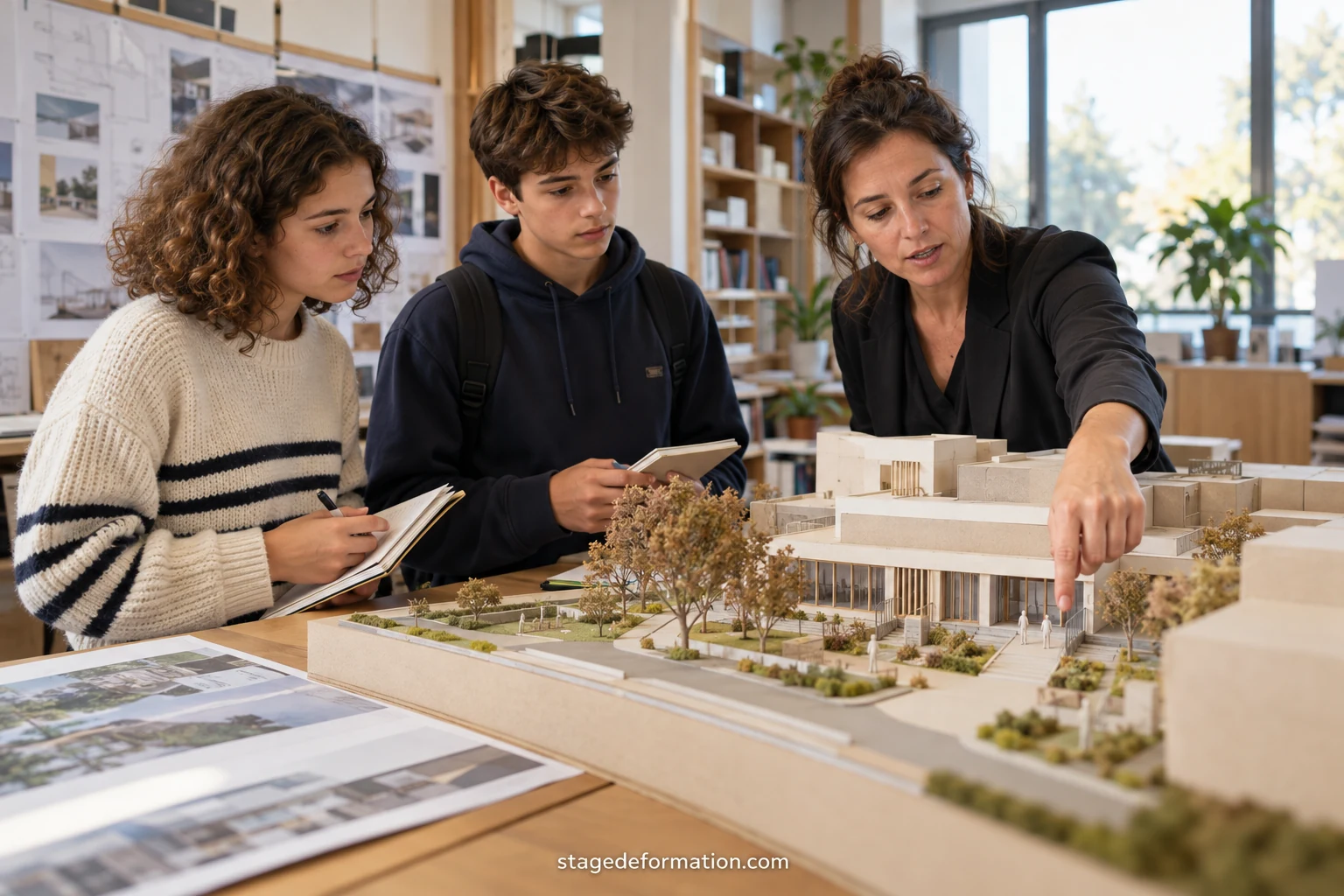
Between a job description on paper and a real Monday morning there is often a wide gap. The observation internship closes that gap: the pupil follows professionals, sits in on meetings or technical tasks, asks questions and writes down what they see. They are not there to produce anything or to stand in for an employee.
That difference in nature explains several rules. In France the pupil keeps school status, receives no wages, and is limited to observing and to light, supervised tasks. The aim is educational: to understand the working world better, with its codes, its constraints and the sheer variety of jobs it contains.
For French pupils in their last year of lower secondary school (troisième, around age 14 to 15), it is part of the career guidance pathway. Other pupils, in general, technological or vocational upper secondary school, may also take part in observation placements at certain points in their schooling, depending on how their school organises things.
The framework: length, agreement and responsibilities
The placement rests on an agreement signed before it starts. It brings together the school, the host organisation, the pupil and, because the pupil is a minor, their parents or legal guardians. It sets out the dates, working hours, location, the name of the supervisor and the planned activities.
In France, a placement in troisième normally lasts one week, at a time set by the school. Hours follow those of the host, within the limits that apply to minors. Safety rules, especially around machinery and hazardous products, are strict: the pupil must not handle equipment reserved for professionals.
- The school approves the agreement and keeps in touch with the pupil.
- The host organisation names a supervisor and explains its internal rules.
- The family signs the agreement and takes care of travel arrangements.
- The pupil respects hours, instructions and confidentiality.
For any question about insurance or exemptions, check with the school office.
Choosing where to observe: three simple criteria
The best place is not necessarily the most prestigious one. Start from three criteria.
- Genuine curiosity: a job that raises concrete questions, not just a familiar name.
- Something you can actually observe: a place where you can watch people at work, ideally in several different roles.
- Accessibility: a realistic journey, compatible hours and someone available to answer your questions.
A town hall, a pharmacy, a farm, a communications agency, a carpentry workshop, an architect's office or a hospital all offer very different experiences. If you are torn between two worlds, it can be better to choose one far from what you imagine: the contrast teaches you more than a confirmation would.
Avoid choosing only because a relative can take you. Family contacts help, but they should not lock you into a single environment.
Where and how to look for a host
Start early, as soon as the dates are known. Organisations receive many requests and often plan several months ahead. Teachers and careers advisers know which places regularly welcome pupils.
Several routes can be combined: public platforms listing observation placements, charities that connect pupils with professionals, the network of other parents, local shops and craftspeople, and local authority services. Pupils at schools in priority education areas can also draw on support schemes.
In your message, introduce yourself in a few lines: your school year, the dates, what interests you about the job, and a parent's contact details. Attach a simple CV. If you hear nothing after a week, follow up politely by phone. A refusal is part of the search: ask whether the person could recommend someone else.
Preparing questions that get people talking
A conversation often begins with "What do you like about your job?", but the most useful answers come from concrete questions.
- What does an ordinary day look like, and what does a difficult one look like?
- Which tools do you use, and which have changed in the last ten years?
- How did you learn this job: studies, an apprenticeship, experience?
- Who do you work with, inside and outside the team?
- What would you recommend to a young person who is undecided?
Prepare ten questions and pick three for each person you meet. Ask about the downsides too: working hours, travel, pay at the start of a career, local prospects. A job should be judged as much on its drawbacks as on its attractions.
During the week: observing with a method
Keep a notebook. Each evening, note three things: what surprised you, a skill you spotted, and a question that is still unanswered. These notes will feed your report and stop you forgetting the details.
Be punctual, dress appropriately for the workplace and keep your phone out of sight. Offer to help with simple tasks when your supervisor allows it: tidying, accompanying someone, preparing a document. An active attitude leaves a better impression than passive presence.
Watch the relationships too: how do exchanges go with a customer, a colleague or a manager? Who makes the decisions? How is a mistake handled? These details describe the culture of the place, which matters as much as the tasks themselves when you are deciding whether a job suits you.
An example of a good write-up
Fictional illustration. Inès, a pupil in her last year of lower secondary school, is torn between a vocational baccalaureate in cooking and a general upper secondary course. She spends her week in a neighbourhood restaurant and in the kitchen of a care home. She notes the hours, the noise, the teamwork, the hygiene checks and how satisfied the diners are.
Her report has four parts: the place and what it does, three days described in detail, what surprised her (how rigorous the organisation is), and what she takes from it for her own plans. She concludes that she likes catering for large groups and precise work, but does not see herself working restaurant evenings. She decides to visit a vocational school at an open day to compare.
The report is useful because it shows reflection, not just a story of the week.
Writing the report and preparing the presentation
The school often specifies the format: a written report, an oral presentation, or both. Either way, structure your account: the organisation, the jobs you met, how a day unfolds, what you gained and the limits of the experience, and the link with your own plans.
A few practical tips: use precise vocabulary and explain technical terms, add a photo if the place allows it, and thank your supervisor with a short written note. Remember to ask permission before sharing any image or internal information.
For the oral, prepare a specific example of what you saw, what you would have liked to try and what changed your mind. Panels value honesty: saying that a job does not appeal to you is a valid conclusion, provided you can back it up.
Common mistakes and alternatives
- Waiting until the last week before the placement to start looking.
- Choosing a place where you cannot see a variety of tasks.
- Asking no questions out of shyness.
- Handing in a report that describes the place without any of your own thinking.
- Ignoring safety or confidentiality rules.
If you cannot find a host, talk to your school: solutions exist, such as group visits, company tours or meetings with professionals organised by the school. They do not always replace a real placement, but they are better than nothing.
Later on, other formats take over: placements in a working environment at vocational school, applied internships in higher education, and work-study. The observation internship is the first step, the lightest and most open of them all.
Frequently asked questions
Is an observation internship paid?
In principle, no: the pupil keeps school status and does not work for the organisation. Some hosts offer a small gesture, such as a meal, but no pay is required. No organisation should ask a pupil for money in return for hosting them. If in doubt, tell the school.
How long does a placement in the last year of lower secondary school last?
It is generally one week, at a time chosen by the school. Dates are given to families at the start of the year. If you have a serious reason you cannot attend, contact the class teacher or the head's office to ask whether another period is possible.
Who signs the internship agreement?
The agreement is signed by the head of the school, the person in charge of the host organisation, the pupil and, if the pupil is a minor, their parents or legal guardians. It must be completed and signed before the placement begins, and each party keeps a copy.
Can I do my placement at a parent's company?
It is possible if the school agrees, but it is not always the best idea. Since the aim is to discover a new professional world, a place outside the family circle often gives a richer experience. Talk it over with your teachers to find the right balance.
What if I cannot find a host?
Tell the school quickly: it sometimes knows partner organisations or matching charities. Widen your search to other sectors, try local authorities, small shops and voluntary organisations, and follow up by phone, which works better than a single message.
Can a pupil operate machinery?
Safety rules for minors are strict. In general the pupil observes and does not use dangerous equipment. Exemptions exist for certain vocational courses, but not for a simple observation placement. The supervisor should explain the safety instructions on the first day.
Can an adult also observe a job?
Yes, through a short work immersion covered by an agreement and arranged as part of support from an adviser. It has the same purpose: to confirm a plan before committing to training. The rules differ from those of a school placement.