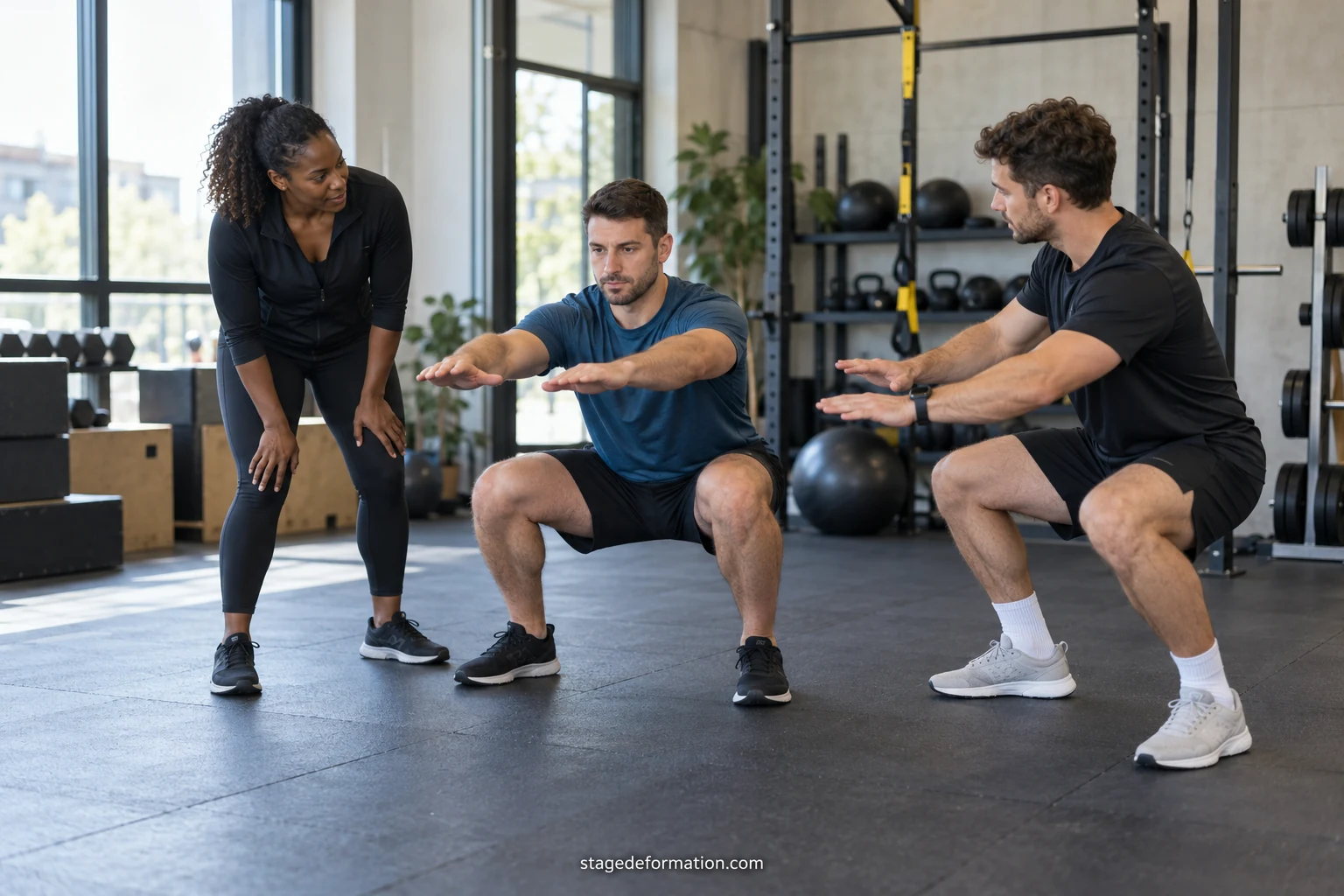
A broad sector, very different roles
Talking about sports careers means talking about realities that have almost nothing in common day to day: the instructor at a gymnastics club welcoming children on Wednesdays, the coach in a fitness studio, the lifeguard-instructor at a municipal pool, the activity leader at a holiday camp, the conditioning coach of a team, the teacher of adapted physical activity in a health establishment.
Before looking for an internship, it is therefore useful to ask yourself which kind of public attracts you (children, teenagers, adults, older people, people with disabilities), which setting suits you (club, local authority, private company, school, health facility) and what rhythm you can accept: evenings, weekends and school holidays are part of the job.
This clarification avoids the most common trap: accepting any sports placement going, then discovering that you are observing a group or a discipline unrelated to your plans.
Qualifications that open the way to coaching
In France, teaching, leading or supervising a physical or sports activity for pay is reserved for people holding a recognised qualification. Several routes exist depending on the level aimed at.
- The BPJEPS, a state diploma at level 4, with different specialities and options: physical activities for all, fitness activities, aquatic activities and swimming, team sports, gymnastic activities, and so on.
- The DEJEPS and the DESJEPS, which lead to coaching, coordination and managing an organisation.
- The STAPS degree and its pathways (sports training, education and motor skills, adapted physical activity and health, sports management), possibly followed by a master’s.
- Federal certificates, useful for introducing or leading activities in a club, but with more limited rights to practise.
The qualification you prepare determines what you will be able to do alone, what you will do in a pair and what you will only observe. It is the first question to put to the training provider.
Work-study or internship: choosing the right formula
In vocational sports training, work-study is very widespread, because the host organisation is the place where you learn. An example published by an agricultural training centre for the BPJEPS “physical activities for all” shows the balance: one year, about 600 hours at the centre and more than 1,000 hours in the organisation, with an apprenticeship contract possible up to age 29 and a professionalisation contract with no age limit.
A classic internship, by contrast, mostly concerns STAPS students, pupils on vocational courses or people on a discovery placement. It is shorter, often centred on observation, with gradual responsibility for parts of sessions.
To decide, compare three criteria:
- how long you want to be present in the organisation;
- your need for a regular income, which a work-study contract provides more reliably than an internship stipend;
- how certain your plan is: if it is not, a short internship lets you test it before you sign a one-year contract.
Entry requirements not to underestimate
Many sports instructor courses impose prerequisites before you can enter. Centres often ask for the first-aid certificate (PSC1) or an equivalent, success in a prior-requirements test, sometimes adapted to the discipline, then an individual interview.
In many cases you must also have found a host organisation before starting the course, because the work-study contract is signed with it. These steps need preparing months in advance: registration for the tests often opens in spring for a September start.
In practice, train for the technical tests in your discipline, prepare a session plan to present and be able to explain why you want to coach rather than just play. Selection panels look for people who can pass on knowledge, not only perform.
Where to find a host organisation
Placement and work-study opportunities fall into broad families. Clubs and association committees regularly look for instructors for their sports schools. Local authorities recruit for swimming pools, neighbourhood facilities and after-school activities. Fitness studios and private leisure centres also employ apprentices, especially for group classes and reception.
Other avenues are less obvious: holiday centres, social-care establishments that offer adapted physical activity, works councils, neighbourhood associations committed to inclusion through sport.
To contact them, draw on your training centre’s network, on the departmental committees of your federation, on town hall sports departments and on work-study job platforms. A speculative application sent before the end of winter, with a short presentation of your plan, is often better received than a generic message.
What an intern may and may not do with a group
This is the number one point to watch. An unqualified intern is not allowed to take sole charge of a paying group: they act under the responsibility of a qualified professional, who remains present and responsible for the safety of the group.
As the internship progresses, the tasks entrusted to you may develop in the following way:
- setting up and putting away equipment, checking the condition of facilities;
- welcoming participants, taking the register, collecting useful information (injuries, absences);
- observing how a session is organised and noting the professional’s adjustments;
- leading a specific warm-up or workshop, with the tutor close by;
- preparing then leading a full session, with a written and oral review.
With minors, additional rules apply in France, notably on integrity checks for supervisors and on the registration of the organisation. Ask your tutor how they are respected in their setting.
Building a session suited to the group: an illustrative example
Imagine a four-week placement in a gentle gym club for adults. The session lasts an hour, with twelve people, two of whom have a known joint condition. The intern begins by reading the tutor’s session plan, then identifies the three parts of the hour: gradual warm-up, main part, cool-down.
During the first two weeks, they note the adaptations they see: a seated variation of a standing exercise, lighter equipment, instructions repeated in a different way. In the third week, with the tutor’s help, they suggest a ten-minute balance workshop. In the fourth, they lead the whole warm-up, then explain what they would change.
This worked example, given for illustration, shows the logic to remember: you start from the group, set a simple objective, plan an easier and a harder variation, and evaluate what worked. A useful session is judged by the participants’ progress, not by its intensity.
Stipend, insurance and practical conditions
In France, an internship of more than two months in the same organisation earns a stipend whose minimum is set by regulation and changes over time: check the current amount with your school. For an apprenticeship or professionalisation contract, pay depends on age, year of training and the rules that apply, sometimes increased by a sports collective agreement.
Before you start, make sure the placement agreement states precisely the activities, places and hours, and that the organisation’s insurance covers interns. For a higher-risk discipline (swimming, climbing, combat sports, horse riding), also ask which authorisations or equipment are expected of you.
Finally, plan for the practical constraints: suitable clothing, travel to facilities that are sometimes far away, irregular hours, weekend work for competitions.
Common mistakes in a sports internship
Several pitfalls recur among beginners. The first is behaving like a participant rather than a coach: you demonstrate brilliantly but no longer watch the group. The second is neglecting safety, for example by starting an exercise without checking the space or the equipment. The third is trying to impose your own method in the first week, instead of observing the professional’s first.
Other mistakes are more discreet: not noting your observations, turning up at the last minute, talking about participants on social media, or accepting a task beyond your level to please someone. In such cases it is better to say clearly that you are not yet authorised and ask to be accompanied.
A logbook kept each week, with three lines on what worked, what got in the way and what you will try next time, provides the basis for your reviews and future applications.
Frequently asked questions
Do I need a qualification to do an internship in sport?
No, an observation or discovery placement is open without a qualification, for example in a school class or in a first year of study. However, leading a paying group alone requires a recognised qualification. The intern therefore acts under the responsibility of a qualified professional, who stays present during sessions.
Can the BPJEPS be prepared as an apprenticeship?
Yes, many training centres and CREPS offer the BPJEPS as work-study, with an apprenticeship or professionalisation contract. Entry generally requires a host organisation ready to employ you, validated prerequisites and an interview. The calendar varies from one centre to another: enquire during the winter before the start.
What age do you have to be to start an apprenticeship in sport?
In France an apprenticeship contract is in principle for people aged 16 to 29, with exceptions in the regulations, notably for disabled workers. The professionalisation contract is not subject to the same upper limit for some groups. Your training centre checks your situation before signing.
Can I do my internship in a volunteer-run club?
Yes, many internships take place in sports associations. A qualified supervisor must agree to act as tutor, the organisation must sign the placement agreement and it must hold suitable insurance. Being a voluntary body does not remove the need to define tasks and supervision precisely.
Are internships in sport paid?
In France, beyond two months in the same organisation, a stipend is compulsory, with a minimum amount set by regulation that changes over time. Below that, it remains possible but optional. In an association, the actual amount therefore depends on duration and resources; the agreement must state it.
How do I prepare for an interview for a work-study coaching post?
Prepare a short model session for a specific group, with objective, equipment and safety instructions. Be ready to explain your availability in the evenings and at weekends, your experience with groups and what you expect from the tutor. A prior visit to the organisation shows real interest and helps you ask useful questions.