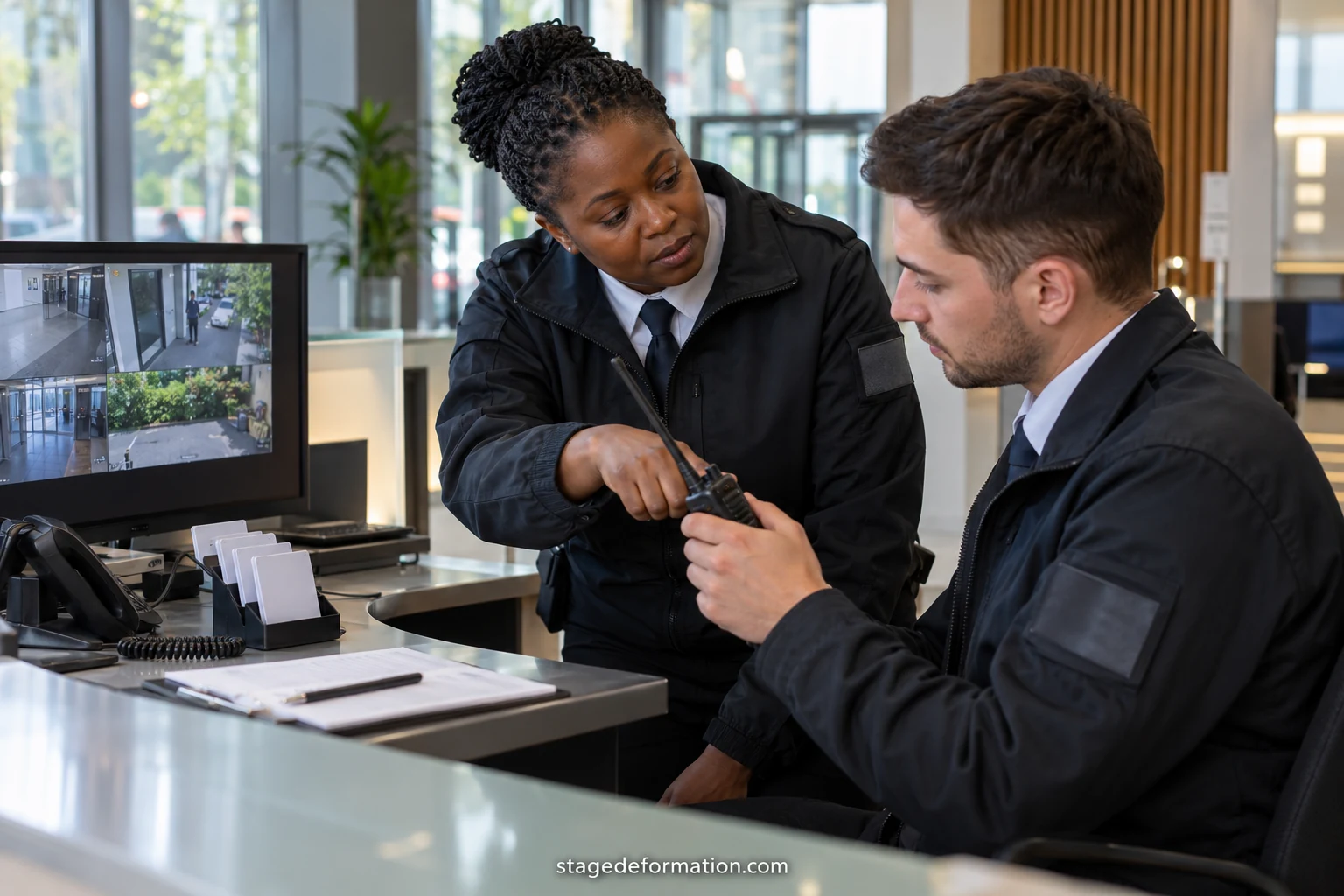
Why this trade sits under a special framework
Private security activities concern the protection of people and property. They allow non-public agents to control access, watch over premises or step in during tense situations. For that reason, in France the internal security code attaches conditions to them: a verified record of good conduct, training, authorisation and a professional card issued by a regulatory body, the Conseil national des activités privées de sécurité.
For a young person, the consequence is simple: you cannot carry out these tasks just because you would like to try. An internship or work-study contract must therefore be chosen according to where you stand in the regulatory pathway. It is better to know this before signing anything.
The aim of this page is to shed light on that framework without oversimplifying it. The rules change, and only checking with the competent bodies gives a reliable answer.
Guarding, remote monitoring and fire safety: three separate worlds
The word "security" covers trades that should not be confused with one another.
- On-site guarding and surveillance: presence on site, reception, access control, patrols, and protection of events or shops.
- Remote monitoring and video protection: analysing images and alarms from a distance, checking whether an alert is genuine and passing information to the relevant services.
- Fire safety and assistance to people: a specific qualification devoted to fire prevention in buildings open to the public and in high-rise buildings.
Add to these airport security, close protection, cash transport and dog-handling security, which have their own requirements. Before choosing an internship, work out which of these worlds it belongs to: the skills, the working hours and the training routes differ markedly.
What an observation placement allows, and what it does not
An observation or discovery placement replaces neither a required qualification nor an authorisation needed to work in the field. The intern is not an agent: they do not take on any control duty independently and have no special powers.
Within an authorised framework, however, they can:
- accompany an agent or a manager to understand a day on duty;
- observe reception, how a security post is run, written instructions and the incident log;
- see how a report is written and passed on;
- talk with a scheduler or a shift supervisor about hours and constraints;
- understand how the company trains and follows its agents.
The tutor must state in advance what the intern does, what they are not allowed to do and who to contact if there is an incident. If a company offers to let you "hold the post" alone or to check people, politely refuse and tell your school.
The regulated pathway to becoming an agent
To work as a prevention and security agent in France, you generally have to complete recognised vocational training, obtain the required authorisations and hold the professional card. The steps can be summed up as follows:
- Find out about the entry conditions: age, personal situation, absence of any incompatibility and a sufficient command of French.
- Choose an approved training provider and check the title or certificate being prepared.
- Submit the authorisation applications to the regulatory body before the training starts, according to the rules that apply.
- Pass the training, which includes first-aid modules and modules on handling difficult situations.
- Apply for the professional card, which you need in order to work.
Processing times vary. That is a reason to start the procedures well before a new school year or a hiring date. The training provider and the regulator's official platform give up-to-date information.
Qualifications, certificates and apprenticeships
Several routes lead into prevention and security jobs in France.
- Vocational baccalaureate dedicated to security trades: a three-year initial course, with periods in companies, preparing for prevention, rescue and safety roles.
- Professional titles and certificates for prevention and security agents: short courses at approved centres, often followed by adults or by young people who have left school.
- Specialist training: video protection, remote monitoring, fire safety, close protection and management of security teams.
- Post-baccalaureate routes: BTS diplomas or professional bachelor's degrees in risk management, safety or the security of property and people.
Apprenticeships exist at several of these levels. The young person signs an employment contract with a security company, alternates classes and periods on duty, and has an apprenticeship supervisor. The company must make sure that the tasks given respect the regulatory conditions that apply to an apprentice.
The qualities expected in the field
Contrary to the image conveyed by some television series, private security values composure and accuracy first.
- Calm and communication: defusing tension with words, staying polite and explaining an instruction without forcing it.
- Punctuality and reliability: a post left unmanned leaves a site unwatched.
- Observation: noticing an unusual detail, a forced entry or a forgotten parcel.
- Clear writing: a report that is dated, factual and free of interpretation.
- Discretion: information about a site is confidential.
- Stamina: night or weekend hours, long periods on your feet and bad weather.
During an internship, these qualities show quickly. Pay attention to how experienced agents speak to visitors, because it illustrates the trade better than any manual.
Applying and succeeding at the interview
A serious security company checks the regulatory situation of every candidate. State yours openly: training under way, authorisation applied for, card already obtained or not.
- Attach a simple, well-structured CV with your availability.
- In the letter, say which type of site you have in mind (shop, events, industrial site, offices) and why.
- Prepare two examples where you stayed calm when something unexpected happened: sport, volunteering or a summer job.
- Ask about supervision, in-house training, how hours are shared out and how incidents are handled.
To find a host company, consult the professional organisations, partner training centres and the jobs sections of the federations for remote monitoring and electronic security. A school or an apprentice training centre that already knows the company is a sign of reliability.
Worked example: a week of discovery in a remote monitoring centre
Here is a fictional scenario with rounded durations. A first-year vocational school student spends five days in a remote monitoring centre, with the agreement of her school.
- Day 1: welcome, presentation of confidentiality rules, a tour of the rooms and reading of the written instructions.
- Days 2 and 3: watching an operator, an explanation of how an alarm is handled, and a look at the software without taking any action herself.
- Day 4: reading anonymised reports and an exercise in writing a factual report from a made-up case.
- Day 5: a talk with the manager about training, hours and possible career progression.
At the end, the student knows whether this setting suits her and which regulatory steps she will need to take later.
Traps and mistakes to avoid
- Accepting a control or surveillance task without the card or authorisation when these are required.
- Paying for a course or a "file" without checking that the provider is recognised.
- Confusing a private security agent, a municipal police officer and the national law enforcement forces: their powers are not the same.
- Promising a client an intervention that the law does not allow.
- Neglecting the contract or agreement: hours, places, tasks, tutoring and any allowance must be put in writing.
- Underestimating the demands of night work, weekends and travel, especially for minors, whose working time is regulated.
If in doubt, contact your school or the training centre before committing yourself.
Frequently asked questions
Can you do a private security internship before holding the professional card?
Yes, an observation or discovery placement is possible, because it gives the intern no powers. It does not, however, replace the qualification or authorisation needed to work. The intern carries out no independent checks or surveillance, and the tutor must set out the tasks in writing.
What is the difference between a prevention agent and a remote monitoring operator?
The agent is present on site: reception, access control and patrols. The operator works remotely in a centre, in front of screens, handling alarms and images. Training, hours and surroundings differ. Some companies offer both, which allows people to move from one role to the other.
At what age can you work in this trade?
In France, working in private security is limited to people who meet the legal conditions, including a minimum age. Pupils who are minors cannot be given reserved tasks. To learn the current rules, ask the regulatory body and your school before looking for a placement.
Is work-study training possible in private security?
Yes, several titles, vocational baccalaureates and post-baccalaureate courses can be prepared as apprenticeships. The apprentice is an employee of a company and alternates classes with periods on duty. The tasks given remain limited by their qualification and the authorisations obtained. Pay depends on the rules in force.
How can I recognise a reliable training provider?
Check that it is approved for the course you want and that it clearly sets out the title prepared, the syllabus, the length, the price and the pass rate. Be wary of promises of guaranteed jobs or an "automatic" card. Ask the regulator, your careers adviser or a company in the sector for advice.
What are an agent's usual working hours?
They vary by site: days, evenings, nights, weekends and public holidays are all common, sometimes on rotating shifts. Contracts provide for schedules given in advance. During an internship, ask for the duty roster to judge whether the rhythm suits you, especially for journeys at night.