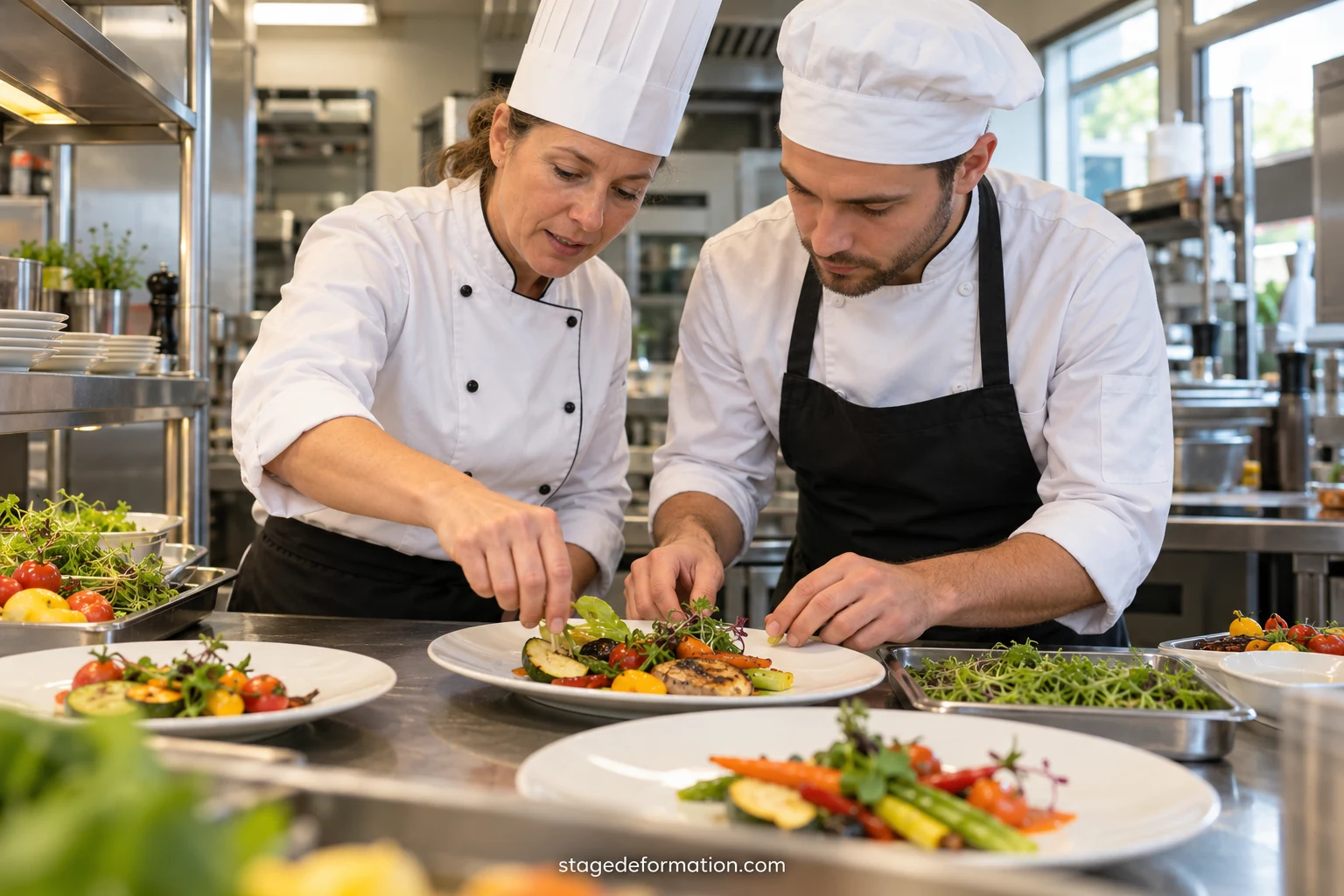
A kitchen day starts long before the first customer
Diners see the plates; professionals know that everything is decided beforehand. Mise en place takes up much of the morning or afternoon: receiving and storing deliveries, peeling, cutting, stocks and sauces, pre-cooked items, stock checks. By the time the first orders arrive, every station must have what it needs within reach.
During service the kitchen works like a chain: the head chef or sous-chef calls the tickets, each station carries them out, and the pass checks and sends the dishes out. After service come a full clean-down, tidying, temperature records and notes for the next day. An intern who understands this cycle learns faster than one who retains only a few recipes.
Traditional, contract and fast-food catering: choosing your field
The word “kitchen” covers several worlds. In traditional or fine-dining restaurants, the menu changes with the seasons, suppliers are varied and precise technique counts for a great deal. In contract catering, in a school canteen, a healthcare establishment or a staff restaurant, large volumes are prepared with planned menus, nutritional constraints and more regular hours.
Fast food and chain catering rely on standardised procedures and a high tempo. Catering for events adds transport, setting up on site and working in a temporary team. None of these worlds is better than another: they call on different skills. Choose according to your tastes, the hours you can manage and what you want to learn.
Qualifications and possible pathways
In France, the CAP cuisine is the most common foundation for entering the trade: preparation techniques, cooking methods, hygiene and organising a station. The vocational baccalaureate in cookery builds on these skills and adds management and sales. The brevet professionnel and the complementary mention allow you to specialise or progress after a first qualification.
The BTS in hotel and catering management, with its culinary arts option, prepares for roles such as chef de partie or sous-chef, even unit manager. Professional titles are also available to adults changing career.
Many of these qualifications are prepared in vocational schools, apprentice training centres or specialist colleges. The Compagnons du Devoir offer an apprenticeship route combined with a travelling tour of France. Compare the programmes, the work-study rhythms and the partner companies before you choose.
Hygiene and safety: rules that shape every movement
In a professional kitchen, hygiene is not a separate chapter: it governs every action. Washing hands at the right moment, keeping raw and cooked products apart, respecting the cold chain, cleaning surfaces, and labelling preparations with their storage dates are all part of the working method. In France, regulations require establishments to apply food-safety risk-control principles and keep records.
Allergens also demand particular rigour. An intern must learn to recognise the products concerned, check what a preparation contains and report any uncertainty instead of guessing. On the safety side, burns, cuts and slips are the most frequent accidents: non-slip shoes, suitable clothing and rules about moving around the kitchen reduce the risks.
From the first day, ask who checks your preparations, how to raise a doubt and which equipment you may use alone. For minors, certain machines and certain hours are prohibited or strictly supervised.
What an intern does, what an apprentice does
The intern is first of all in supervised observation: preparing vegetables, cleaning, plating simple elements, following a station and asking questions at appropriate moments. The tasks must stay linked to the objectives in the placement agreement and must not replace an employee.
The apprentice is an employee in training. From the first weeks they hold a simple station, then progress: basic cooking, sauces, plating, and sometimes running a whole station towards the end of the course. Their apprenticeship master assigns tasks so that practice matches the qualification being prepared. Pay depends on age and year of contract, within limits set by regulation. If you want an income and a long immersion, an apprenticeship is often the most complete route; if you simply want to test the trade, a short internship is the safer choice.
Finding a kitchen that really trains you
A good host kitchen depends less on reputation than on the team’s attitude. Go for a visit: see whether the stations are clean, whether the chef speaks calmly, whether young people are included and whether safety instructions are displayed. Ask who your supervisor will be, how staff meals are organised and whether you will work on several stations.
There are several ways to search: schools and training centres, which know their partner businesses; hospitality trade organisations; contract catering companies; and restaurants in your neighbourhood visited outside the rush. Preferably introduce yourself between two services, with a short CV, a clean uniform and clear availability.
Illustrative example: four weeks in a neighbourhood restaurant
Imagine Inès, a CAP student, hosted for four weeks in a thirty-seat restaurant. She begins at half past noon with the mise en place: vegetables of the day, checking the containers, labelling. During the first week she does not touch the cooking, but she watches the rhythm of service and notes the order of the tickets.
In the second week she prepares garnishes and plates starters under supervision. In the third she follows a full station for forty minutes of quiet service. In the final week she writes a report built around one subject: how the chef adjusts quantities according to bookings.
This example is an illustration with round figures: tasks, hours and the level of independence depend on the establishment, the student’s age and the requirements of the qualification.
Working rhythms and physical stamina
The job is done standing up, sometimes in great heat, with loads to carry and long days. Hours often include a break between lunch and dinner service, and weekends and public holidays are worked. In France these conditions are governed by employment law and the collective agreement, with special protections for minors.
Prepare yourself physically: good shoes, water to drink, a balanced meal before service. Ask for the typical weekly rota and the rest days. A rhythm that is too heavy harms both learning and safety; if your agreement is not being respected, contact your school contact before the situation worsens.
Writing a useful report and preparing what comes next
A kitchen placement report is better when it describes an organisation rather than a list of recipes: the layout of a station, managing quantities, handling returns, coordination between kitchen and dining room, dealing with waste. Add measurable elements, such as the time spent on a task or the number of covers in a service.
For what comes next, ask your tutor which qualities they look for in a future apprentice, which stations to discover next and which competitions or challenges exist for young cooks. Keep a record of your progress: a list of techniques mastered, feedback received, contact details. This makes it easier to apply for a work-study place or a first job.
Frequently asked questions
Do I need to have cooked at home before starting?
It is not compulsory. Kitchens mainly expect motivation, punctuality and the ability to learn. Having cooked for family and friends makes the first movements easier, but professional work follows rules of hygiene, pace and quantity that are very different from home cooking.
What is the difference between a CAP in cookery at school and as an apprenticeship?
The content of the qualification is the same. In a vocational school you attend classes and placements covered by an agreement. As an apprentice you are employed and alternate between the company and the training centre. The second is often more intense, while the first leaves more time for teaching.
Is a kitchen internship paid?
In France, beyond a minimum placement length set by law, a stipend is compulsory, with a minimum amount defined by regulation and liable to change. Meals or benefits in kind may be taken into account under the applicable rules. Have all of this made clear before signing.
At what age can you start a cookery apprenticeship?
In France an apprenticeship contract is open to young people within an age bracket set by the labour code, with special cases. Some courses start straight after lower secondary school. To find out your exact situation, ask an apprentice training centre or your school’s guidance service.
What should I do if I hurt myself in the kitchen?
Tell the manager immediately, have the injury treated and ask for it to be declared as a work or placement accident, depending on your status. Inform your school. A prompt declaration protects your rights, even if the injury seems minor.
Can I do a kitchen internship as a vegetarian?
Yes, but say so in advance. A professional sometimes has to taste or handle animal products. Depending on the establishment, some tasks can be adapted. Discuss it frankly before the agreement is signed, to check that your learning goals remain compatible with how the kitchen works.
How can I progress quickly during an internship?
Be punctual, observe before acting, ask how to do something when an instruction is unclear and note each evening what you have learned. An intern who keeps their station clean, anticipates the mise en place and accepts feedback is soon given more interesting tasks.