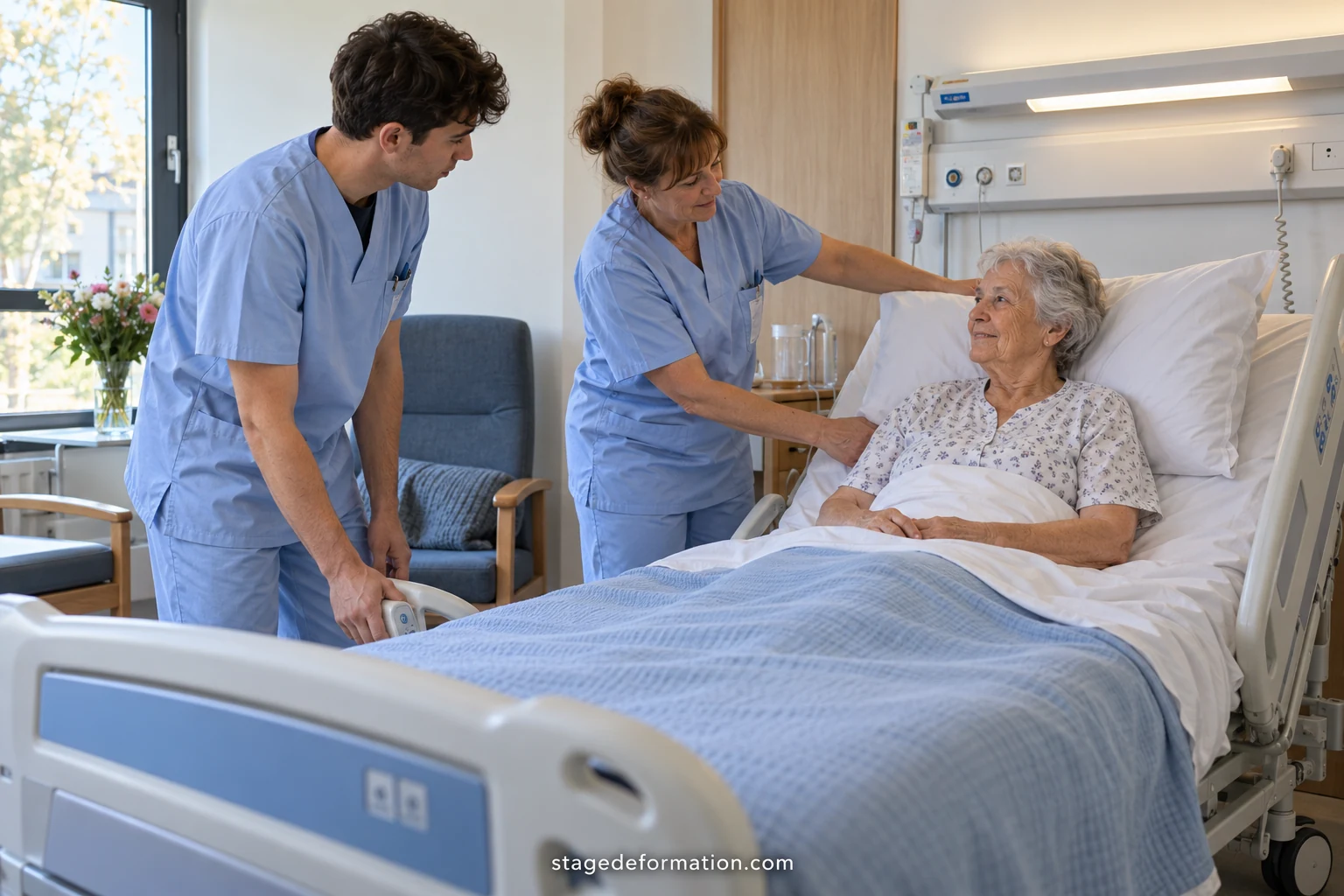
A caring job, learned in the field
The healthcare assistant works as close as possible to the people in their care: washing, help with dressing and meals, moving and handling, monitoring general condition, and gathering information for the team. They work with the nurse, who remains responsible for nursing care, and they help to spot what changes in a patient's or resident's condition.
This job is not learned in a classroom alone. The training gives as much room to practice as to theory, because everyday care skills, moving and handling, communicating with vulnerable people and a sense of teamwork are built through repetition, with professionals who demonstrate and correct.
For a reader who is hesitating, keep this in mind: the course suits school-leavers as well as adults changing career, and in most cases you do not need a prior qualification to apply.
Length and structure of the training
Under the order governing the course since 2021, the State Diploma amounts to 1,540 hours, or 44 weeks, divided into two equal halves.
- 770 hours, or 22 weeks, at the institute: ten modules, individual educational support and guided personal work. Part of the theory teaching can be done remotely.
- 770 hours, or 22 weeks of 35 hours, in the workplace.
There are four internship periods. Three five-week periods (A, B and C) let you explore the duties in different care settings. A fourth, seven-week period (D) takes place at the end of the course, in one block, to consolidate independence.
The route must include at least one period with people with disabilities, one with older people, as well as a night-shift experience and a weekend experience. Institutes organise the split; the total duration can stretch over more than a year depending on the route chosen.
Where the internships take place
Host employers may be public or private, in the health, social and medico-social sectors. Each setting shows a different side of the job.
- A hospital unit for medicine, surgery or follow-up care, with more technical care and a fast turnover of patients.
- A care home for older people (EHPAD) or a long-stay unit, where you support residents over time and the relationship matters as much as the technical skill.
- A service for people with disabilities, which demands patience, observation and listening to the person.
- A hospital-at-home service or a home care and support service, where you work with more independence.
An internship agreement is signed whatever the setting. It sets out the objectives, the tutor, the hours and the conditions of the placement. Read it before signing and keep a copy.
How to get onto the course: selection and profiles
The entry and selection conditions are set by regulation and applied by each institute. At several institutes you must be at least seventeen on entry, but no qualification is required to take part in selection, which is based on a file review and, in some cases, an interview. Applications may go through a national platform or directly to the institute, depending on your situation.
Some routes are shortened. Holders of related qualifications, such as childcare auxiliary, ambulance technician or certain vocational baccalaureates in personal services, can obtain exemptions from certain modules. Qualified hospital service staff may also benefit from adjustments.
If you already work in the sector, continuing training or the validation of experience are other possible routes. Ask the institute or your employer which one fits your situation.
The apprenticeship route: alternating contract and institute
It is possible to prepare the diploma through an apprenticeship at institutes that offer this route. The apprentice signs a contract with an employer, such as a hospital, a care home or a home-help organisation, and divides their time between the institute and the workplace. The training lasts at most eighteen months, with periods of work at the employer's in addition to the teaching and internships.
The benefit is twofold: the apprentice is an employee, receives pay set by regulation according to age and year, and gains long experience in a team that may then offer a job. In return the pace is more demanding, working hours are a real constraint and the contract means finding an employer before or during the start of the course.
Pay levels and hiring subsidies change; ask the institute, the apprentice training centre and the skills operator for the health sector for the current figures.
Internship route or apprenticeship: compare before you choose
Both routes lead to the same diploma, but they do not suit the same situations.
The initial-training route with internships
It leaves more time for theory and for changing setting with each period. It suits students who want to discover several types of patients before choosing a sector. Any allowance depends on how the course is funded.
The apprenticeship
It requires an employer and regular presence in the same place, which helps integration and hiring but reduces the variety of experience, unless the institute arranges complementary periods in other organisations.
Put precise questions to the institute: how many apprenticeship places, who looks for the employer, what alternation calendar, which complementary internship settings, and what help with travel costs?
Getting ready for the practical conditions of the job
The work is physical and emotionally demanding. Before starting the course, think about what that means.
- Morning, afternoon, night and weekend shifts, with days off that do not always match those of family and friends.
- Travel, sometimes considerable, between home, the institute and the placement sites; test the journey and have a fallback plan.
- Moving and handling work, for which you learn good posture and the use of technical aids.
- Sensitive situations: pain, end of life, disorientation and sometimes aggression.
For the first internship, prepare a suitable uniform, comfortable shoes and a few questions for the tutor: how are handovers organised, who do I contact if in doubt, which care can I observe or carry out under supervision?
Succeeding in assessments and avoiding common mistakes
Each internship period ends with an assessment of skills, completed by the tutor and discussed with the student. It becomes a working tool if you approach it methodically.
- Set one objective per week, for example a full wash respecting privacy, or reporting your observations orally.
- Ask for immediate feedback after difficult situations.
- Note what you have learned and what you want to improve for the next period.
Frequent mistakes include going into a room without knocking or introducing yourself, talking about the person as if they were an object while they are present, forgetting to check identity before care, going beyond your role by carrying out a procedure reserved for nurses, or staying silent about a fall or pain reported by the patient. If in doubt, call the nurse in charge before acting.
Worked example: a year of training by alternation
For illustration only, imagine a student who joins an institute in September and follows the continuous 44-week course.
- September to November: 7 weeks of teaching, then a first 5-week internship in a care home.
- January to March: 8 weeks of teaching, then a 5-week internship on a medical ward.
- April to May: a 5-week internship with people with disabilities.
- At the end of the course: a final 7-week internship, during which she looks after a group of residents with the tutor.
The total remains 22 weeks of teaching and 22 weeks of internship. This calendar is fictional: each institute publishes its own, with its own holidays and group sessions.
After the diploma: work and further study
The diploma opens up posts in hospitals, clinics, care homes, home-care services, establishments for people with disabilities and health centres. Recruitment needs are large in several areas, but working conditions vary greatly between organisations: do not hesitate to compare rotas, cover arrangements and the continuing training on offer.
Many healthcare assistants go on to other care qualifications, notably nursing, through bridging routes and professional promotion schemes. Internships serve here as first contacts: keep your tutors' contact details, as they can support an application or flag a vacancy.
Frequently asked questions
How long does healthcare assistant training last?
It amounts to 1,540 hours, or 44 weeks, split between 22 weeks of teaching at the institute and 22 weeks of internship. Depending on the route, it can run continuously over about a year or in stages over two years at most. An apprenticeship lasts at most eighteen months.
Do you need a qualification to enter a training institute?
At most institutes no qualification is required to take part in selection, which relies on a file and sometimes an interview. A minimum age of seventeen is often asked for. The exact conditions are set by regulation and by each institute, which is best contacted before you apply.
Can you become a healthcare assistant through an apprenticeship?
Yes, at institutes that offer this route. The apprentice signs a contract with an employer and alternates periods at the institute with periods in the workplace, for a maximum of eighteen months. You have to find the employer, so start looking early and use the support of the institute or the apprentice training centre.
Which types of internship setting are compulsory?
The route must include at least one period with older people and one with people with disabilities, plus a night-shift experience and a weekend experience. The other settings are chosen by the institute: hospital, care home, hospital-at-home, social or medico-social organisation.
Are healthcare assistant internships paid?
It depends on your status. An apprentice receives pay set by regulation. On other routes an allowance or grant may exist depending on the funding, for example from the region, France Travail or the employer. Amounts change: ask the institute about your exact situation before committing.
Can you carry out nursing procedures during the internship?
No, not independently. The trainee healthcare assistant carries out hygiene, comfort and monitoring care within their competences, under the responsibility of the team. Procedures that belong to the nursing role remain reserved for authorised professionals. If in doubt, always ask before acting.