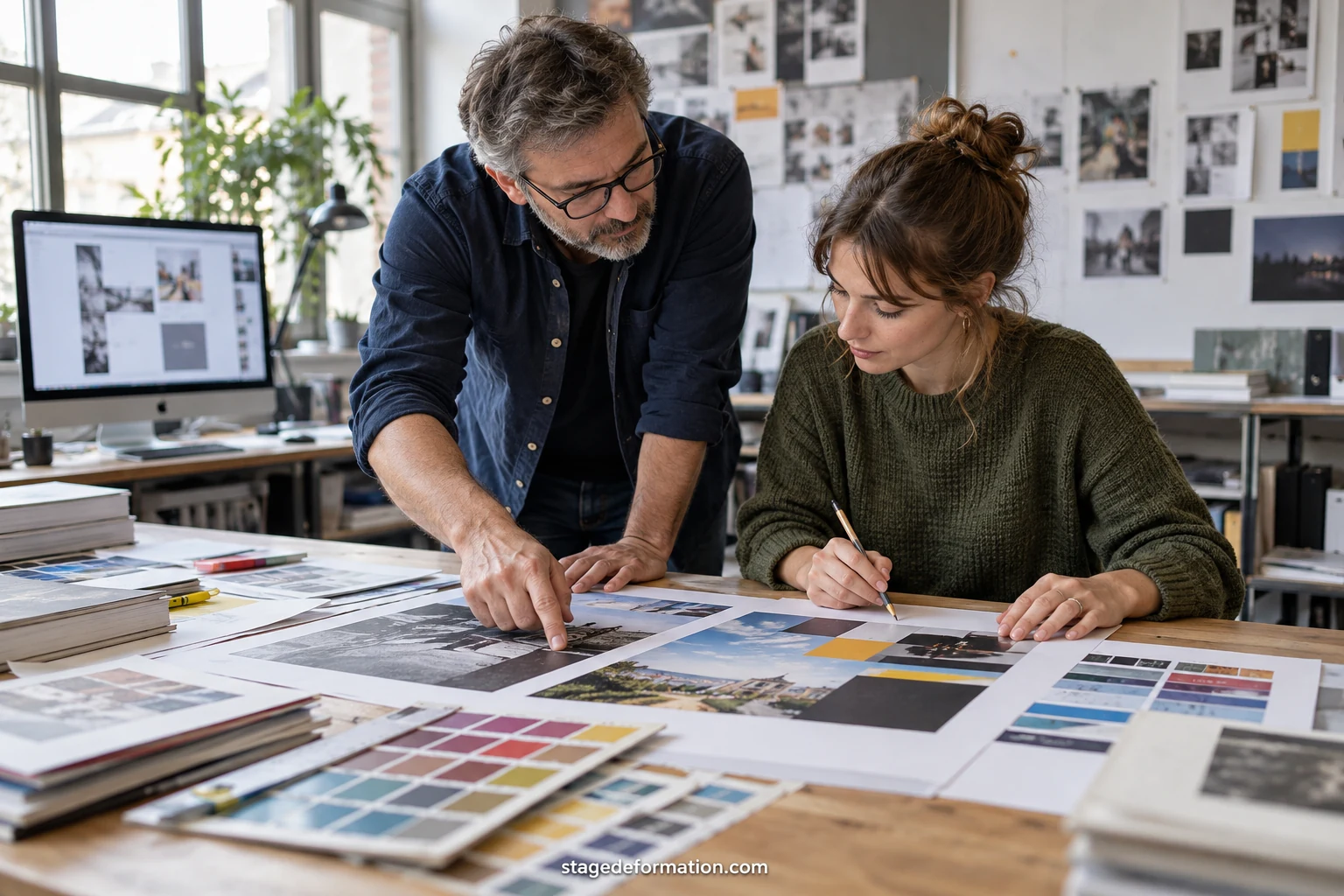
A profession between creativity, constraints and production
In publishing, the graphic designer almost never works alone on a blank page. They respond to a brief: a publisher, an author, an editorial team, a series or a communications department has a message, an audience and a medium. The work consists of translating that framework into readable visual choices: heading hierarchy, grid, typography, colours, the place of images and the rhythm of the pages.
An internship lets you see what separates a beautiful composition from an object that can really be published. Printing deadlines, the paper budget, the length of a volume, legibility on a small screen or the constraints of an existing series often limit the options. Learning to create within those limits is one of the skills recruiters look for most.
The organisations that take on graphic design interns
The word “publishing” covers very different environments, and each brings a particular kind of learning.
- Book publishers: covers, interiors, paperback or art series, and sometimes dust jackets and promotional materials.
- Press and magazines: fast layout, respecting a template, and handling photos and captions under deadline pressure.
- Graphic design studios: identities, annual reports and exhibition catalogues for institutions or companies.
- Communications departments of organisations: brochures, reports, institutional materials and digital versions.
- Digital and children’s publishing: enhanced books, apps and picture books where drawing and typography work together.
A small organisation often gives more responsibility, whereas a large house offers smoother processes and a team to observe.
Possible tasks during the internship
Tasks vary with the organisation, but some come up often:
- laying out a book or an issue from an existing template;
- proposing covers or opening pages, with several options presented to the art director;
- retouching and calibrating images, preparing captions and checking credits;
- entering proofreading corrections and keeping track of successive versions;
- preparing files for the printer or for digital distribution;
- adapting a visual to several formats: poster, social media, website banner.
Your role is to learn the approval chain: who signs off the text, who signs off the visuals, who gives the final go-ahead for print. Ask the question early, because every workplace has its own method.
Technical skills and visual culture expected
Layout and image-editing software are the foundation, but they are not enough. Teams above all look for interns who can justify their choices. A good command of typography (legibility, line spacing, hyphenation, hierarchy) is worth more than a collection of fashionable fonts.
A few points to work on before the internship:
- the notions of colour on screen and in print, of resolution and of bleed;
- the vocabulary of the graphic chain: mock-up, template, proof, print approval;
- an editorial culture: knowing how to look at a cover, a signature or a magazine and say why it works;
- the ability to take criticism and rework a piece without getting defensive.
The most common courses range from applied arts programmes to schools specialising in graphic design or visual communication. Some pathways, such as the French DN MADE in graphic design, include periods of internship and then work-study: at the Gobelins school, for example, the first year is full time with internships, and the next two years are spent as an apprentice.
A portfolio that shows your process, not only the result
A graphic designer’s portfolio is judged in a few minutes, so it has to be selective. Five or six well-documented projects are worth more than twenty visuals without context.
- For each project, state the brief, the audience, the medium and your exact role.
- Show the process: sketches, research, rejected variants and the reasons for the final choice.
- Include at least one complete editorial project: opening pages, a typical double page, cover, spine and back cover.
- Present the production side if you have experienced it: the paper chosen, the format, the binding and the file delivered.
- Take care over the presentation of the portfolio itself, which is already a piece of layout.
Attach a light PDF to your application and keep an online link up to date, but recall the essentials of your background in your message, since many recruiters do not download large attachments.
Rights, fonts and images: a subject not to discover too late
A graphic designer handles protected works: typefaces, photographs, illustrations and texts. Each element has its own terms of use. A font that is free for personal use may not be free for a book that is sold. An image found online is not royalty-free by default. In a publishing organisation, these questions are governed by contracts and by a person in charge of rights; it is up to the intern to respect them and to flag any doubts.
For your portfolio, apply the same rigour: include only elements whose use you can justify, mention credits and ask your supervisor what you are allowed to show of work done in a company, particularly if it concerns a book that has not yet been published.
Where to look and how to apply
Offers can be found on the careers pages of publishing houses, in school announcements, on creative job sites and through professional networks. An unsolicited application works better here than elsewhere when it is targeted: mention a book or series you admire and explain what you would bring.
A few practical tips:
- address the right person: art director, production manager or in-house studio;
- send a short message, a portfolio and a one-page CV;
- be ready for a test: laying out an extract, proposing a cover, correcting a mock-up;
- follow up once, politely, after about two weeks.
The internship is governed by an agreement signed with your school. In France, beyond two months a stipend is due, with a minimum set by regulations that change over time: check it before signing.
Illustration: a week in a studio preparing a catalogue
Fictional example, with rounded figures. Inès is an intern in a small studio producing the catalogue of an exhibition of about one hundred and twenty pages. On Monday she applies the approved grid to twenty pages of text and flags two captions that are too long for their space. On Tuesday she prepares layout tests for a section of images, with two variants of rhythm that she presents to the art director.
On Wednesday she enters corrections from the proofreading committee and keeps the versions to avoid confusion. On Thursday she checks the images: resolution, colour profile and credits. On Friday she prepares one export for the printer and a second for a digital version, then notes the differences between the two. By the end of the week she understands better why a page that is perfect on screen can cause problems in print.
Common mistakes and good habits
- Showing images without context. A portfolio must explain the brief and the choices.
- Ignoring production. A file that is well designed but badly prepared costs time and money.
- Multiplying fonts and effects. Restraint serves reading, especially in publishing.
- Neglecting versions. Name and store files clearly, without overwriting earlier states.
- Forgetting to ask for feedback. Ask for a critique halfway through, note it down and apply it.
Finally, keep a record of your work, with the organisation’s consent, to feed your next portfolio.
Frequently asked questions
Which software do I need to know for a graphic design internship in publishing?
Layout, image-editing and vector drawing programs are the most widely used, but every organisation has its preferences. It is better to master the principles (grid, typography, colour, export) than to depend on one tool, because they carry over from one program to another.
Is a portfolio compulsory?
In almost every case, yes: it replaces a large part of the cover letter. It can be a PDF or online. Select a few projects that show your process, your typographic choices and, if possible, a complete editorial project with a cover and inside pages.
Can I do an internship in publishing without specialist graphic design training?
It is possible for some positions close to publishing, such as production or editorial assistance. For a graphic design post, however, recruiters expect skills that are visible in a portfolio, acquired at school, in courses or through solid personal projects.
Who owns the layouts produced during an internship?
The question falls under copyright law and the contract or agreement. In practice, work done for the organisation belongs to it or is assigned to it under the agreed terms. Ask before the internship what you will be able to show afterwards, especially for a book that has not yet been published.
Can a graphic design internship be done remotely?
Some organisations offer partial remote work, but most of the learning comes from being there: exchanges with the art director, checking proofs and discussions with the production team. Ask in advance how the internship is organised and how you will get feedback on your work.
What is the difference between a graphic designer and a layout artist?
The layout artist applies and adapts an existing template to lay out content, whereas the graphic designer also designs the identity, the grid and the visual choices of a series or a medium. In small organisations the two roles are often blurred, especially during an internship.