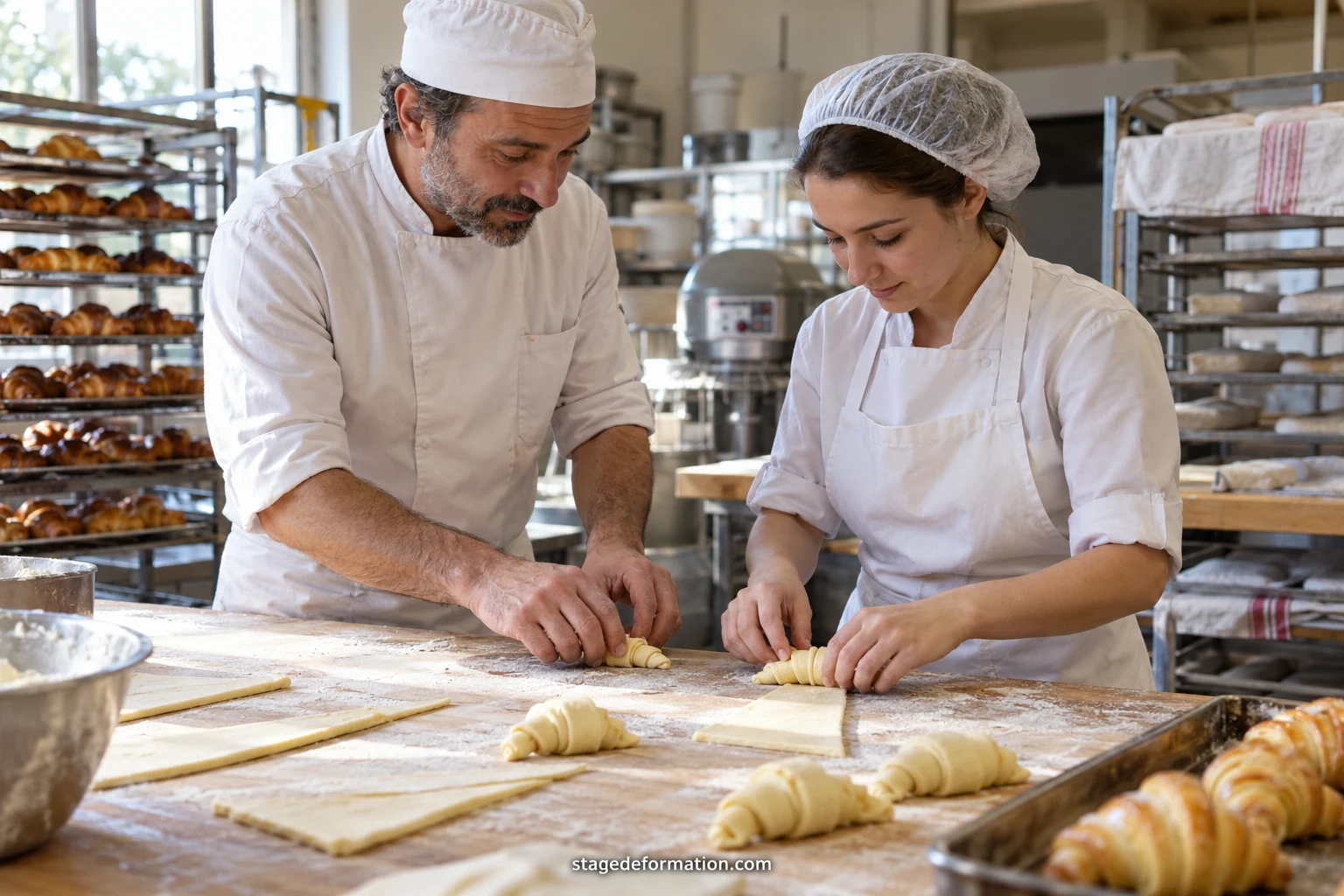
Two neighbouring trades, two ways of working
In the same shop, the baker and the pastry chef do not work to the same tempo. The first manages something alive: dough reacts to the temperature of the water, the flour and the humidity of the room, and fermentation time dictates the organisation. The second works more through successive preparations: creams, pastry doughs, assembly, baking at precise temperatures, cooling and finishing.
Many businesses offer both, others only one of the two specialities, and some add viennoiserie, snacking or chocolate. Before applying, therefore, ask which production you will really see: everyday bread, speciality breads, viennoiserie, layered desserts, shop pastry or restaurant desserts.
This detail changes everything for your learning. An intern who spends three weeks at the mixer and on shaping does not acquire the same reflexes as one who assembles tarts all day. Note what you want to observe, then check that the business can offer it.
Observation placement, training placement or apprenticeship contract
Three frameworks exist, and they are not equivalent. A discovery placement, often done at lower or upper secondary school, is meant to check that the trade suits you: you observe, help with simple tasks and replace nobody. In France, the period of training in the workplace (période de formation en milieu professionnel), provided for in vocational baccalaureates and other courses, forms part of a school programme with assessment objectives.
An apprenticeship contract is of a different nature: it is an employment contract alternating with classes at an apprentice training centre. The apprentice is an employee, paid according to rules linked to age and year of training, and followed by an apprenticeship master. Amounts change with regulations: check with the training centre when you sign.
In the food trades, apprenticeship is the most widespread route for the CAP, because the business trains you on real production. An internship nevertheless remains useful for testing the trade before committing for two years.
Qualifications that lead to the workshop
In France the classic entry point is the CAP boulanger or CAP pâtissier, prepared over two years, as an apprentice or in a vocational school. The vocational baccalaureate for baker-pastry chefs extends the path with more management, technology and commerce. Next come the brevet professionnel, then the brevet de maîtrise, which prepares you to lead a team or set up on your own.
Complementary mentions and specialisation certificates also allow you to refine your skills: viennoiserie, bakery pastry, lamination techniques. Career changers often take a one-year CAP or short courses for adults, depending on the experience already gained.
Choose the qualification according to your plan: working in a craft bakehouse, joining a supermarket workshop, entering the food industry or taking over a business do not call for the same level of technique or management.
A typical day, from weighing to the shop shelves
Work starts early. In a bakery, production generally begins before dawn, since the bread must be baked by opening time. Here is a common organisation, to be adapted to each house:
- setting up the station, checking raw materials and weighing ingredients;
- kneading, resting the dough, dividing and shaping;
- proving, loading the oven, watching the bake and unloading;
- viennoiserie, pastries and snacking items according to the range;
- cleaning, tidying, traceability and preparing for the next day.
Beginners start with repetitive but instructive tasks: weighing, filling trays, cleaning, looking after equipment. The skill comes afterwards. Do not treat this as drudgery: the consistency of a product is exactly what distinguishes a professional from an amateur.
Before the first day, ask what hours are planned, which days are rest days and how often weekends are worked, so that you can organise your travel and your sleep.
Hygiene, safety and working conditions
A food workshop obeys strict rules. The principles of food-safety control, often summed up as the HACCP method, require temperatures to be checked, clean and dirty routes to be separated, batches to be traced and hands to be washed as often as necessary. The allergens that must be declared by law have to be known and flagged: an intern who ignores this rule puts a customer in danger.
On the safety side, a bakehouse combines heat, machinery and slippery floors. The mixer, sheeter, beater, slicer and oven are used only with the agreement and presence of the tutor, especially for a minor. In France, the rules on night work and dangerous machinery are stricter for under-18s, with supervised exemptions in certain trades: have them confirmed by your training establishment before signing.
Bring non-slip safety shoes, a clean uniform every day, tied-back hair and short nails. These details, which seem minor, count in the assessment.
Finding a host business
Proximity matters, since early hours make long journeys wearing. Start with the craft bakeries and pastry shops in your neighbourhood or town, but also think of catering workshops, hotels with their own pastry section, chocolatiers and supermarkets with an in-store bakehouse.
Introduce yourself in person in the early afternoon, when the team is less busy, with a short, readable CV. A craftsman responds better to a young person who knows his shop, his signature loaf or his speciality than to an application sent out in bulk. Apprentice training centres, chambers of trades and trade organisations often keep lists of businesses that recruit apprentices, which makes it easier to get in touch.
If you are looking for an apprenticeship contract, start early in the preceding school year: the good places go quickly, especially in houses with a reputation for training well.
Preparing for the interview and the first day
The craftsman is looking less for a qualification than for an attitude: punctuality, eagerness to learn, physical stamina and respect for instructions. Be ready to explain why the trade attracts you, what you have already tried (home-baked bread, a workshop, a small job) and how you plan to cope with the hours.
You can ask a few questions in turn: who will be your tutor, how many people make up the team, which productions you will see, which tasks you will be given at the start. These are a professional’s questions, not a nosy person’s.
On the first day, arrive ten minutes early and bring your uniform, a notebook and a pen. Write down the proportions, temperatures and resting times you are given; recipes remain the property of the business and must not be photographed without permission.
A worked illustration: one placement week to make progress
By way of example, imagine a CAP pastry student doing a four-week placement in a neighbourhood pâtisserie. Instead of setting a vague goal, she writes three measurable targets in her notebook:
- weigh out the ingredients of a shortcrust dough on her own, with a deviation of less than one gram on the precision scale;
- line ten tart cases that are even in thickness and baking, without having to redo any;
- explain aloud each stage of a layered dessert, from the cream to the glaze.
At the end of each week she compares her results with what her tutor expected and notes what remains to be worked on. This example is deliberately simplified, but it shows that a successful placement is built with benchmarks, not just goodwill.
Common mistakes to avoid
Some slips come up often among beginners. Arriving late in a trade where a batch is waiting disorganises the whole team. Altering a recipe “to improve it” without telling the tutor is another classic fault: a change in salt or yeast shows across the entire production.
Neglecting hygiene, tasting a product with your fingers, putting a tray on the floor or forgetting to label a batch are among the most serious reproaches. And not asking when you do not know costs more than admitting a doubt.
By contrast, the interns people remember are those who clean without being asked, who watch how a worktop is floured or a dough is cut, and who come back the next day with a precise question.
Frequently asked questions
Do I have to choose between baking and pastry?
Not necessarily at the start. Many businesses offer both and an internship lets you compare. However, the CAP is separate for each speciality. Some young people take one first, then prepare a complementary mention or the second CAP to widen their job options and versatility.
What is the difference between an internship and an apprenticeship?
An internship is a period of training or discovery covered by an agreement, with no employment contract. An apprenticeship is a work-study employment contract, with a salary, holiday and a training centre. The apprentice prepares a qualification while genuinely taking part in the company’s production.
Are night hours compulsory?
Hours depend on the house: many bakeries start very early, while some pastry shops or workshops open a little later. Rules are stricter for minors. Ask for the rota before signing, and have the conditions validated by your training establishment.
Can I do an internship with no previous experience?
Yes, it is even common for a first taste of the trade. The business mainly expects motivation, punctuality and respect for hygiene rules. A few trials at home, a workshop or a visit to a bakehouse show you are serious and reassure the craftsman who is taking time to train you.
Is an intern paid?
It depends on the framework. In France, a long company internship may earn a stipend whose principle and amount are set by regulation, which changes over time. An apprentice receives a salary. Short observation periods are generally not paid. Check each point in the agreement or contract.
What career prospects are there after training?
An employee can become a baker or pastry chef, team leader or workshop manager, then a self-employed craftsman. Routes also exist in catering, the food industry, teaching or technical consulting. Progress depends on qualifications, experience gained and the quality of the network built during placements.