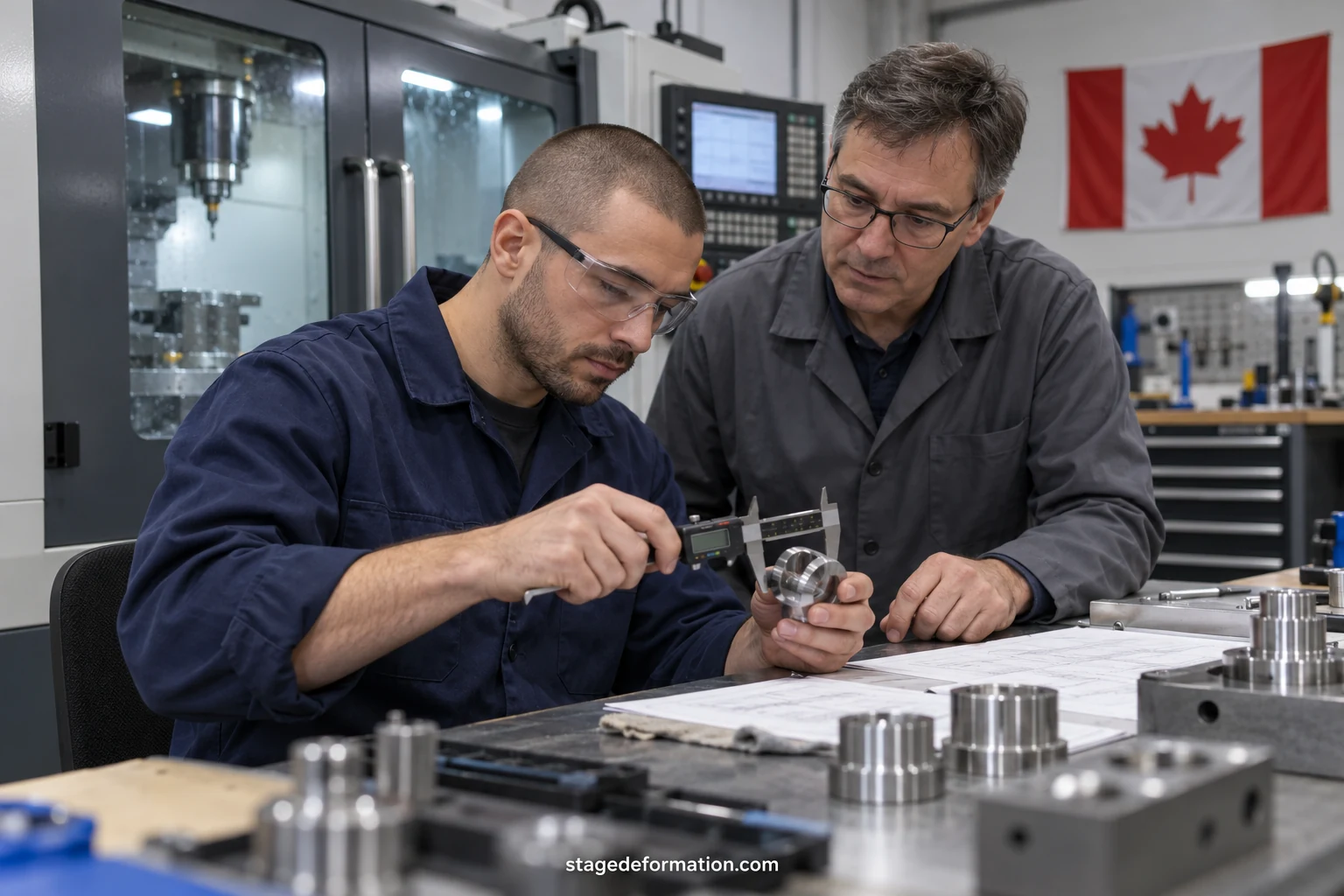
A country of engineers with very varied fields
Canadian engineering rests on heavy and diverse sectors: energy and natural resources, aerospace, rail transport, automotive, civil engineering, telecommunications, clean technology and medical devices. Advanced technologies such as robotics, materials, batteries and automation are developing around university and industrial hubs.
For a student, this means internships that differ greatly by region: aeronautics in Montréal, energy in Calgary, advanced manufacturing in Ontario, oceans and forestry on the west coast and in the Atlantic provinces. The choice of place almost determines the choice of career.
Co-op, internship or apprenticeship: three routes
The most widespread route for future engineers is the co-operative education model: several paid work terms of about four months alternate with study terms. Universities such as Waterloo, British Columbia, Sherbrooke and Polytechnique Montréal have developed dedicated services to support this.
The final-year or summer internship is more of a one-off and suits those who are not on a co-op programme. As for apprenticeship, in the Canadian sense, it concerns skilled trades (welding, electrical work, industrial mechanics) and takes place in a company with periods of classroom training, under provincial authority. It leads to trade certifications, not to the title of engineer, but it can complement a path as a technician or technologist.
The engineer title: a profession regulated by province
In Canada, the engineering profession is regulated by provincial or territorial bodies, such as the Ordre des ingénieurs du Québec or the associations of engineers and geoscientists in the other provinces. Only their members may use the title and sign certain plans. A student or recent graduate can register as an engineer-in-training or junior engineer and build up supervised experience.
Undergraduate programmes are assessed by a national accreditation body, which explains the role of Engineers Canada. For an intern, the point is simple: working under the supervision of a licensed engineer can later help to document the experience required. Ask the employer whether this is possible.
Typical assignments in a technical team
Design and simulation
Modelling parts, sizing, finite element analysis, updating drawings. Precision is expected, along with mastery of CAD software.
Testing and validation
Preparing test benches, collecting measurements, writing protocols and reports. This phase trains rigour: a result that is not documented is a result lost.
Production and continuous improvement
Monitoring lines, reducing scrap, automation, programming controllers. The intern learns to work with operators and technicians, which is worth any management course.
Safety, access and clearances: what you cannot guess
In industry, safety comes before everything else. Expect an induction course, the wearing of protective equipment and precise rules about access zones. Occupational health and safety laws are a provincial matter, with differences of detail. An intern is protected like any other worker and must be able to report a hazard without fear.
In aerospace or defence, certain work is subject to special controls on equipment and technology, and even to personnel security checks. This can limit access for foreign nationals to some projects. Ask very early whether the assignment you are aiming for involves such constraints.
Choosing between a public laboratory and a company
A public research body such as the National Research Council of Canada offers student jobs in its research and development activities, with periods of about sixteen weeks and pay linked to the number of terms already completed. This route suits anyone who wants to deepen a method, work long-term on a test bench or prepare for postgraduate study.
An industrial company offers direct contact with production, costs and deadlines. The two environments teach complementary things: compare the assignments, the supervision and the possibility of publishing or handing over a result, rather than the fame of the name alone.
International students: permits, agreement and insurance
For a foreign student enrolled in Canada, a compulsory internship in the programme generally requires a valid study permit and a work authorisation linked to that internship, issued on the basis of a letter from the institution. For a project outside a programme or from abroad, the rules differ, and some mobility routes depend on nationality.
Check the official federal information as well as the advice of your school's international office. Also arrange health insurance valid from the day you arrive: the public system is provincial and does not automatically cover temporary arrivals. Finally, ask for a signed agreement stating tasks, duration, hours and location.
Preparing a credible technical portfolio
An engineering intern's CV fits on one page and describes projects with facts: dimensions, tools, tolerances, measured results. Recruiters first read design projects, prototyping work and student competitions, because they show teamwork under constraint.
- two or three achievements with a diagram, your personal role and the result;
- a precise list of software you can use, with an honest level;
- an example of a clear, plain report or test protocol;
- references from your university or from projects.
In an interview you will probably be asked to describe a technical problem you met and how you solved it. Prepare that story so that it takes five minutes.
A worked example and mistakes to avoid
A hypothetical illustration with round figures: a mechanical engineering student does a four-month term, about sixteen weeks, in a factory. The goal is to cut the tooling changeover time of a line by ten per cent. The student observes the process for two weeks, proposes three changes, tests one of them for five weeks and spends the rest of the term on the report and handing over the updated drawings.
This scenario shows the value of a measurable objective and a usable record. As for mistakes, avoid applying without knowing the company's products, underestimating safety instructions, changing a drawing without a change log, or accepting an assignment with no named supervisor.
Frequently asked questions
Is an engineering internship reserved for Canadian students?
No, but foreign nationals must comply with immigration rules: a study permit and a work authorisation linked to the internship, or another scheme depending on nationality. Some sensitive projects, notably in defence or aerospace, may also carry restrictions. Confirm these points with the employer and your institution's international office before committing.
How long is a co-op term usually?
It is generally around four months, or about sixteen weeks, and several terms can follow one another over the course of a degree. Internships outside a programme vary more. The exact length, hours and location must appear in the agreement: do not start without this written document.
Is the internship paid?
Co-op terms and student jobs in industry or public laboratories are generally paid, at levels that depend on the employer, the province and how far along your studies are. No amount can be guaranteed here. Compare offers and ask for the hourly or monthly rate before accepting.
Can I sign drawings as an intern?
In principle no: signing and sealing are the responsibility of engineers licensed by the provincial regulator. An intern prepares, calculates and documents under supervision. This rule takes nothing away from the value of the internship, since being supervised by a registered engineer can later make it easier to have your experience recognised.
How do I tell an apprenticeship from an internship?
Canadian apprenticeship targets skilled trades and combines employment with training, leading to a certification recognised by the province. An engineering internship is a supervised period of work linked to your studies. A future engineer rarely follows a trade apprenticeship, but will work alongside technicians and journeypersons.
When should I apply for a summer internship?
For a summer internship, start eight to twelve months ahead if you are abroad. Co-op cycles often post their offers several months before the term. Prepare your application, portfolio and references from the autumn, and leave time for immigration formalities.