Very different technical sectors under one label
Talking about engineering in the United Kingdom covers working environments that have almost nothing in common. Aerospace and propulsion are driven by engine and equipment manufacturers; civil engineering and construction by large design consultancies; energy by grid, nuclear and offshore wind operators; defence and embedded systems by a few major industrial groups; research by public bodies and universities.
For a student, the first job is to connect their specialism to a sector. A student in structural mechanics will look at testing and design, a student in electronics at control systems, a student in civil engineering at structures and modelling. So-called advanced technologies (composite materials, additive manufacturing, digital twins, autonomous systems, hydrogen) appear mostly in research and development teams.
Choose a sector before choosing an employer: it gives a common thread to your letter, the projects you cite and the questions you ask at interview.
Summer internship, placement year, apprenticeship: what really changes
The same employer may offer several formats, with very different availability requirements.
- Summer internship: for example ten weeks for an engineering and technology programme at an engine manufacturer, according to the presentation page consulted in October 2026. It suits a student who cannot be away for a whole year.
- Placement year: twelve months, between two university years, with responsibilities closer to those of a junior engineer.
- Apprenticeship: a paid employment contract combined with a qualification, sometimes up to engineering degree level in the case of degree apprenticeships.
The same industrial group may also offer internships in its management functions, which have nothing to do with the workshop or the design office. Read the title and the job description before applying: a "business" internship does not put you in front of a test bench.
A student at a French engineering school who needs a six-month period will lean towards a shortened placement year or the end-of-studies internship; most standardised British programmes do not line up exactly with the French calendar.
Three families of employers, three ways of working
An industrial manufacturer most often runs mass programmes, with an online application, tests, an assessment centre and a final offer. Teams are large, processes standardised, and you are given a subset of a bigger project: validating a component, analysing test data, documenting a design.
An engineering consultancy in infrastructure and buildings offers assignments spread across many British and Irish sites. Its model is built on projects: you join a multidisciplinary team, you learn to estimate the time spent and to comply with standards. Arup's internship page mentions technical internships and industrial placements for the United Kingdom and Ireland.
A research body or a university will put you in contact with scientific facilities, laboratories and experimental databases. The rhythms are less calibrated, autonomy is greater, and the expectation of experimental rigour is stronger. Compare these three worlds with your own temperament before sending out many applications.
Making a measurement reliable: the exercise that reveals your method
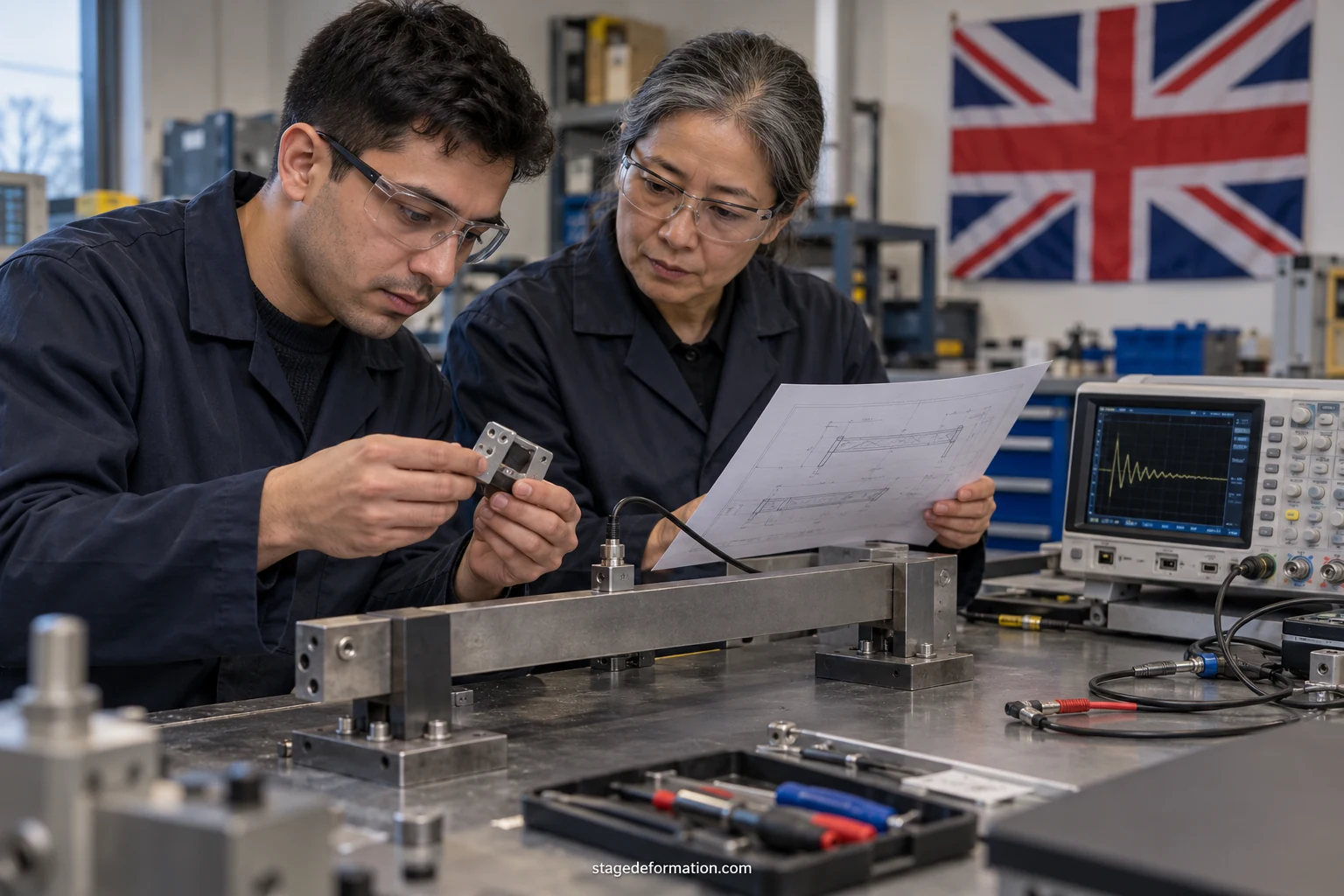
A technical interview often turns on how you would prove that a result is sound. Imagine a vibration signal recorded on a test bench. It only means something if the set-up is described: how the sensor is fixed, its orientation, the cable length, the temperature conditions, the sampling frequency.
A useful exercise is to repeat two acquisitions and look for what changes between them.
- Record the set-up with photos and an annotated sketch.
- Repeat the measurement under the same conditions and compare the spectra.
- Change one variable at a time, for example the mounting point.
- Tell apart a real mechanical phenomenon, which persists when you change sensor, from a measurement artefact, which moves with the set-up.
- Write in a few lines what you concluded and what you could not conclude.
This reasoning shows your rigour as much as theoretical knowledge does. It carries over to thermal work, metrology, electronics and materials testing.
Right to work, security and entry conditions
The United Kingdom has left the European Union: a European student can no longer work there automatically. Depending on the length of stay and your status, a visa may be needed, sponsored by the employer or not. Check the conditions on the official pages of the British Home Office and with the company's human resources department.
In aerospace, defence or nuclear, some posts require security clearance or nationality and residency conditions that the advert specifies. Do not treat this point as a detail: a defence post may be closed to you while a civil post in the same group remains open.
On pay, the national minimum wage applies to a person who genuinely works for the organisation, at a rate revised every year. Large employers often advertise higher levels. For example, a manufacturer's page consulted in October 2026 mentions a starting annual salary and a joining bonus, but those figures cover all its programmes, including those for graduates, and do not apply to any given summer internship.
Professional recognition: think long term from the internship onwards
In British engineering, recognition comes through professional qualifications awarded under the Engineering Council: Engineering Technician, Incorporated Engineer, Chartered Engineer. Learned societies, including the Institution of Mechanical Engineers, assess candidates and manage progression.
For a student the benefit is twofold. First, an internship supervised by an engineer who is themselves on this path gives an idea of what the profession expects. Second, some learned societies offer students resources: a virtual work experience in mechanical engineering, a young members' network, bursaries and grants, and events such as Formula Student.
Taking part in a team project of this kind strongly strengthens an application, because it proves you can run a technical project, manage a limited budget and keep to a schedule.
Building the application: projects, CV and technical interview
A British engineer's CV fits on one or two pages, without a photo. It highlights projects using action verbs, the tools you master (CAD and simulation software, programming languages, measuring instruments) and figures for results where they exist.
- One project = one problem, one method, one result, and what you would do differently.
- A sentence on safety: following workshop rules, risk assessment.
- A short letter linking your specialism to the precise activity of the team.
Interviews combine behavioural and technical questions. Be ready to explain aloud a circuit diagram, an order-of-magnitude calculation or a testing approach. If you get stuck, describe your reasoning: the recruiter assesses the method before the final answer.
An illustrative example: choosing between three offers
Take a hypothetical example with round figures. Léo, a fourth-year student at a French engineering school, receives three replies: a ten-week summer internship at an engine maker, a twelve-month placement year at an infrastructure design consultancy, and a six-month internship in a research laboratory.
- His school accepts only internships of five to six months: the summer internship is too short, the placement year too long unless there is a special agreement.
- The laboratory covers the exact period, and no particular clearance is mentioned; the consultancy requires a sponsored visa, with delays of several weeks.
- Léo therefore ranks the offers on three criteria: compatibility with the agreement, right to work and technical content.
He chooses the laboratory, because the length matches and the subject overlaps with his specialism. The lesson of the example: you do not choose a brand name, you choose a set of constraints.
Common mistakes to avoid
- Applying for a management internship believing you will land a technical one.
- Ignoring nationality or clearance conditions in sensitive sectors.
- Sending a French-style CV as it stands, with a photo and marital status.
- Talking about your projects without saying what your own contribution was in a team.
- Neglecting visa and housing lead times, which can exceed the recruitment calendar.
Before signing, check with your school the duration and status required to validate the period.
Frequently asked questions
How long is an engineering summer internship in the UK?
It varies by employer. A large engine manufacturer presented in October 2026 a ten-week engineering and technology summer internship, alongside a full placement year. Other organisations offer different lengths. Read each advert and compare it with the duration your school requires.
Can a European student apply without a visa?
Not automatically since the departure from the European Union. Depending on the length of stay, the status and the nationality, a particular immigration route may be needed, sometimes sponsored by the employer. The rules change: check them on the official British pages and ask the employer before applying.
Do you need security clearance for an engineering internship?
Only for certain posts, notably in defence, nuclear or sensitive projects. The advert should specify the conditions of nationality, residency or security vetting. A civil post in the same group may remain open without those conditions, which is why it pays to read the description carefully.
What is a degree apprenticeship in engineering?
It is a higher-level apprenticeship combining paid employment with university study, leading to a degree. The apprentice is an employee of the company and studies part time. It is aimed mainly at candidates based in the United Kingdom with the right to work there; the exact conditions vary by employer and course.
How does an internship help you become a chartered engineer?
British professional qualifications rest on education, supervised experience and an assessment by an accredited learned society. A good internship familiarises you with the skills expected and can end with projects you can showcase. It does not confer the title on its own: the path continues after your studies.
Should you show a personal project in your application?
Yes, if you can explain it clearly. A test bench, robot, simulation or student team project shows your method, your independence and your ability to document. Describe the problem, your choices, your results and your limits rather than a bare list of tools used.