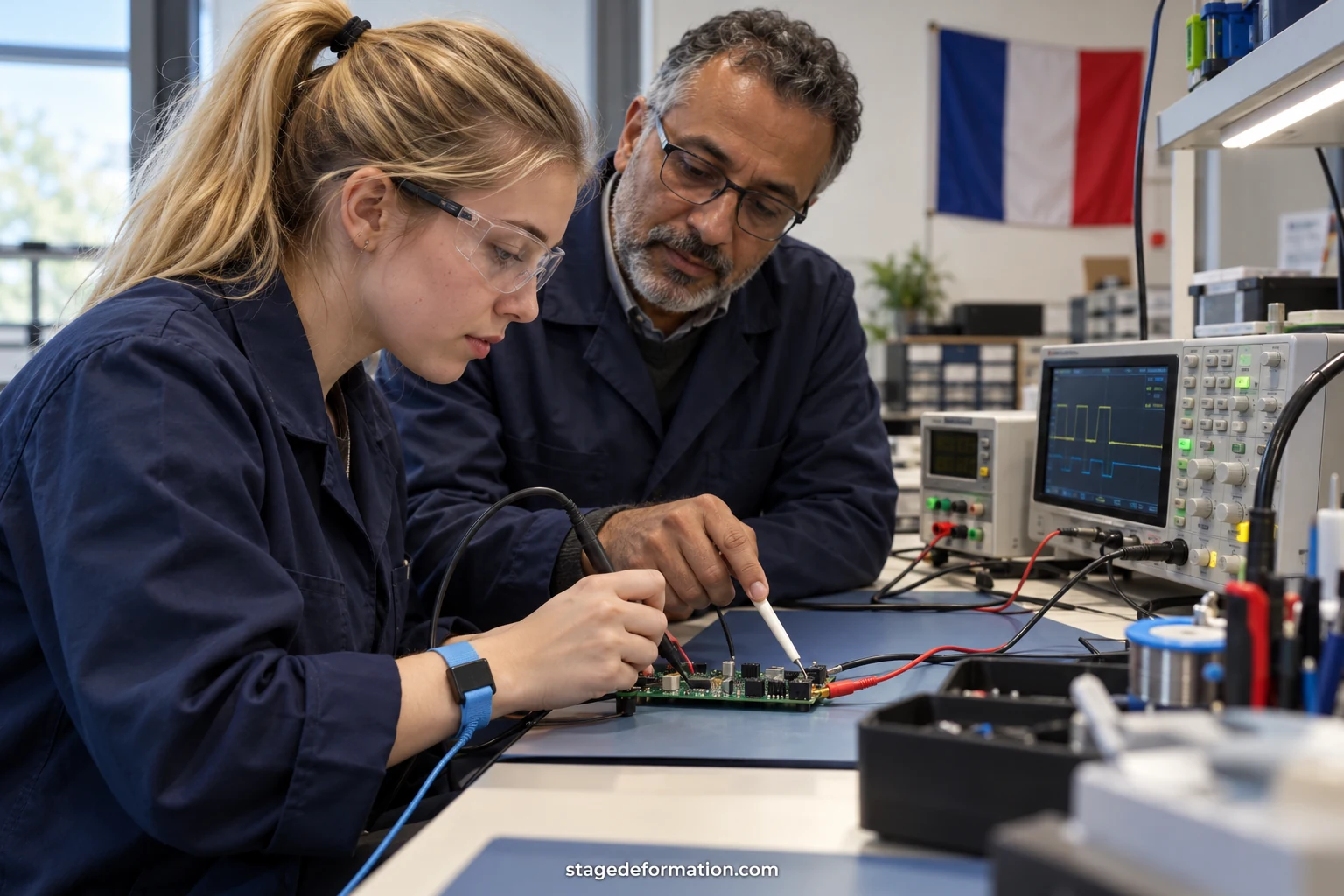
What advanced engineering means for an intern
Under the label "advanced technologies" sit very different fields: aeronautical structures and materials, propulsion, embedded electronics, space systems, robotics, numerical simulation, energy and nuclear, secure communications, sensors. What unites them is less the discipline than the method: costly tests, quality requirements, multidisciplinary teams and a strong culture of documentation.
For a student, this means the assignment given is rarely "free". It fits into an existing programme, with milestones, reviews and confidentiality constraints. The intern does not invent a product; they take charge of a defined work package, for example characterising a component, developing a post-processing tool, modelling a phenomenon or preparing a measurement campaign.
Understanding this logic from the application stage changes how you present yourself: it is better to describe what you can already measure, simulate or program than to promise to "bring innovation".
Internship, work-study, final-year project: choosing the right format
Three formats dominate in French engineering degrees and in technical programmes at three to five years of higher education.
- The short internship, lasting a few weeks, is for discovering an industrial site or a laboratory. It is often offered at the start of a course, sometimes as a shop-floor or observation placement.
- The application internship or assistant engineer internship, lasting two to six months, entrusts a real technical task, with a tutor and a report.
- The final-year project, in the last year, generally lasts five to six months and serves as a full-scale test before hiring. Many schools have it defended before a jury.
An apprenticeship, for its part, is an employment contract: the apprentice alternates between a school or an apprentice training centre and the company, over one to three years depending on the qualification. Engineering degrees and professional bachelor's degrees are available through this route. The work-study rhythm varies from one institution to another; you find it in the programme's calendar, not in the job advertisement.
The legal framework: agreement, contract and pay
In France, an internship rests on a three-party agreement signed by the student, the educational institution and the host organisation. Without a validated agreement, no presence on site. It specifies the assignments, the length, the hours, the tutor on the company side and the supervising teacher on the school side. The length of an internship at a single organisation is capped at six months per academic year.
Beyond an attendance threshold set by law, a stipend is compulsory; its minimum amount is calculated as a percentage of the Social Security hourly ceiling and changes every year, so you should check the value in force before signing. Many large technical groups pay more than this minimum, but that is a matter of their own policy and nothing automatic.
The apprenticeship contract is a full employment contract in France: a salary expressed as a percentage of the minimum wage according to age and year of training, paid leave and social protection. Training costs are in principle covered by the employer's skills operator, which spares the apprentice from funding them personally.
Sensitive sites, clearances and foreign interns
This is a French particularity that candidates underestimate: some laboratories and defence, space or energy industries are places where access is controlled. An internship may require an access check, a personal badge, or even a prior authorisation procedure when the site falls within a zone protected for scientific and technical reasons.
In practice, there are three consequences:
- the delay between acceptance and the first day can reach several weeks; so apply early and do not fix rigid dates on a rental or a ticket;
- foreign students, including Europeans, may be subject to additional procedures, which the host organisation manages with its security department;
- some of the information handled cannot appear as it stands in a report intended for the school, which is settled with lighter or confidential versions.
Raise these questions at the interview, calmly, as a matter of organisation: they show that you know the reality of the sector.
Where to look: large groups, research bodies, technical SMEs
The landscape divides into three families. The major prime contractors in aeronautics, defence electronics and energy publish internship and work-study campaigns online, on fairly regular calendars. Public research bodies host interns on very specific topics, often attached to a team and a lecturer-researcher. Finally, the network of subcontracting small and mid-sized companies, concentrated around the major industrial hubs, offers more versatile assignments, where you see a product from specification through to delivery.
Schools have their own platforms for offers, company fairs and alumni networks. For an apprentice, the school's or training centre's employer relations office often plays a decisive role in making connections. Do not forget the competitiveness clusters and regional industry groups, which circulate offers and organise meetings.
A well-targeted speculative application, addressed to a team manager rather than a generic mailbox, remains an excellent way to reach topics that were never advertised.
Building a credible technical application
The recruiter in a design office reads your file with a simple question: will this person be able to take charge of a piece of work without tying up their tutor? Your CV must therefore answer with facts.
- Put the tools and methods you master at the top: languages, calculation or CAD software, measuring instruments, standards used.
- Describe an academic project in three stages: the problem, your personal part, the result obtained with an order of magnitude.
- Distinguish what belongs to design, simulation and experimental validation, to show where your independence begins.
- Write a short letter linking one of the team's problems to a specific skill from your background.
At the interview, expect a technical question on a point in your CV, then a discussion of how you handle a test that fails. The most convincing answer tells how you isolated the cause, not how you avoided the error.
Making tests usable: the intern's real value
In engineering, a result that nobody can reproduce is worth almost nothing. This is where the intern makes the difference: by taking care over traceability, they leave the team a lasting asset.
- Before testing, ask for the equipment access instructions, the safety rules and the expected format of reports.
- Record file versions, parameters, measurement conditions and every correction made to the protocol.
- Keep raw data separate from processed data, with a file name that lets you find the campaign.
- Finish with a short handover note: what was done, what remains open, the pitfalls encountered.
The report intended for your institution must also respect the distribution arrangements agreed with the host organisation. A discussion at the start of the internship, with the tutor, about what may be cited avoids a painful rewrite on the eve of the defence.
An illustrative example of a five-month assignment
By way of illustration only, imagine a final-year engineering student carrying out their final-year project in a team that tests electronic components intended for embedded equipment. The figures that follow are rounded and hypothetical.
- Month 1: safety training, getting to grips with the bench, reading the procedures and earlier tests; about twenty documents to absorb.
- Months 2 and 3: automating part of the measurements with a script, which reduces a series lasting several hours to a noticeably shorter time.
- Month 4: test campaign, with about thirty recorded readings and two anomalies analysed.
- Month 5: report, handover note and presentation to the team.
What matters afterwards is not a spectacular performance, but the clarity of the file left behind: an engineer arriving after them can restart the bench in half a day. This is the kind of contribution that feeds job offers.
Common mistakes and alternatives to consider
Several pitfalls come back every year. Targeting only the best-known names, when many fascinating topics are found at subcontractors. Waiting until the last moment to submit the agreement, at the risk of missing the window for site access. Accepting a vague assignment, with no defined deliverable and no identified tutor. Neglecting confidentiality by sharing diagrams or data with classmates.
If access to a controlled site seems too slow, other routes exist: an internship in a university laboratory, a software or simulation project carried out largely remotely, an apprenticeship contract at a small or mid-sized company whose premises are easier to access, or a European exchange through the Erasmus+ programme. Each has its advantages; the important thing is to stay consistent with the qualification you are aiming for and to discuss it with your school's supervising teacher.
Frequently asked questions
Is an engineering internship always paid in France?
Beyond an attendance threshold set by law, a stipend is compulsory in France, with a minimum calculated as a percentage of the Social Security hourly ceiling. This minimum changes: check the value in force and what the employer offers, as it may pay more. For a very short internship, payment is not required.
What is the difference between an internship and an apprenticeship for a future engineer?
In France, an internship is a period of training in a professional setting governed by an agreement, with a stipend. An apprenticeship is an employment contract alternating between school and company, over one to three years, with a salary proportional to the minimum wage. It gives more time in the company, but requires finding the employer as soon as you are admitted.
Can a non-French citizen do an internship in a defence or space laboratory?
It is sometimes possible, but authorisation and access procedures may be added and lengthen the delay by several weeks. The host organisation decides with its security department. It is better to apply very early and to raise the question of access clearly from the first exchange.
When should I submit applications for a final-year project?
Many groups publish their topics several months before the start, often in the autumn for a spring start. Calendars differ between companies and schools, so follow the careers pages and your institution's internship office, then follow up politely if no reply arrives.
What should I put in the report if the data is confidential?
Agree with the tutor, from the start, on what may be cited. Schools generally accept a lighter version, normalised values or a confidential appendix that is not circulated. The principle is to show your method and your reasoning without exposing what the host organisation must protect.
Why document your tests if you are only there for a short time?
A team rarely keeps the same person on a bench for more than a few months. Tracked versions, recorded parameters and a handover note allow your successor to carry on without starting over. It is also a concrete argument for being contacted or recommended afterwards.