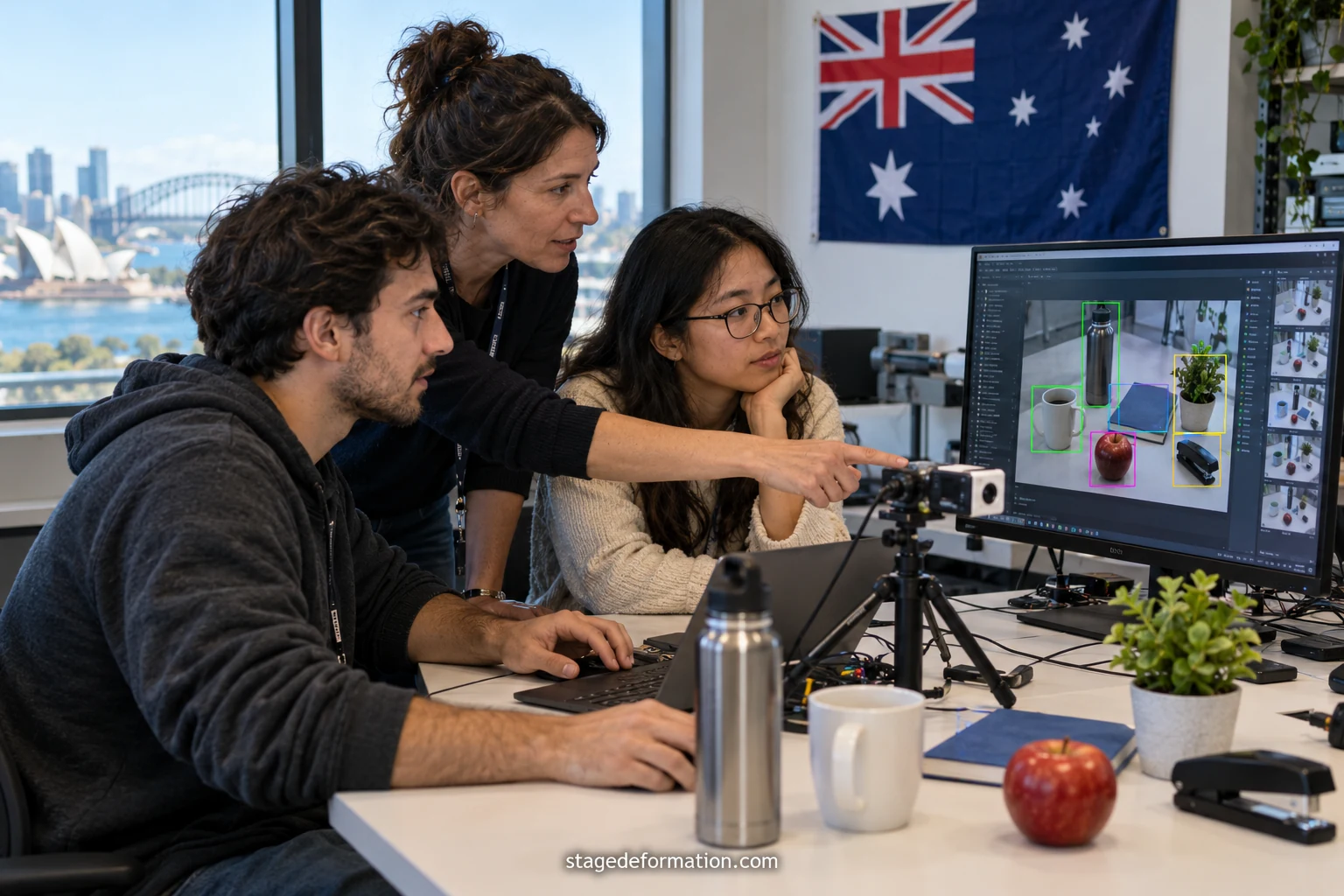
Where AI is practised in Australia
Australia’s artificial intelligence landscape rests on three pillars. The first is public research: the national science agency CSIRO, whose Data61 unit is devoted to data and digital technology, and several universities that have set up specialist institutes, such as the Australian Institute for Machine Learning at the University of Adelaide. The second is the business sector: banks, insurers, telecommunications operators, mining, health, precision agriculture, logistics and start-ups. The third is government, which employs data specialists and sets the ethical framework.
Sydney, Melbourne, Canberra, Brisbane, Adelaide and Perth each host different hubs. Canberra leans towards public policy and defence, Adelaide towards machine learning and computer vision, and Melbourne and Sydney towards finance, health and digital platforms. Choosing a city therefore means, in part, choosing a type of project.
Three routes to a first experience
Depending on your level, three paths are realistic.
- The summer research programme: some institutions offer vacation scholarships for undergraduates, such as the vacation studentships run by CSIRO’s Data61 unit. These schemes target students with strong academic potential and have their own rules on nationality and residence.
- The company internship: a data science or engineering team hosts a student on a defined assignment, such as preparing datasets, evaluating a model or building a dashboard.
- The vocational apprenticeship: the Australian Apprenticeships system includes traineeships in digital fields, leading to qualifications at Certificate or Diploma level, which are different from a master’s degree in AI.
Research schemes are selective and most places are scarce. Always keep a fallback strategy in mind, for example a supervised university project or an assignment with a small company.
The skills you will really be asked for
For an AI internship, the baseline demand is solid but specific. In programming, Python dominates, together with numerical computing and machine learning libraries, and SQL for querying data. In mathematics, linear algebra, probability, statistics and optimisation are expected. In practice you are also assessed on your ability to use version control, document an experiment and explain a result to a non-specialist.
Many students overestimate the importance of fashionable models and underestimate the work on data: cleaning, labelling, bias detection, separating training and evaluation sets, and tracking versions. These tasks often take up most of an intern’s time and are an excellent place to show rigour.
A short portfolio on a public repository, with a clear problem, a method, results and their limits, is worth more than a list of courses taken.
Ethics, data and rules on sharing
Australia has published ethical principles for artificial intelligence, covering fairness, privacy protection, transparency, reliability and accountability, among other things. These principles do not replace the law, but serious employers refer to them. Privacy legislation governs the handling of personal data, and the health and finance sectors add requirements of their own.
In practical terms, before your first day, clarify four points with your supervisor: where the data comes from, who can access it, where it is stored and what may be published. A classic mistake is to copy a dataset onto a personal computer in order to work faster. In an industrial or public setting, that is a serious breach.
Also settle who owns the code and the results, especially if you hope to reuse them in a dissertation or a publication. A written agreement avoids misunderstandings.
Status, duration and pay
Australian law distinguishes between an employee, a student on a placement required by their course, and a mere observer. A person who does work that is useful to the organisation must in principle be paid; an unpaid placement is allowed only in defined cases, notably when it is required by a recognised programme of study. To decide, the Fair Work Ombudsman provides official information.
Duration varies. An experience built into a course can last from a few weeks to several months, according to the description published by the national information portal for international students. Summer research scholarships generally last a few weeks during the southern holidays. No pay figure is universal: ask for it in the offer, and find out whether it is a salary, a scholarship or an allowance.
International students: visas and reception
A candidate coming from abroad should treat the visa as a stage in its own right. If you are enrolled at an Australian university, the immigration rule that applies to your student visa determines what you may do, and the compulsory experience in your course is covered by specific provisions that should be confirmed with the international office. If you leave from a university in your home country, the placement agreement and the residence permit must match the real nature of the activity.
Some public bodies or defence-related organisations impose nationality conditions or security clearance. Do not try to get around them: read the offer, then ask the human resources department. Also allow for accommodation, suitable health insurance and enough time to obtain the supporting documents.
Illustration: a small model evaluation project
Imagine, purely for illustration, a ten-week internship in the data team of an Australian insurer. The assignment: compare two models that classify claims automatically.
- The first two weeks are spent learning the business vocabulary and checking data access rights.
- Weeks three and four cover cleaning the data and building an evaluation set that is separate from the training set.
- Weeks five to seven involve training and comparing the models, with an experiment log.
- Week eight is for error analysis: which types of claims are misclassified, and why.
- Weeks nine and ten are set aside for the presentation to the team and the final report.
These timings are example orders of magnitude. What matters for your later applications is the written record: the protocol, the results and the limits of the work.
Applying and standing out
Begin with a list of the teams working on your subject, reading their publications or project pages. Then write a short message to a researcher or manager, mentioning one specific result from their work and what you can contribute. Generic messages are ignored.
- Attach a CV of one or two pages, a translated transcript and a link to your code repository.
- State your availability dates, bearing in mind the southern summer, from December to February.
- Prepare for questions on bias, evaluation and validation, more than on the latest fashionable models.
- Professional digital associations and university careers services circulate openings and run useful networking events.
A reply can take time: follow up once, politely, after two or three weeks.
Common mistakes and alternatives
The most frequent mistakes are to target only highly selective laboratories, to propose a topic that is too broad, to neglect the data side and to skip checking the eligibility conditions. There is also the risk of accepting a poorly defined assignment in which you are asked to “do AI” with no objective and no supervisor.
If access to a laboratory is out of reach, other options exist: an applied project in a small organisation, a data analysis assignment with a local authority, an internship at a European subsidiary of an Australian company, or a local course that includes a placement. A less prestigious but well-supervised and well-documented experience serves your career better than a vague promise attached to a famous name.
Frequently asked questions
Which degrees lead to an AI internship in Australia?
Mostly students of computer science, mathematics, statistics, engineering, physics or data science. The exact requirements depend on the level of the role and on the team. An application is strengthened by concrete projects, good command of Python and solid grades rather than by the title of the degree alone.
Are summer research programmes open to foreign students?
It varies by institution and programme. Some reserve their places for citizens or residents, while others accept international students enrolled at an Australian university. Read the criteria published by the organisation concerned and do not assume an exception will be granted simply on request.
Can an AI internship be unpaid?
In principle, productive work for an organisation must be paid. A placement without pay is permitted only in defined cases, notably when a recognised course requires it or when it consists of observation. If in doubt, rely on the information provided by the Fair Work Ombudsman.
Is there an apprenticeship in artificial intelligence?
The Australian Apprenticeships system mostly offers vocational-level digital qualifications, for example in IT, cybersecurity or data analysis. They are not equivalent to a specialist master’s in AI, but they can be a way into technical jobs in companies.
What is the best time of year to go?
The southern summer, from December to February, matches the university holidays and the summer programmes. Applications often open several months earlier, sometimes in the middle of the year. Companies also take interns at other times, depending on their needs and the length of your placement agreement.
What should I prepare on data and confidentiality?
Ask your supervisor about the origin of the data, access rights, where it is stored and the rules on publication. Never copy data to a personal device without permission. Get written confirmation of who owns the code and the results, especially if you want to use them in a dissertation.