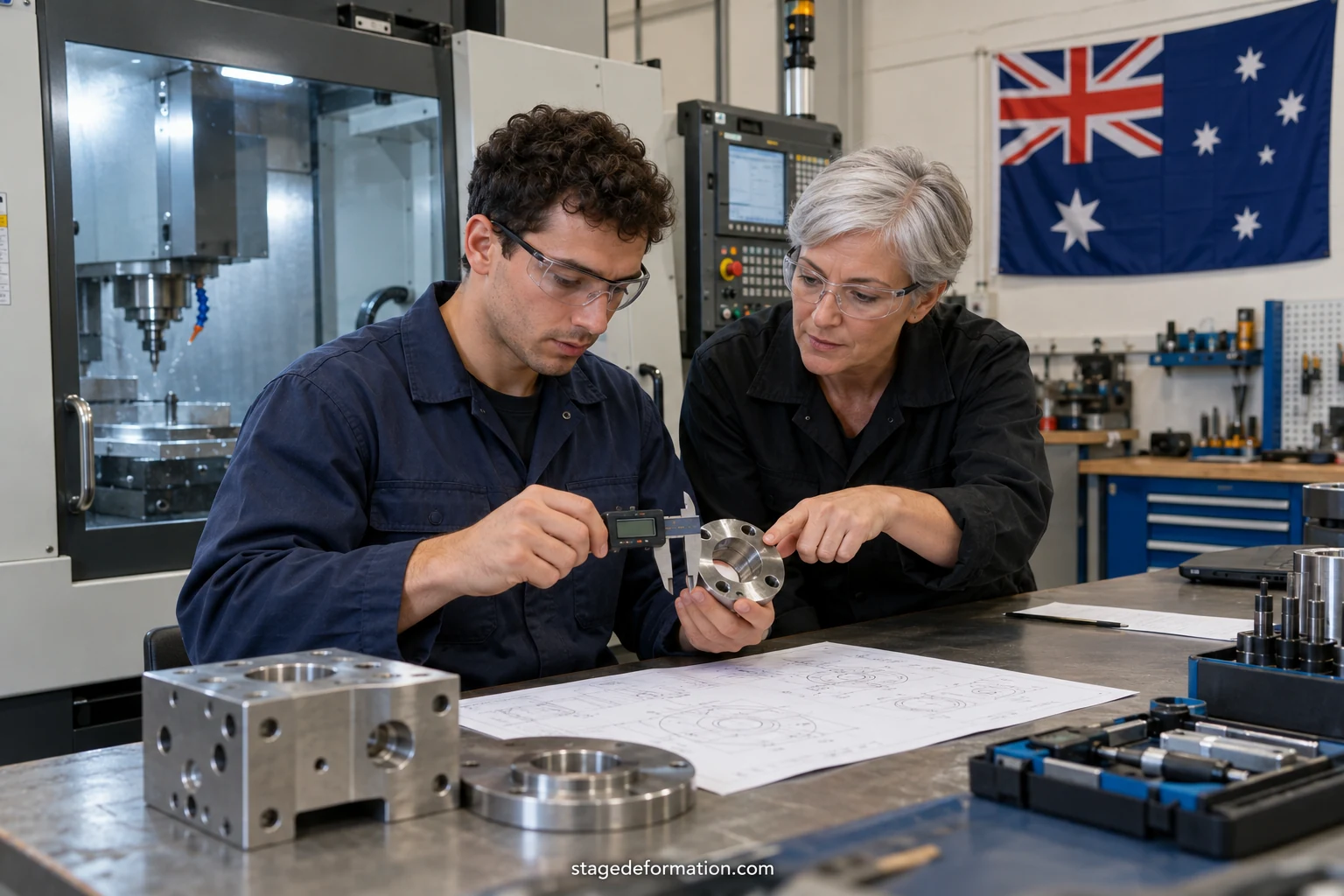
Three routes not to confuse when practising engineering in Australia
The word “internship” covers very different legal situations in Australia. For a project in engineering or advanced technology (mechanical, electrical, automation, aerospace, materials, energy, robotics), you first need to know which route you are dealing with.
- The placement built into a degree (work-integrated learning, vocational placement): a period of practical experience provided for by a programme of study and organised with the institution.
- The summer internship or studentship: an experience of a few weeks, often during the university holidays, offered by a company, a research body or a university.
- The Australian Apprenticeship: a training contract combining paid employment with recognised training, for example in electrotechnology, precision mechanics or manufacturing.
The first two routes are aimed mainly at undergraduate and master’s students. The third is for people who want to learn a technical trade while working, whatever their educational starting point. Confusing them leads to poor applications, unrealistic pay expectations or unsuitable visa procedures.
The legal framework: when an internship can be unpaid and when it must be paid
Australian employment law is strict on this point. As a general rule, a person who does real work for a business is a worker and must be paid. Unpaid work is lawful only in limited cases: a compulsory placement within a course organised by an educational institution, genuine volunteering for a not-for-profit organisation, or a simple period of observation with no real production.
In practice, an engineering internship that is not part of your programme of study, and in which you carry out tasks that are useful to the company, is quite likely to require a wage, at least at the applicable minimum. Rates depend on the industry award or the enterprise agreement, and they are reviewed regularly: the exact amount should be checked with the workplace relations authority or the host organisation.
If you are offered a “free internship” with no link to a course, ask in writing what the basis for the lack of pay is. A vague answer is a warning sign.
The placement built into studies: the model of the technical universities
Australian engineering degrees, normally four years long for a Bachelor-type qualification, are generally accredited by the engineers’ professional body. That accreditation comes with a requirement for practical experience in a professional setting, in the order of several weeks in total, which universities organise through placements, industry projects or summer internships.
Several technical universities have a dedicated service that negotiates with industry partners, checks safety conditions and signs an agreement with the employer. For an international student on exchange or on a double degree, the question to ask early is simple: does the host university recognise a placement, and does your home institution agree to validate it as a training internship? The two agreements must be consistent.
One point that is often overlooked: the calendars are reversed compared with Europe. The Australian academic year runs roughly from February or March to November, and the long holidays fall in December to February, in the middle of the southern summer. This is the natural window for summer internships.
Where advanced engineering happens: typical sectors and employers
Australia concentrates its engineering activity in a few clearly identifiable fields. Knowing them lets you target an application rather than writing blindly.
- Mining and resources: automation, remote operation, predictive maintenance, process engineering.
- Energy: power grids, solar, wind, storage, hydrogen.
- Defence, aerospace and space: industrial subcontracting, testing, embedded systems.
- Infrastructure and transport: bridges, rail, water management, digital modelling.
- Applied research: the national science agency, university laboratories and cooperative research centres.
- Advanced manufacturing and robotics: small and medium-sized technology companies, often in the large cities of the east coast.
In defence and certain sensitive projects, access may be limited to citizens or residents, or even subject to a security clearance. This is not a judgement on your profile: it is a rule of the sector that is better known before you spend time on an application.
Technical apprenticeship: the Australian Apprenticeship
Australian apprenticeship rests on a training contract between the apprentice, the employer and, where relevant, a body that administers the contract. The apprentice works and, in parallel, follows training delivered by a registered training organisation, leading to a national qualification. There are many technical trades linked to engineering: electrician, automation technician, industrial mechanic, machinist, welder, civil engineering technician.
The duration depends on the qualification and on the pace at which skills are acquired; it is generally counted in years rather than months. Pay follows scales set by sector regulation, often tied to the year of apprenticeship, and some public financial support exists for the employer or the apprentice. Amounts change, so they should be checked with the competent bodies for the latest figures.
For a foreigner, the decisive point is the right to work. An apprenticeship is a job: it requires a residence permit that allows it. Someone who has arrived on a simple student or tourist visa generally cannot freely take one on.
Visas and the right to work for an overseas student
The visa is the subject that makes the most projects fail. Here are some general markers, to be confirmed with the Australian immigration authority before you commit to anything.
- Student visa: it allows work within a limit of hours per fortnight during study periods. A placement that is an integral part of the programme is treated differently from ordinary employment, but you need to have this confirmed by your institution.
- Working holiday visa: available to young people in a limited age range. It allows you to work, but the time you can stay with one employer is often restricted, and the conditions change from period to period.
- Employer-sponsored visa: relevant for skilled positions, rarely for a short internship.
A visitor visa does not allow you to work or to take a professional-type internship, barring an explicit exception. Never rely on an employer who tells you “we’ll sort it out”: the responsibility for holding the right visa is yours.
Preparing a technical application that stands out
An engineering recruiter reads an application looking for evidence of practice. A list of software named without context carries little weight; a precise example is more convincing.
- Choose one achievement: a test bench, a model, a small embedded system, a group project in mechanical design.
- Describe the difficulty: an outlying measurement, a tolerance not met, a model that would not converge.
- Show the fix: what you changed, how you rechecked it, what you would do differently.
- Adapt your CV to the English-language format: one or two pages, no photo, no age or family status, with achievements first.
- Write a short letter linking one of the employer’s projects to a skill you can demonstrate.
For the interview, prepare structured answers about a real situation: the context, your action, the result. Australian employers appreciate frankness about the limits of a test as much as the final result.
A worked example: a ten-week summer internship
Take a fictional example, with rounded figures used only for illustration. Camille, a French student in the fifth year of an engineering school, is on a double degree at an Australian university. She is looking for a ten-week placement during the southern summer.
- September: she contacts the university’s industry partnerships office and her academic supervisor in France, who confirm that the placement can be validated as an end-of-studies internship.
- October: she applies to five organisations (a laboratory, two energy companies, a robotics SME, an engineering consultancy) with an application centred on a test bench she built in France.
- November: one company offers an interview; she asks how the tests will be approved, who will supervise her and what safety induction is planned.
- December to February: she completes the placement, keeps a measurement log and prepares a report comparing the expected and the actual result.
In this illustration, the key is not the employer’s prestige but the clarity of the framework: an agreement signed before the start, an identified supervisor and written objectives.
Frequent mistakes and a comparison with the alternatives
Some mistakes come up often among overseas applicants:
- starting without an agreement or without checking your visa status;
- accepting unpaid work outside any training framework;
- ignoring the southern calendar and arriving when the summer recruitment is already finished;
- not finding out about safety rules and personal protective equipment;
- applying only to big names, without looking at technology SMEs.
Compared with other destinations, Australia offers a dynamic technical market and a very formalised workplace safety culture, but it is farther away, more expensive to reach and stricter on the right to work than the European countries where free movement applies. Depending on your profile, an internship in Europe may be a simpler first step, with an Australian stay as a more targeted project afterwards.
Before committing, check the conditions with your institution and with the host organisation.
Frequently asked questions
Can an engineering internship be unpaid in Australia?
Only in defined cases, notably when it is a compulsory placement within a course organised by an educational institution, or simple observation. An internship unconnected to your studies, involving real work, should in principle be paid. Ask in writing for the legal basis of any lack of pay and check with the competent authority.
Which visa do I need for an engineering internship?
It depends on your situation: a student visa covers a placement built into the programme, a working holiday visa lets you work within certain age limits, and a visitor visa generally does not allow work. Always check with the Australian immigration authority before you book a ticket.
When should I look for a summer internship?
The southern summer runs from December to February, so offers are generally published several months earlier, often from the southern autumn, between March and August. Start looking at least six months before your desired departure, allowing for the time needed for the visa and for signing the agreement.
Is apprenticeship open to foreigners?
An apprenticeship is a job: it requires a matching right to work, often obtained through a suitable visa or sponsorship. An international student generally cannot sign an apprenticeship contract freely. Find out about your status before contacting an employer or a body that handles contracts.
Do I need to speak very good English?
A solid professional level is expected, particularly to follow safety instructions, write reports and discuss measurements. The language tests required for a visa or a university are separate from those an employer asks for; also be ready for technical exchanges in spoken English.
Are defence or space internships accessible?
Often with limits: some projects require citizenship or residence, or even a security clearance, and are not open to foreign students. Check the conditions of each offer. Positions with no particular requirement exist in civil research, energy, infrastructure and industry.
How do I get this internship validated by my school at home?
Tell your placements office before you leave, have a three-party agreement drawn up if your school requires one, and specify the objectives, the duration, the supervisor and the method of assessment. Keep your correspondence and supporting documents, as they are used for validation and for the final report.