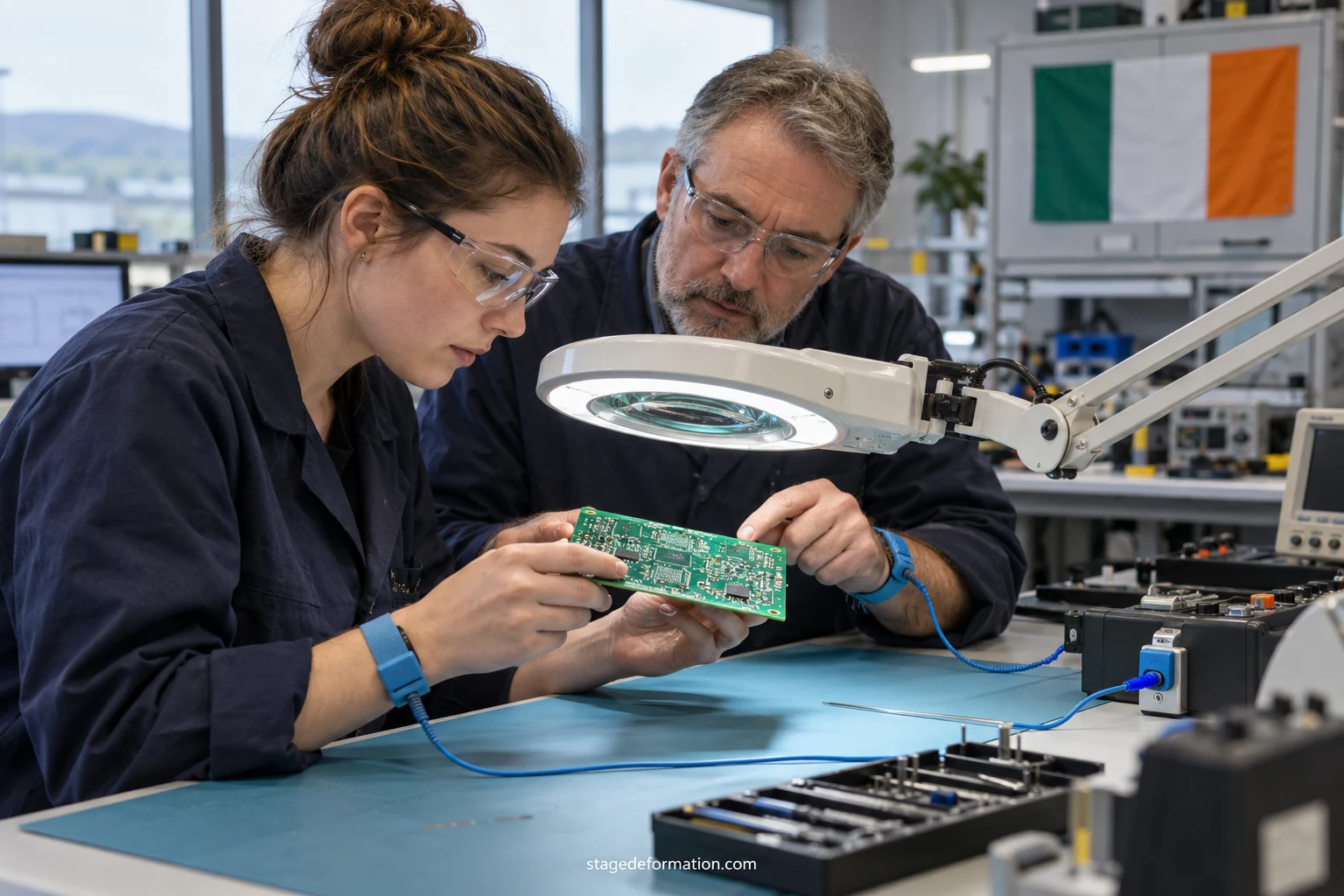
An industrial base that recruits technical profiles
Ireland has built part of its economy on hosting international high-technology companies. There are chip and electronic component manufacturing sites around Dublin and Limerick, medical device makers with a strong presence in Galway and Cork, pharmaceutical laboratories, aerospace equipment suppliers and a large number of data centres. On top of this come applied research institutes and universities that work with these companies.
For a student or an apprentice, this variety is an opportunity: the same path can lead to a design office, a clean room, an automated production line or an embedded software team. It also forces you to choose. An internship in a research laboratory has neither the pace nor the expectations of an internship in a factory, and the application is not built in the same way.
Internship, integrated placement or apprenticeship: three distinct paths
In Irish usage, work placement or co-op refers to a period in industry built into the course, internship to a summer or end-of-studies placement, and apprenticeship to work-based training.
- The integrated placement: many engineering courses include several months in industry, often in the middle of the degree. The agreement is then three-way and the institution follows the student.
- The summer internship: a few weeks to three months, during the university holidays, on a limited topic.
- The apprenticeship: the apprentice is an employee of their employer and alternates between work and classes at a training institution. The scheme has widened beyond the construction and electrical trades to engineering and advanced manufacturing pathways, with durations counted in years.
For a French student, the end-of-studies internship or the internship arranged by the school remains the most accessible. The Irish apprenticeship is aimed first at people who already live in the country or are settling there for the long term.
Where to look: research institutes, factories and suppliers
The big names attract many applications. Several avenues deserve to be explored in parallel.
- Technology research institutes, such as Tyndall in Cork, which works on photonics, micro and nanotechnologies and integrated circuits, and offers internships and summer scholarships for students.
- Industrial research centres, which act as a bridge between universities and factories in advanced manufacturing.
- Multinational sites, which publish their internship vacancies on their careers pages, often in the autumn for the following summer.
- Small firms and subcontractors, less visible but sometimes more willing to entrust real responsibility to an intern.
- University careers services, whose vacancy portals are sometimes open to exchange students.
A well-targeted speculative application, addressed to a team leader rather than to a generic address, is more likely to be read than a mass mailing.
Legal framework, agreement and stay
An internship abroad rests on a document signed by three parties: the student, the home institution and the host organisation. Under Erasmus+, a learning agreement is added, specifying the objectives, the tasks and the methods of assessment. Ask your school for it very early: without it, no serious company will entrust you with equipment or access to a site.
Citizens of the European Union do not need a specific work authorisation to stay and work in Ireland. People of other nationalities, however, must check their situation before any commitment, because immigration rules depend on status and length of stay. This is checked with the home institution and the competent Irish authorities, never by hearsay.
On the ground, an engineering intern almost always signs a confidentiality agreement and takes safety training before entering a laboratory or an industrial site. Read these documents carefully: they set out what you may publish or reuse in your report.
Pay and cost of living: staying cautious
Pay for an intern in Ireland varies widely depending on the nature of the placement. Some engineering placements are paid, others are unpaid or carry a simple allowance, particularly when they are integrated into a degree. No figure can be taken for granted: it depends on the employer, the sector and the status. Ask for it in writing before signing and compare it with the cost of living on the spot.
Housing is the heaviest item, especially in Dublin, where demand far exceeds supply. Cork, Limerick and Galway are generally cheaper, and several industrial sites are on the outskirts, which means arranging some form of transport. For an apprentice, the wage is paid by the employer and its level is governed by the apprenticeship scheme, which evolves: check the current scale with the body responsible for apprenticeships.
Mobility funding, such as the Erasmus+ grant for placements, can top up the budget. Its amount and conditions are set each year by the national agency of the sending country.
Building a technical application that reassures an engineer
A team leader reads an application with one question in mind: will this person be autonomous on a specific topic in three weeks? Your application must therefore show verifiable achievements.
- A one-page CV, listing the tools you genuinely master: design software, simulation, programming, instrumentation, languages used in electronics or automation.
- A short portfolio: a diagram, a measurement curve, a photo of a test set-up, with a sentence on your exact role in the team project.
- A letter centred on the topic: name the team's field, the problem that interests you and what you bring, in three lines.
- Clear dates: duration, period, compatibility with your school's calendar.
A tip that pays off: document your projects as if a colleague had to take them over. Diagrams, versions, measurements and decisions on record show a rigour that engineers recognise immediately.
An example journey, for illustration
Imagine Camille, a second-year student on an electronics engineering course. She is aiming for a four-month internship starting in June. In October she draws up a list of twelve teams: three research institutes, five industrial sites and four small firms. She adapts a letter to each and attaches a two-page project report on a sensor she characterised in lab sessions.
In January three replies arrive: two polite refusals and a video interview with a validation engineer. He asks her to explain how she would check a component's drift with temperature. She sets out her approach, admits what she does not yet know and offers to build up skills on the team's test tool. The offer arrives in February and the agreement is signed in March. These figures are purely illustrative: the real pace varies a great deal from one employer to another.
Frequent mistakes to avoid
- Aiming only at the best-known brands, when less publicised teams also take on interns.
- Neglecting the agreement until the last week, at the risk of losing the offer.
- Applying too late: summer internships are prepared from the autumn.
- Describing tools without results: listing software proves nothing without an example of a measurement, some code or a prototype.
- Underestimating safety: a candidate who asks about laboratory rules inspires more confidence than one in a hurry to handle equipment.
- Forgetting housing before you have signed: look for it without delay, and be wary of adverts that demand payment before any viewing.
Frequently asked questions
Do I need fluent English for an engineering internship in Ireland?
English is the working language in laboratories and factories. An operational level is needed to understand safety instructions, read specifications and present results orally. You do not need a perfect accent, but you do need clear expression and solid technical vocabulary in your specialism.
Is an internship in Ireland always paid?
No. Depending on the employer, the sector and the status, it may be paid, covered by a flat-rate allowance or unpaid, especially when it forms part of the degree. No single rule lets you say in advance. Ask for the amount, or confirmation that there is no pay, in writing before signing the agreement.
When should I start looking for a summer internship?
Ideally between September and December for a period starting in June. International companies often open applications early, and research teams fix their numbers before the spring. An application sent in May rarely has good chances, except with a small organisation.
Does a French student need a visa to work in Ireland?
A citizen of the European Union can stay and work in Ireland without a specific work permit. For other nationalities, the situation depends on status and length of stay. Check it with your institution and the competent Irish authorities before accepting an offer.
Is the engineering apprenticeship open to foreigners?
The scheme rests on a contract with an employer established in Ireland, which must register the apprentice. It is therefore mainly suited to people who already live in the country or obtain a job there. For a short stay, an internship arranged by the home institution remains the simplest route.
What should I put in a technical portfolio for an internship?
Choose two or three readable projects: a diagram, measurements, a code extract or a photo of a set-up, with the starting problem, your personal contribution and the result obtained. State the limits. A short, precise document convinces more than a bulky, vague one.