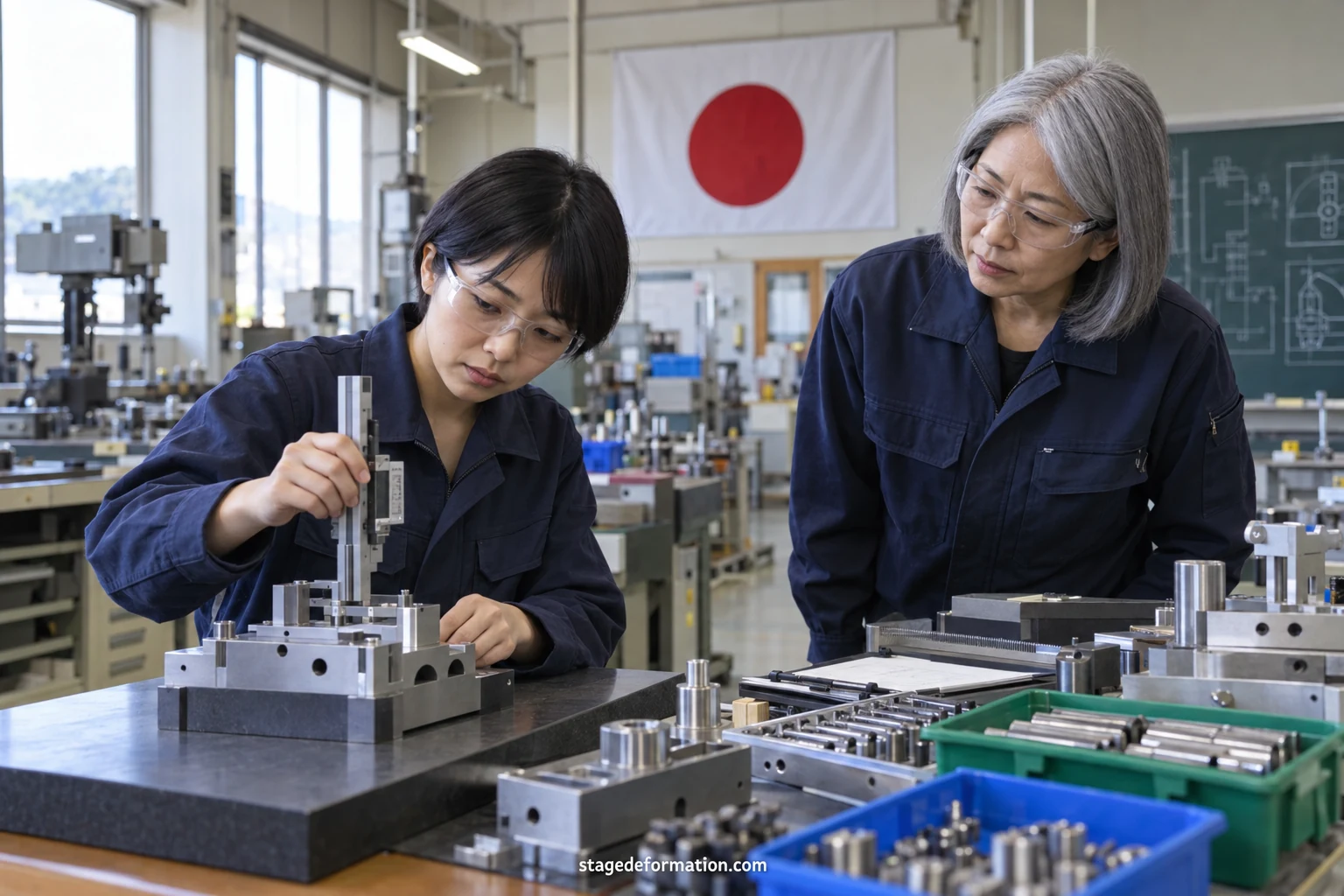
In Japan, internship and apprenticeship opportunities for foreigners are reached through three main doors: a public or semi-public program, an agreement between a student's institution and a Japanese company or university, or a spontaneous application to an employer. Japanese is not always required but remains a decisive advantage in most companies, while English-speaking employers are concentrated in technology, international finance, consulting and research. The residence status depends on the length of the placement, whether it is paid and the link with an institution, so it must be checked before departure.
The internship landscape for foreigners in Japan
The Japanese internship market has long been designed for Japanese students: summer internships in the third year of university, company information days and a highly codified collective recruitment calendar.
Each has its own rules. A public program specifies its target audience, its selection process and its length. An agreement between institutions sets the credits and the supervision. A spontaneous application depends entirely on the employer, who must also agree to handle the residence procedures. The first question is therefore not "Where can I find a job posting?" but "Which door is my profile eligible for?"
The Japan Internship Program: what is known and what to verify
The Japan Internship Program, linked to the Ministry of Economy, Trade and Industry and coordinated with JETRO, connects qualified foreign professionals with Japanese companies, in particular small and medium-sized enterprises and regional companies that want to open up internationally. According to the program's public page, applicants must demonstrate a Japanese level equivalent to JLPT N3 or English proficiency, and the details of the requirements are set out in the guidelines for each edition.
Two points call for particular vigilance. First, the calendars are annual: for fiscal year 2026, the application period for foreign interns is closed and the selection was shown as completed at the time of consultation. You therefore need to watch for the opening of the next edition. Second, the program is aimed at profiles with expertise; it does not automatically accept all students.
The existence of a program guarantees neither admission nor an immediate assignment. It provides a selection framework and support, notably for matching, organizing the stay and follow-up.
Residence status: a step that conditions everything
According to explanations published by firms specializing in immigration, the main categories are as follows:
- a short unpaid internship may fall under a temporary visitor stay, limited to 90 days;
- a longer unpaid internship may fall under a cultural activities category;
- an internship that is part of a degree program, with an agreement between the foreign university and the company, may fall under designated activities;
- a student already enrolled in a Japanese university must obtain permission for activities outside their status in order to work, with a weekly limit on hours during the academic term.
The exact conditions change and are examined case by case: the activity must be related to the studies, the employer must be able to supervise the intern, and a paid internship is subject to stricter checks on salary and working hours. Check the applicable category with the employer and the immigration authority before buying a ticket. A certificate of eligibility is generally requested for each period.
Applying to a Japanese employer
Japanese companies expect applications that are careful, well organized and respectful of local customs. A local-format CV, called a rirekisho, is sometimes requested, together with an introduction form; other companies accept an international CV in English. In both cases, clarity matters more than originality.
Present your skills with precise examples: a university project, an experience in a student association, a tool you have mastered, a language you speak. State your Japanese level honestly, preferably with a recognized test, and ask which language will be used day to day. If you write in Japanese, have your message proofread by a native speaker; if you write in English, stay formal and concise.
Timing matters as much as content. Companies organize their recruitment in cycles, and an application sent late may arrive after the decision. Find out when summer or spring internships open and how long responses take, which can stretch over several weeks.
Institutional employers and large companies
Some institutions publish their own recruitment procedures, which illustrate the Japanese logic well: successive stages, written tests, multiple interviews and close attention to motivation. The Bank of Japan, for example, presents recruitment information and opportunities for students on its website; the procedures are specific to the institution and are aimed first at a Japanese audience, which is a reminder that an institutional employer may have different conditions from a private company open to international applicants.
Large industrial, retail or service groups offer introductory programs, but access is often conditioned on language and on the national calendar. Small companies, regional organizations and foreign firms established in Japan are sometimes more accessible for a French-speaking profile, especially one who speaks English or Japanese.
In every case, a good approach is to identify a specific theme that matches the company's activity rather than applying for a generic "internship".
Agreement, assignment, duration and pay
A university internship is frequently based on a cooperation agreement between the home institution and the host organization. This agreement specifies the period, any credits, the assignments and the tutor. Without an agreement, some residence permits become difficult to obtain.
On pay, Japan has no single equivalent of the French gratification. An academic internship may be unpaid or come with a travel allowance; a summer-job type internship is paid and subject to minimum wage rules, which vary by prefecture and are revised every year. Ask for the current amounts and for the calculation of hours in writing.
Fictional example, with rounded figures: a student plans a ten-week internship, with no salary but a monthly transport allowance. They estimate their housing, food and insurance costs, add the plane ticket and keep a reserve. If the total exceeds their savings, they ask their school for mobility aid rather than accepting a poorly defined assignment.
Work culture and daily life
Punctuality, discretion and team spirit are central values. Arrive early, greet every colleague, follow the dress code in force and do not hesitate to ask questions at the right moment. Collective work relies heavily on prior consultation: do not present a decision as settled without having informed your tutor.
Days can be long in some sectors, but your agreement must remain the benchmark. Transport is efficient, housing in large cities is expensive and small furnished rooms are common. Think about health insurance, setting up a suitable means of payment and the possibility of a university residence if your host institution offers one.
Short stays are sometimes easier to organize than long ones. A first internship of a few weeks lets you test the environment and prepare a longer return.
Common mistakes to avoid
Several mistakes come up again and again among foreign applicants:
- leaving on a tourist status for an internship that requires a different authorization;
- overestimating your Japanese level in the application;
- applying too late relative to the company's cycle;
- sending a message that is too long and poorly structured;
- neglecting the internship agreement or the host letter specifying the assignments.
If you are turned down, you can redirect your efforts toward a partner university, an exchange program, a French company established in Japan or a preparatory remote internship. Your home institution and your school's international relations office remain the best channels for obtaining a reliable contact.
Frequently asked questions
Is the Japan Internship Program open to all students?
No. The program is aimed at foreign professionals with expertise and a language level specified in the guidelines, for example JLPT N3 or English proficiency. Each edition has its own application and selection calendar; consult the official page before preparing an application.
Do you need to speak Japanese to do an internship in Japan?
Not always, but it is a major asset. Some international companies, start-ups or research centers work in English. In most other cases, Japanese is expected at a professional or conversational level. State your level honestly and ask which language is used for supervision before accepting.
What visa do you need for an internship in Japan?
It depends on the length, the pay and your link to an institution. A short unpaid internship may fall under a temporary stay, while a degree-related internship with an agreement falls under another category. Only the immigration authority and the employer can confirm the solution that applies to your situation.
Is an internship in Japan paid?
Not necessarily. An academic internship may be unpaid or come with a limited allowance, whereas an internship treated like a summer job must comply with minimum wage rules. The amount is set by regulation and changes over time, which is why it is important to obtain the conditions in writing.
When should you start the process?
As early as possible: several months before the internship begins. You need to allow time to find an employer, sign the agreement, obtain the certificate of eligibility if required and apply for the visa. Japanese companies also operate on annual cycles that limit late applications.
Can you apply directly to the Bank of Japan?
The Bank of Japan publishes recruitment information on its website, but its procedures are specific to the institution and are aimed first at Japanese candidates. A foreign student must check whether they are eligible, which language is required and whether an internship open to their profile actually exists.