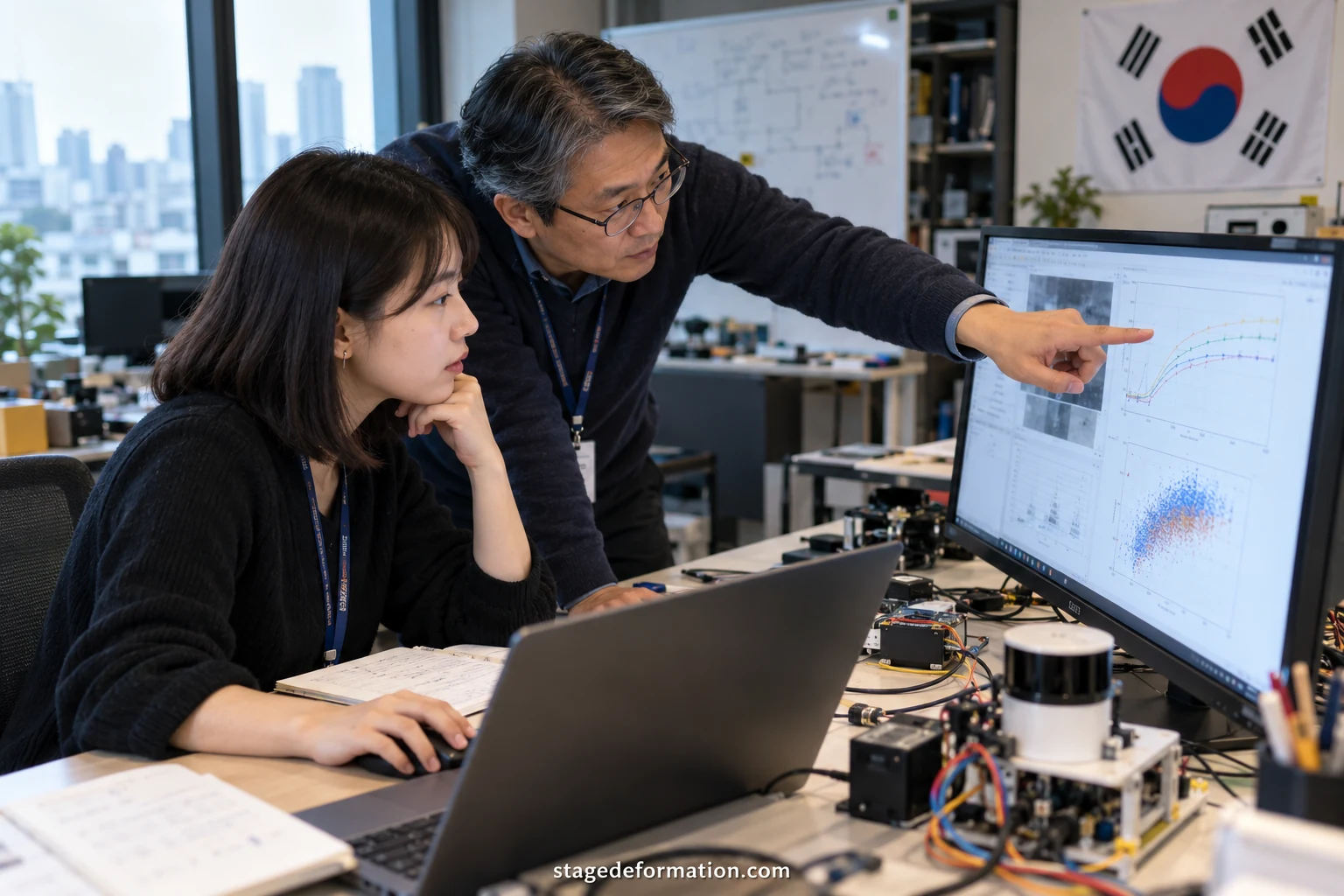
South Korea artificial intelligence internship opportunities follow two main routes. The academic route places a student in a university laboratory for a few weeks or months around a research subject, while the industrial route offers a product-oriented placement in a company, a start-up or an applied research centre. Expectations and calendar differ clearly between the two. Universities, public research institutes and large groups work on language processing, computer vision and robotics. A verifiable technical application, a clear working language and a written agreement on mission, dates and supervision are the best foundations for a placement.
A two-speed Korean AI ecosystem
South Korea has one of the densest digital landscapes in Asia. Two national platforms, Naver and Kakao, have developed their own artificial intelligence services, and several conglomerates have presented in-house language models.
For a foreign intern, this translates into two main routes. Expectations, calendar and hosting arrangements differ clearly from one route to the other.
University laboratory: what you really do there
In a laboratory, the intern joins an existing project led by a professor, surrounded by doctoral students. Typical tasks are concrete: cleaning and annotating a dataset, reproducing the results of a paper, training variants of a model, writing evaluation scripts, preparing figures for a publication.
A few useful pointers before writing to a supervisor:
- Read two or three recent publications from the laboratory and cite one of them precisely in your message.
- Describe in a few lines what you can contribute, for example a skill in deep learning or statistics.
- Ask who will supervise on a daily basis, what computing resources are accessible and whether a contribution to a paper is possible.
Laboratories receive many unsolicited requests. A short, targeted email, accompanied by a clear file, has far more chance of getting a reply than a generic mailing.
Summer programmes: reading the criteria carefully
Some universities open summer programmes for foreign students. At the Korea Advanced Institute of Science and Technology, the KAI-X research programme is aimed, according to its presentation page, at third- or fourth-year bachelor’s students and master’s students from foreign universities, in the field of basic sciences. It lasts about seven weeks in July and August, and the 2026 edition ran from 1 July to 13 August, with applications open from mid-January to mid-February.
Two practical lessons follow. First, a programme classified under basic sciences does not automatically cover an applied AI project: check that the discipline and the target audience match your profile. Second, the annual calendar is tight: applications are submitted several months before summer, so preparation starts in the autumn. The dates of future editions must be read again on the programme’s official page.
Companies, platforms and research institutes
On the industry side, the research departments of large groups and digital platforms recruit interns for short periods, often through annual campaigns published on their careers sites. The profiles sought are generally strong in programming, applied mathematics and machine learning, with verifiable personal projects.
Public research institutes, such as the Electronics and Telecommunications Research Institute based in Daejeon, also publish information on their activities and their offers. They are an interesting avenue for those who want an applied setting without going through a commercial group.
Start-ups in Seoul and in the Pangyo technology zone offer another face: small teams, broader responsibilities, but a contractual framework that is sometimes less formal. In that case, insist on a written document specifying mission, duration, working hours and any allowance before buying a plane ticket.
Building a technical application that can be checked
A Korean recruiter or an international researcher first evaluates what they can verify. A public code repository, well documented, is worth more than a list of keywords.
- Choose two projects at most and describe for each the problem, the data, the method, the metrics and the limits.
- State your personal contribution if the work was collective.
- Attach a one-page CV in English, sometimes accompanied by a Korean version if you are fluent.
- Prepare a short ten-minute oral presentation, since technical interviews often ask you to explain a choice of model or debug an idea.
Avoid inflating results: a technical interview quickly reveals the gap between a project title and real understanding.
Working language: English, Korean and technical vocabulary
In international research, English is generally enough to read, write and discuss. In a company, reality varies: some teams work in English, others communicate mainly in Korean, notably for meetings and internal messaging. A few months of learning Korean before departure clearly improves integration, even if the level remains modest.
Before accepting, ask what language is used for meetings, documentation and code comments. An internship where you do not understand team exchanges exposes you to unintentional marginalisation, whereas technical English simplifies collaboration around the code.
Administrative framework: agreement, visa and status
In France, a training internship requires a tripartite agreement signed between the student, their institution and the host organisation, which defines mission, duration and supervision. For a mobility abroad, the institution generally checks insurance cover and educational consistency. The amount of any gratification depends on the regulations of the host country and on the signed agreement: it cannot be presumed.
Residence status depends on the duration and nature of the activity. A tourist stay does not allow you to work, and a student enrolled in Korea follows specific rules on permitted activities. A working holiday agreement exists between France and Korea, with age conditions and quotas to be checked. The Korean immigration administration and the embassy remain the reference for your precise situation.
Illustrative example: an application path
Take a master’s student in computer science, with one project on classifying medical images and another on multilingual text processing. In October, she lists ten laboratories and three companies, and reads their publications. In November, she sends fifteen personalised messages, five of which receive a reply. Two video interviews follow in January, and one leads to an eight-week offer for the following summer. These figures are purely hypothetical and serve to show a rhythm: monitoring, personalisation, patience and several parallel leads.
Common mistakes to avoid
- Writing to a laboratory without having read its work.
- Assuming that a “science” summer programme accepts any computer science profile.
- Accepting a vague assignment and forgetting to ask about working hours, housing and health cover.
- Neglecting confidentiality: company or research data are often subject to agreements signed before starting.
- Leaving without having clarified the ownership of the code and results produced during the internship.
Frequently asked questions
Do you need to speak Korean for an AI internship in South Korea?
Not always. In international university research, English is often enough to work and communicate with the team. In a company, Korean is more frequently used in meetings and internal messaging. Ask in advance which language will be used, and consider a few months of lessons before departure to ease integration.
When should you apply for a summer programme?
Summer programmes generally open applications several months before the start. For the KAI-X programme, the 2026 edition accepted applications from mid-January to mid-February for a stay in July and August. For later editions, read the calendar on the programme page again from the autumn.
Is a laboratory internship paid?
It depends on the programme and the host. Some cover part of the costs, others do not. The amount is never guaranteed without a written document. Ask what is included, for example housing, meals or an allowance, and plan a personal budget for international travel and insurance.
Which profile is most sought after in AI?
Teams value a solid grounding in mathematics, statistics and programming, as well as concrete projects showing the use of deep learning libraries. A clear code repository and a reproduced paper are good arguments. The subject of your project must also match the themes of the target laboratory or company.
Can a foreign student work freely in Korea?
No, not without respecting their residence status. Permitted activities depend on the type of visa and the nature of the assignment. Check the situation with the Korean immigration administration, the embassy and your institution before signing anything, especially if pay is planned.
How do you contact a professor without a prior reply?
Write a short email in English, with a precise subject line, one sentence on a recent piece of their work, two lines on your skills and your CV attached. State the dates you want. If there is no reply, a polite reminder after two weeks is acceptable, then move on to other teams.