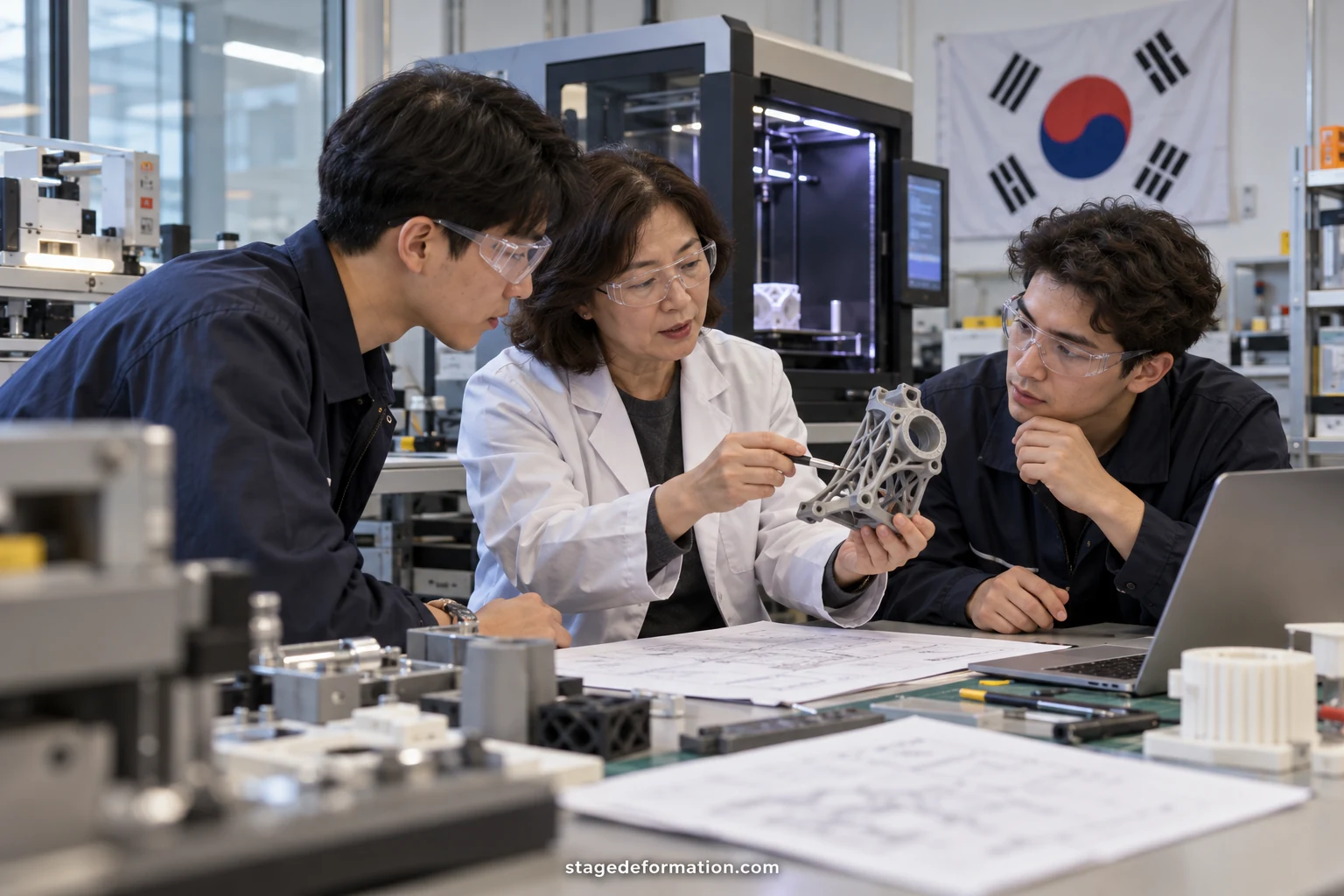
South Korea engineering internship placements are built around an export-oriented industry covering electronics, automotive, chemicals, steel, shipbuilding and energy, alongside technical universities and public institutes working on microelectronics, materials, batteries, robotics and telecommunications. Students can choose between a research laboratory, with a precise subject and an expected report or prototype, and an industrial workshop, with tasks tied to a product or process. The setting is demanding, with strict procedures and a strong culture of results. Matching your specialty to a concrete field, city and written agreement is the best way to prepare.
Why Korean industry attracts engineers
For a student, the appeal lies in the proximity between research and production: a single area can bring together a laboratory, a subcontractor and a major principal.
It is better to know this before applying.
Mapping specialties and cities
The skills sought depend on the region. Seoul and its suburbs concentrate headquarters, design offices and start-ups. Daejeon brings together research institutes and a leading science university. Pohang is linked to steelmaking and a technology university. The port areas of the south-east host shipbuilding and heavy mechanical engineering.
- electrical and electronic engineering: components, sensors, embedded systems;
- mechanics and production: automation, metrology, part design;
- chemistry and materials: batteries, polymers, surface treatments;
- industrial computing: robotics, digital twins, process control.
This mapping avoids overly vague messages and makes it easier to find contacts.
Two main routes: research laboratory or industrial workshop
A laboratory generally offers a precise subject, supervision by a professor or a researcher, and an expected output in the form of a report, a prototype or experimental results.
The rhythms also differ. Research follows an academic calendar with summer sessions, whereas industry recruits through campaigns or according to departmental needs. Choose according to your career plan: doctorate, design office position or production career.
Summer programmes and exchange networks
Several institutions organise short programmes for foreign students, but their nature varies. At the Korea Advanced Institute of Science and Technology, the summer home page presents an international summer school created in 2007, centred on academic and cultural exchange, which is not to be confused with a research internship. The description must therefore be read before committing.
International networks, such as the association for technical internships between students, offer paid placements abroad in many countries. Their website does not immediately specify the situation for Korea, which means consulting the list of member countries and the committee of your country of origin. A technology university such as POSTECH also publishes information in English on its departments and research activities.
Safety, equipment and confidentiality
An engineering internship often involves access to expensive or dangerous equipment. Before departure, ask in writing:
- which safety training is mandatory and in what language it is held;
- which personal protective equipment is provided;
- which machines or instruments you will be allowed to use alone;
- who responds in case of an incident and which insurance cover applies.
Cutting-edge companies also ask you to sign confidentiality agreements, sometimes with strict rules on photographs, personal devices and file storage. Also clarify the ownership of results and the possibility of citing them in a dissertation or an internship report.
A technical application oriented towards proof
The recruiter wants to know what you have actually designed, measured or programmed. Prepare one flagship achievement and explain it in a few lines: problem, constraints, solution, test, result, limits.
- Describe your personal contribution in a team project.
- Provide diagrams, photos of a prototype or a code repository depending on the nature of the project.
- Mention the software you master, for example for computer-aided design, simulation or signal processing.
- Prepare a one-page CV in English and a letter explaining why this laboratory or company.
In the interview, expect practical questions: sizing, analysis of an unexpected result, reasoning about an order of magnitude.
Language, daily life and team culture
In an international laboratory, English is generally sufficient. In a factory or a design office, many documents, safety signs and exchanges are in Korean. Knowing how to read essential instructions and a few technical terms then becomes a real plus. Team culture values punctuality, respect for hierarchy and discretion in disagreements: observe how meetings unfold before proposing a contrary idea.
For housing, find out about university residences, company dormitories or studios to rent. Conditions vary and must appear in the written exchange with the host organisation.
Internship agreement, visa and budget
A training internship in engineering rests on an agreement between the student, the educational institution and the host organisation. It sets the mission, the duration and the supervision. Any pay and benefits depend on the rules of the host country and on the signed agreement. They are not guaranteed.
Residence status must be checked according to the duration and nature of the activity, with the embassy and the Korean immigration administration. Also assess the overall budget: plane ticket, health and liability insurance, housing, local transport, personal equipment. A clear financial file reassures the institution that validates the mobility.
Illustrative example and common pitfalls
Take an electrical engineering student interested in power electronics. They identify three laboratories, study their publications, prepare a write-up of their converter project and write in September for a summer stay. Two teams reply, one proposes a video call, and a written agreement specifies the subject, the dates and the supervisor. This sequence is hypothetical, but it illustrates the method.
Among the pitfalls: aiming for a programme without checking its audience, leaving before the agreement is signed, ignoring safety instructions, believing that a summer school is equivalent to a research internship, or neglecting insurance.
Frequently asked questions
Which engineering fields are most present in South Korea?
Electronics and semiconductors, automotive, chemicals and batteries, shipbuilding, steelmaking and robotics hold an important place. Opportunities nonetheless depend on your specialty and the region. Target a precise field rather than a general engineer application.
Is a summer school equivalent to a research internship?
No. A summer school centred on academic and cultural exchange does not necessarily place the student in a laboratory project. Read the programme description, the target audience, the activities and the duration to know whether it meets your internship or training goal.
Do you need to master Korean for a technical internship?
In an international laboratory, English often allows you to work. In industry, part of the instructions and documents are in Korean. Ask for the working language before accepting, learn the essential safety terms and consider lessons to ease daily life.
Which documents should you prepare to apply?
A one-page CV, a targeted letter, a description of a technical project with your personal contribution, and if possible diagrams or a code repository. Also plan the documents from your institution for the agreement and proof of insurance, which the host organisation will ask for.
What should you do if confidentiality rules limit my report?
Discuss it early with the supervisor and with your institution. It is possible to produce a report describing the method without disclosing sensitive data, or to plan a confidential version. Obtain a written agreement on what you may cite, circulate or present at your defence.
When should you start the process for a summer internship?
Ideally the previous autumn. Structured programmes open applications several months before summer, and the agreement, insurance and residence procedures take time. For an unsolicited application to a laboratory, also allow several weeks between the first message and a final agreement.