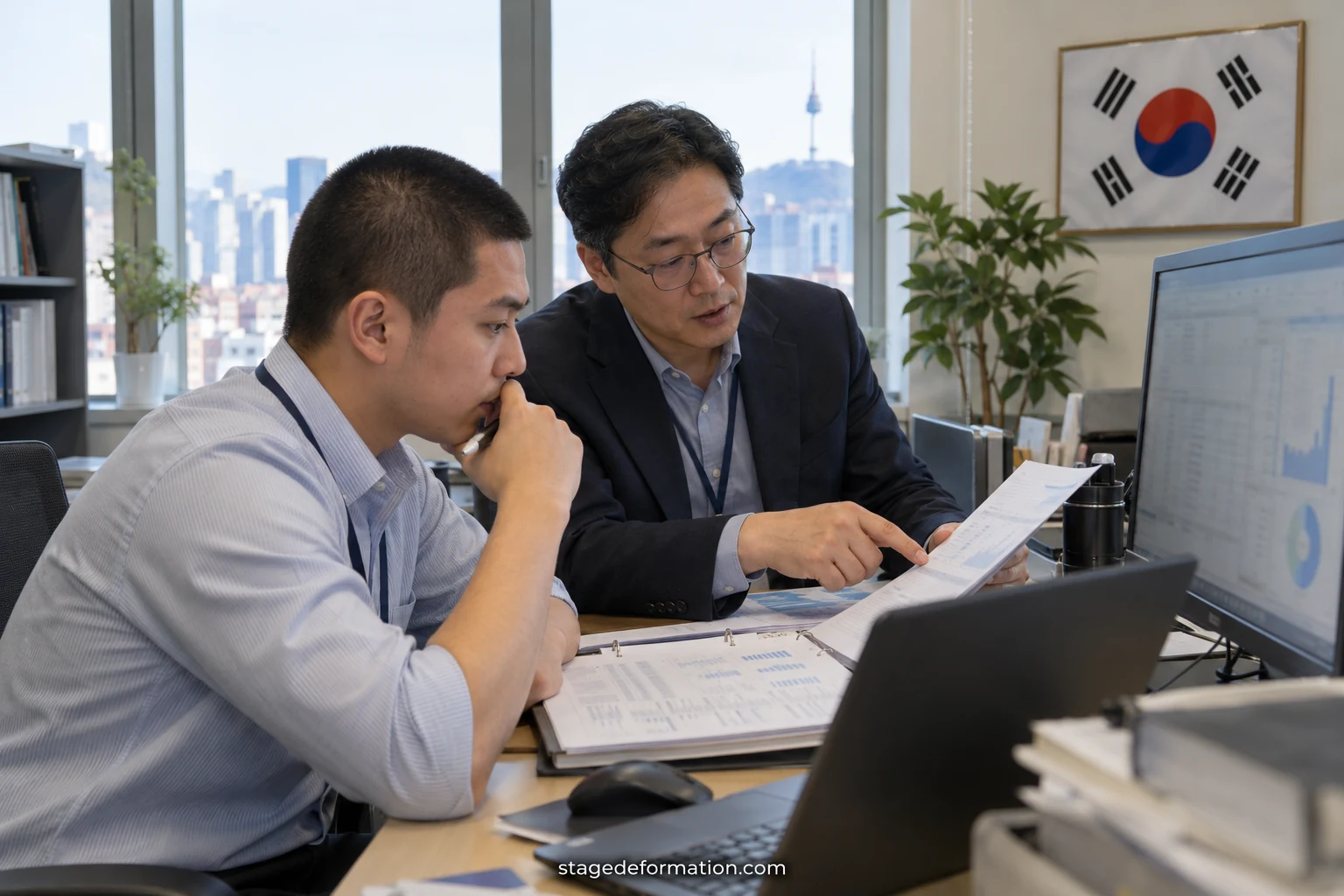
South Korea finance internship opportunities are concentrated around Seoul, in the Yeouido district, where securities firms, asset managers, regulators, commercial banks, insurers and the central bank are found. Each type of institution expects different profiles, from client advice and credit analysis to market monitoring, statistics and research. Applying does not mean being authorised to work, so a foreign candidate must separate selection from residence status. Reading each announcement in full, with its dates, tracks, documents and conditions, and preparing a short sourced analysis are the most reliable ways to build a credible application.
A sector structured around major institutions
Commercial banks, insurers, the central bank, public development and export credit banks, the Korea Exchange and a growing fintech sector make up the landscape in which an internship may fit.
Each family has its own expectations. A retail bank looks for profiles close to client advice, credit analysis or compliance. A securities firm looks for skills in sector analysis or market monitoring. A public institution is interested in statistics, economic research and communication. Before writing, therefore, identify the function actually offered rather than the mere word finance.
Reading an intern call: the example of the Bank of Korea
The Bank of Korea publishes on its portal calls for experience-type interns, aimed at young people. The 2026 call announced tracks at headquarters, in regional branches and for people with disabilities. The areas cited at headquarters included policy and research, international affairs and finance, statistics and data, and media and communication.
The published calendar provided for online submission of applications from 3 to 13 April 2026, results of the application review in early May or later, interviews in May and provisional selections at the end of May. Applications went through a dedicated recruitment site of the institution.
This example teaches a method: an announcement is read in full, with dates, tracks, documents required and conditions. A past campaign is not an available place, and the criteria on nationality, status or residence must be confirmed in the text of the current campaign.
Residence status: applying is not the same as being authorised to work
A foreign candidate must distinguish two questions. The first is that of selection: is the announcement open to non-Koreans? The second is that of the right to reside and carry out the activity in Korea.
Depending on the profile, student status, authorisation for part-time activity, a job-seeking visa or a status linked to an exchange may come into play. The government’s information portal for international students and the immigration service answer these questions; a company cannot replace them.
In finance, this point is all the more sensitive because the intern may have access to confidential client or market data. Institutions often ask for checks, confidentiality undertakings and full identity documents. Anticipate these documents several weeks before the deadline.
Skills sought for a first finance internship
Korean recruiters appreciate a clear technical foundation and the ability to explain a line of reasoning. The following skills come up most often:
- general accounting and balance sheet analysis;
- microeconomics, macroeconomics and reading monetary indicators;
- statistics and basic econometrics, with Excel and, depending on the role, Python or R;
- market finance: bonds, equities, exchange rates, simple derivatives;
- writing short, clear, sourced notes.
The central bank and research institutions value rigour in data and method. Securities firms expect responsiveness and an interest in markets. Retail banks look at a sense of service and compliance with procedures. Adapt the content of your application to each audience, and refrain from sending the same letter everywhere.
Language: Korean, English and financial vocabulary
In most institutions, the language of documents, meetings and internal exchanges is Korean. For an intern position, this often includes reports, compliance instructions and statistical tools. English dominates in subsidiaries of foreign groups, in some international market activities and in research centres that publish for an outside audience.
Before accepting, ask what the language of documents and exchanges is, and whether the use of statistical tools comes with documentation in English. A proven level in Korean, for example with a TOPIK result, is often a clear criterion. Learning about twenty basic financial terms (rate, balance sheet, receivable, bond, foreign exchange market) before arriving makes the first weeks easier.
Be honest about your level: claiming a fluency you do not have shows from the first meeting.
Showing what you have learned through a short analysis
An effective way to demonstrate your abilities is to attach or prepare a brief analysis, for example one page on the evolution of an indicator, a commentary on a company balance sheet or a comparison of two monetary policies. The essential thing is to state your sources, distinguish facts from interpretation and remain sober.
A useful four-step format
- A precise question, posed in one sentence.
- Two or three verifiable data points, with their origin.
- A cautious reading of the results, with the limits.
- A conclusion that answers the question, without promises.
This document can serve as support in an interview. It proves that you know how to work with data, cite your sources and explain simply, qualities expected of an intern in a financial institution.
An illustrative example of an application path
Let us take a fictional case with round figures. Léa, a master’s student in finance, wants to do an eight-week internship in South Korea during the summer.
- In September, she draws up a list of ten organisations: a central bank, three banks, two securities firms, two foreign subsidiaries, two fintechs.
- In October, she notes for each the usual campaign dates, the language required and the nationality conditions.
- In November, she takes a Korean course and prepares a one-page analysis.
- In February, she watches for recruitment platforms opening and submits three applications.
- In March, she checks her residence status with the competent authorities.
This schedule illustrates an order of steps and guarantees neither an interview nor a place. The most important thing is to assume nothing without having read it in an official announcement.
Interview and professional culture in a financial setting
The interview in Korean finance often includes a part on motivation and a part on knowledge. Expect questions about economic news, your study plans and how you react in a group.
A few practical tips:
- stay informed about monetary policy decisions and recent market events;
- prepare a simple explanation of a technical concept, without needless jargon;
- show that you respect schedules, hierarchy and confidentiality rules;
- bring examples of teamwork rather than only individual successes.
The dress code is generally formal in banks and public institutions. If in doubt, ask the person organising the interview; it shows attentiveness rather than ignorance.
Mistakes to avoid and further sources
Here are the most frequent mistakes in a finance application in Korea:
- taking an old campaign for an open offer;
- applying without checking the nationality or status required;
- sending an application in English to an institution that asks for Korean;
- presenting an analysis with no source or limits;
- confusing a financial function with a purely sales position.
To complete the information, the professional associations of the banking and investment sector publish presentations of their members and of the framework of activity. The government’s information services for international students and the KOTRA agency can also help depending on your situation, without confusing these schemes with bank recruitment.
Frequently asked questions
Can a foreigner apply for the Bank of Korea internship?
It depends on each campaign. The 2026 call was presented as an experience-type internship for young people, with its own conditions. Read the conditions section of the current announcement and, if it does not specify nationality, contact the institution. A past campaign guarantees nothing for the next one.
When do Korean banks recruit interns?
Campaigns are dated and vary by institution. The Bank of Korea’s in 2026 opened in early April, with interviews in May. Many internships take place during university holidays. Watch each organisation’s recruitment sites several months in advance.
Do you need to speak Korean for a finance internship?
In most institutions, yes, because documents, meetings and instructions are in Korean. Subsidiaries of foreign groups and some international market teams work more in English. Check the language stated in the announcement and prove your level with a test or a diploma.
What analysis should you attach to a finance internship application?
A one-page note is enough: a precise question, a few data points with their source, a cautious reading and a clear conclusion. It can cover a company balance sheet, a macroeconomic indicator or a rate decision. Always cite the origin of the figures and state the limits.
Is a finance internship in Korea paid?
It varies according to the organisation, the nature of the assignments and the intern’s status. Some experience-type internships pay an allowance, others are linked to a study programme. Ask for the amount, the duration and the health cover in writing before accepting, and check the applicable legal framework.
What residence status do you need to intern in Korea?
The status depends on your nationality, your age, your studies and the nature of the internship. The student visa does not always allow paid activity without permission. Consult the official information for international students and the immigration service before answering yes to an offer.