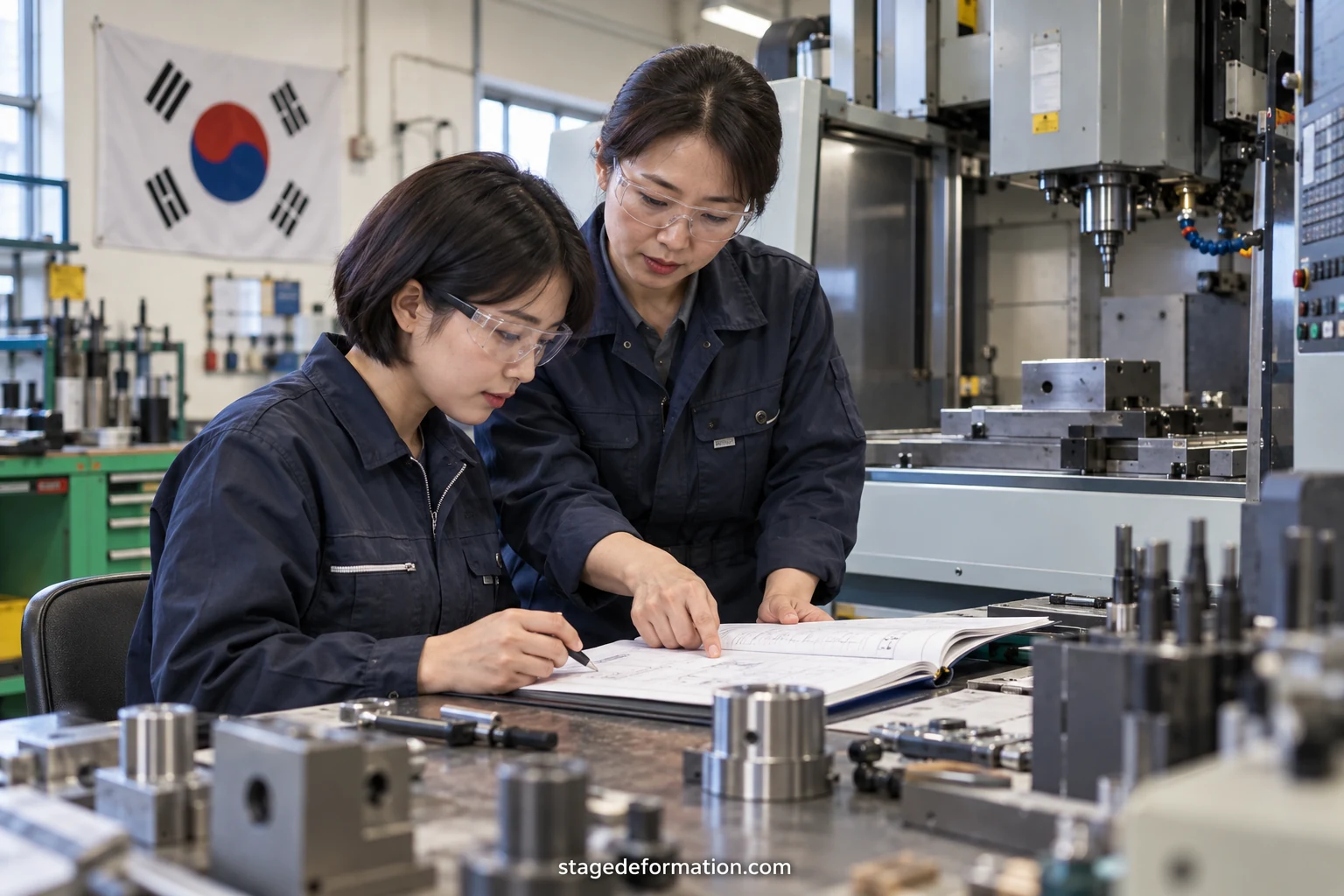
South Korea internship and apprenticeship opportunities cover temporary work experience in companies, administrations and public institutions, as well as a work-study training system alternating between employer and training centre. Many large groups run recruitment campaigns on fixed dates, mainly for Korean students and recent graduates, so foreigners often enter through a partner institution, an exchange programme or a state initiative. Finding an offer does not settle the right to work: residence status, language of work, pay and calendar must each be checked before accepting, using official information and written confirmation from the host organisation.
What an internship in South Korea covers
In South Korea, the word internship (인턴) refers to a temporary work experience, most often in a company, an administration or a public institution.
Two types are common:
- the discovery internship, sometimes called “experience-type”, short in duration, with supervised assignments;
- the recruitment-linked internship, which may lead to a job offer, with a more demanding selection.
Korean universities also offer field internships built into the curriculum, with credits.
It is aimed mainly at young people living in Korea and goes through approved employers and institutions; a foreigner must check whether they are eligible.
Studying or interning: separating residence status from the search for an assignment
The public information service Study in Korea publishes information on the employment of international students; the first rule is to read it before accepting anything.
Several statuses may come into play depending on the profile:
- the student visa, generally referred to as D-2, which strictly regulates paid activities and may require prior authorisation;
- the job-seeking visa for certain recent graduates, referred to as D-10, whose conditions change;
- working holiday agreements for certain nationalities and age groups;
- statuses linked to an internship organised by an institution or an official programme.
The precise rules change and depend on nationality, age, level of study and duration. The immigration information service Hi Korea and the consulate are the points of contact to settle the matter. A company that says “come, we’ll sort it out” is no substitute for an official answer.
A specific science programme: the example of KAIST KAI-X
For science students, a concrete example is the KAIST KAI-X summer research internship in Daejeon. It is a programme of about seven weeks, held in July and August, open to students from universities outside Korea in the final years of a bachelor’s degree or in a master’s programme in the basic sciences. The 2026 session was announced from 1 July to 13 August, with applications between mid-January and mid-February.
Participants work in a laboratory under the direction of a faculty member, with group activities, cultural outings and a closing symposium. The programme provides support for travel and housing on campus, within limits specified on its page; only those published items count.
The value of this example is methodological: it shows that a Korean programme aimed at foreigners has its own calendar, audience and criteria, which can be found in the official text. Each season may change, so the page for the current year must be read again.
KOTRA and services for foreign talent
The Korean trade and investment promotion agency, KOTRA, runs a Global Talent Center that connects international talent with Korean companies. According to its presentation in English, the process includes submitting a CV, a matching service, an online interview and, at the end, a visa recommendation and entry into Korea.
It is a talent recruitment scheme, not a guarantee of an internship. The profiles sought are generally technical or specialised, and the participating companies set their own criteria. A programme called K-Tech Pass appears in the agency’s website menu; its conditions must be read on the spot.
It is therefore worth comparing the objectives: KAIST KAI-X targets science students for a short laboratory immersion, while KOTRA addresses profiles sought by employers. Choosing the wrong scheme costs weeks.
Pay and intern protection
Korea has a minimum wage set each year by regulation. Under the rules applicable in 2026, it is 10,320 won per hour, an amount to be confirmed with the Ministry of Employment and Labor. An internship in which the intern performs real work under the employer’s direction may fall under labour law, whereas simple observation or a purely educational internship falls under other rules.
Many discovery-type internships pay a flat allowance, the level of which depends on the organisation. Some university or science programmes provide an allowance, housing or a partial refund of travel costs. Foreign internships not linked to an official programme are sometimes unpaid, which raises legal and financial questions.
Before signing, ask in writing for: the duration, the working hours, the amount paid, health and accident insurance, and the person who supervises the work. Keep a copy of the document.
Working language: Korean, English or both
Most Korean companies work in Korean, including for meetings, internal emails and forms. English is used in international teams, research laboratories, subsidiaries of foreign companies and some hosting programmes. A level in Korean is often proved by the TOPIK test, which universities and employers mention in their criteria.
Even when an internship is carried out in English, daily life and integration require a basic knowledge of Korean: reading signs, understanding a safety instruction, following a group discussion. State your level on your CV without exaggeration and specify what you are able to do without help.
Also pay attention to the codes of politeness: respectful forms of speech, strict punctuality, respect for hierarchy, care over collective schedules. Observing them makes a better impression than any letter formula.
Calendar: semesters, summers and recruitment campaigns
The Korean academic year begins in March, with a second semester starting in September. The summer and winter holiday periods are when Korean students do the most internships, and when programmes for foreigners hold their sessions. Applications for a summer programme are often submitted several months ahead: a calendar announced in January for July is a published example.
Large companies and public institutions launch their intern campaigns at specific times, sometimes for placements of only a few weeks. They state the dates in their announcement and close the platform at the stated time.
For each target, therefore, note the opening date, the deadline, the documents and the expected outcome. A personal tracking table avoids missing a window that only comes back the following year.
Preparing a credible application for a Korean recruiter
Korean applications often follow a precise format, with a self-introduction, a statement of motivation and structured experiences. For a foreign candidate, the most useful thing is to show a clear project and verifiable skills.
The CV
One page, a photo depending on the organisation’s custom, studies, languages with level and proof, quantified projects. Avoid lists of qualities without examples.
The cover letter
Explain why this sector, why Korea, why this organisation, with a precise link to what it does. A candidate who cites a concrete product or piece of research stands out.
The interview
Prepare a two-minute presentation, examples of teamwork and questions about how the assignment will run. Show that you have understood the collective dimension of the work.
Frequent pitfalls and a sample schedule
Here are the mistakes most often observed:
- confusing the possibility of applying with authorisation to work;
- applying to a campaign reserved for residents or Korean recent graduates;
- underestimating the cost of housing in Seoul and the length of the search;
- not reading the announcement to the end, including the languages required;
- leaving without suitable health insurance.
By way of illustration, here is a fictional schedule. A science student aims for a summer programme: in September, they list three schemes and read their conditions; in November, they update their CV and obtain a letter from a professor; in January, they submit the application; in March and April, they find out about residence status; in June, they organise travel and housing. This calendar is not a promise of a place, but it shows the order of the steps.
Frequently asked questions
Can you do an internship in South Korea without speaking Korean?
It is possible in some laboratories, international subsidiaries and hosting programmes where the working language is English. In most companies, however, Korean is essential. Read the announcement to find out the language of communication, and state your level honestly in your application.
Can a foreign student work or intern freely in Korea?
No, not automatically. Residence status determines what is permitted, and some activities require prior authorisation. Study in Korea and the immigration service publish information. An internship offer is not an authorisation: check before starting.
What is KOTRA’s Global Talent Center?
It is a service of the KOTRA agency that connects foreign talent with Korean companies. The process described on its site includes submitting a CV, a matching step, an online interview and then support with the visa. It is not a guaranteed internship programme.
Is KAIST KAI-X a company internship?
No. It is a summer research programme in KAIST laboratories, for students from universities outside Korea in the basic sciences. It lasts about seven weeks in summer. Each session has its own calendar, criteria and support, which must be read again on the official page.
Is an internship in Korea paid?
It depends on the organisation, the intern’s status and the nature of the work. Some internships give an allowance, others are linked to a university programme with an allowance, and others are unpaid. Ask in writing for the amount, the payment schedule and the health cover before agreeing.
When should you start looking for an internship in South Korea?
Ideally six to nine months before departure. Programmes for foreigners open applications several months before the session, and residence status takes time. Note the dates of each scheme, because a missed campaign often only comes back the following year.